Regional frameworks — one control surface, four rulebooks
The Mesh Series · Article 30
SAMACompliance evidenceCERT-In & DPDPRBIMulti-cluster & residencyPCI DSSAuthorizationPolicyDrift & posture
An institution running card workloads out of Mumbai, Riyadh, and Dubai answers to RBI, SAMA, the UAE regulators, and — because a board asked for it — ISO 27001, all at once. The instinct is to run four compliance programs. That instinct is expensive and wrong.
Regulators do not disagree about the controls. Read RBI's IT directions, SAMA's Cyber Security Framework, the UAE Information Assurance standards, and ISO 27001:2022 Annex A side by side and the technical demands rhyme: encrypt data in transit, authenticate every identity uniquely, grant access by least privilege, keep a tamper-evident audit trail, prove the controls keep running. Those are the mesh primitives you have spent this series building. What the four rulebooks actually disagree about is three things the mesh does not give you for free — and that is where the real architecture work is.
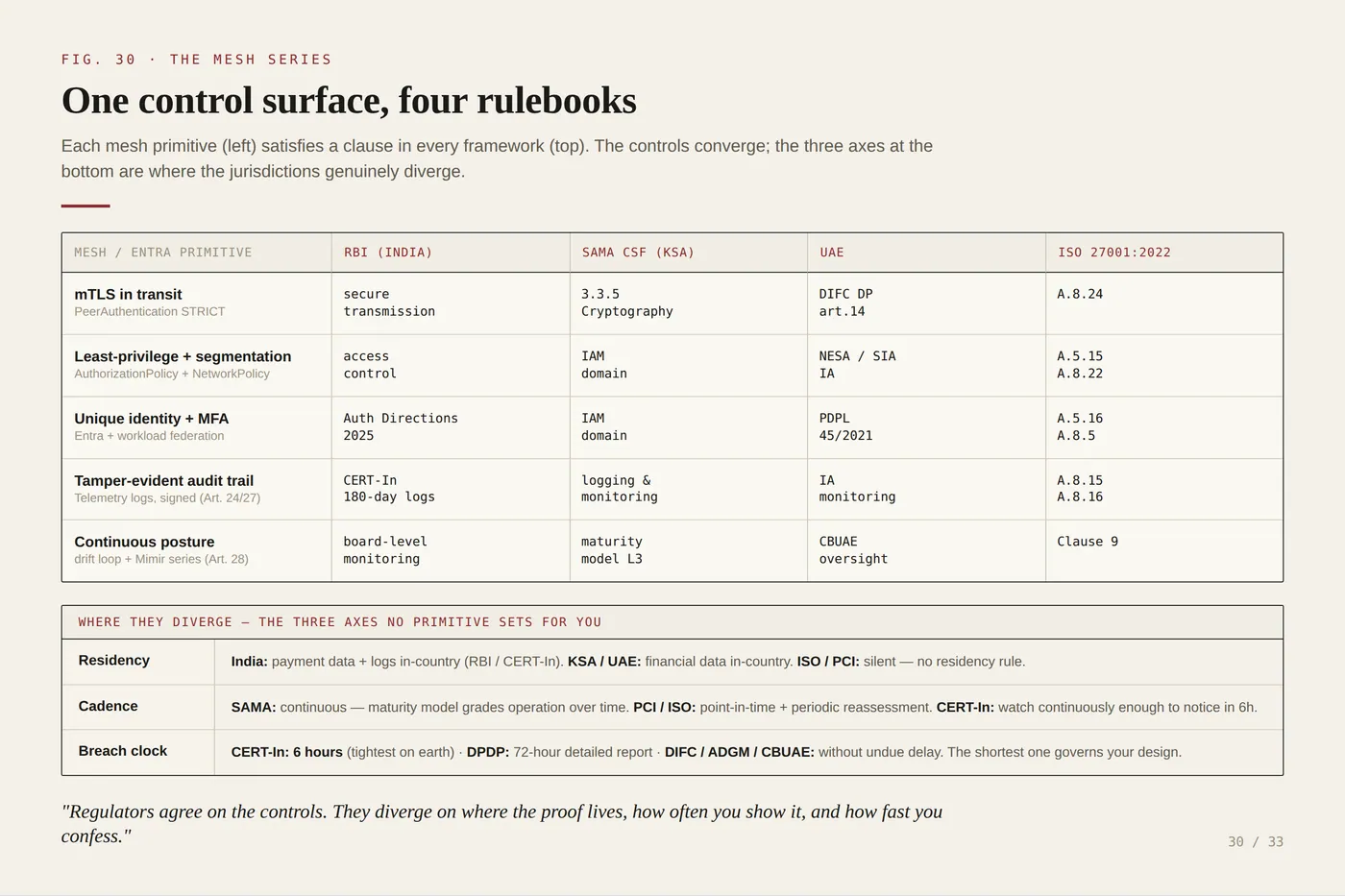
Read the map as two halves. The top half — the controls — converges: one PeerAuthentication, one default-deny AuthorizationPolicy, one audit stream satisfies a clause in every column. The bottom half — residency, cadence, and the breach clock — diverges, and those are the three things you must design for per jurisdiction because no primitive sets them for you.
Why this matters now
This is not a stable target you mapped once in 2023. Every framework in the set moved in the last eighteen months, and the movement is toward more prescription, not less.
India finally has teeth. The Digital Personal Data Protection Rules, 2025 were notified in November 2025 — the DPDP Act is no longer a statute waiting for rules. Breach notification runs in two stages: intimation to the Data Protection Board without delay, then a detailed report within 72 hours, plus notice to affected individuals in plain language. The breach-reporting machinery phases in over roughly eighteen months (into 2027), so the window to build and test the process is now, not when it bites. This stacks on top of the CERT-In six-hour clock — report a cyber incident within six hours of noticing it, logs retained 180 days inside Indian jurisdiction — which remains the tightest reporting deadline of any major regime on earth. And RBI's 2018 payment-data localization has not softened: payment system data is stored only in India, full stop.
Saudi Arabia hardened in parallel. The PDPL has been fully enforced since September 2024 — fines to SAR 5 million, doubling for repeat offenders, and it reaches any organization processing Saudi residents' data regardless of where the company sits. NCA's Essential Cybersecurity Controls were refreshed to ECC-2:2024, restructured around governance, defense, resilience, and third-party-and-cloud security. And SAMA's Cyber Security Framework still grades you on a maturity model where Level 3 — controls defined, implemented, and consistently enforced — is the floor a regulated financial institution is expected to hit. A screenshot from assessment week cannot demonstrate Level 3 by construction.
ISO moved too, quietly. The transition to ISO 27001:2022 closed on 31 October 2025 — the 2013 certificate is dead, and the 2022 Annex A's 93 controls across four themes are the only version an auditor will certify against now.
The UAE completed the picture: federal PDPL (Decree-Law 45/2021), the NESA/SIA Information Assurance standards, CBUAE's expectations for licensed institutions, and the GDPR-aligned free-zone regimes — DIFC's Data Protection Law and ADGM's regulations — each carrying their own breach-notification duty and their own view on where financial data may rest.
Four regulators, four timelines, one cluster. Run them as four programs and you have quadrupled your evidence workload for controls that are, underneath, the same controls.
The controls converge
Take the mesh primitives one at a time and watch the clauses stack up behind each.
Strong cryptography in transit. PeerAuthentication: STRICT — mesh-wide mTLS — is simultaneously PCI 4.2, ISO 27001:2022 A.8.24 (use of cryptography), a SAMA CSF cryptography-and-transmission control, RBI's secure-transmission expectation, and the "appropriate technical measures" that DIFC and ADGM both require. One primitive, five citations. You do not configure it five times.
Least privilege and segmentation. Default-deny AuthorizationPolicy at L7 plus NetworkPolicy at L3/L4 covers ISO A.5.15 (access control) and A.8.22 (segregation of networks), SAMA's identity-and-access-management domain, RBI's access-control requirements, and — as the previous article covered — PCI's segmentation test. The same two objects; five rulebooks satisfied.
Unique, authenticated identity. Entra as the user identity plane and workload federation as the service identity plane answers ISO A.5.16 / A.5.17 / A.8.5 (identity, authentication information, secure authentication), SAMA's IAM domain, and — sharply — RBI's Authentication Mechanisms for Digital Payment Transactions Directions, 2025, which make two-factor mandatory from April 2026 and phase out SMS OTP as no longer phishing-resistant. Passkeys and certificate-based auth are not gold-plating here; they are the named direction of travel.
Tamper-evident audit trail. The Istio Telemetry access-log stream, retained and signed, is ISO A.8.15 (logging) and A.8.16 (monitoring activities), CERT-In's 180-day retention, SAMA's logging-and-monitoring controls, and PCI 10. One pipeline.
Continuous proof. The drift loop and time-series posture from Articles 27 and 28 are what SAMA's maturity model actually wants — evidence the control kept operating, not that it existed once. ISO's management-system model (Clause 9, monitoring and measurement) asks the same in gentler language.
The pattern is the whole point: you build the control surface once, from the primitives in Articles 14 through 28, and you map it to each framework. You do not rebuild it four times.
Where the frameworks actually diverge
If the controls converge, what is left to architect? Three things — and they are the three the mesh cannot set for you.
Residency: where the evidence physically lives. This is the divergence that breaks naive designs. RBI localization requires payment data in India. CERT-In requires the logs retained within Indian jurisdiction. Saudi and the UAE expect financial data — and increasingly its audit trail — to rest in-country. A SaaS observability backend in a US or EU region fails all of these at once, no matter how good the control it records. This is precisely why the series chose a self-hostable LGTM stack and a self-hostable transparency log back in Articles 25 and 27: not because managed services are worse, but because you can pin self-hosted object storage to ap-south-1 or a Riyadh region and a managed multi-region SaaS you cannot. Residency is an architecture decision made at the evidence store, and it is invisible until an auditor asks which country a log line slept in.
Cadence: how continuously you must prove it. PCI and ISO are, at heart, point-in-time attestations with periodic reassessment. SAMA's maturity model is not — Level 3 is a claim about continuous enforcement, and CERT-In's six-hour clock presumes you are watching continuously enough to notice within six hours. A control that is green on audit day and unmonitored the rest of the year passes ISO and fails SAMA. The Mimir posture series and the drift loop are the difference, and they are the reason continuity was built before this mapping article, not after.
The clock: how fast you confess. CERT-In's six hours is the tightest; India's DPDP adds a 72-hour detailed report; SAMA and CBUAE and the DIFC/ADGM commissioners each set their own. Same breach, four stopwatches, and the shortest one governs your incident-response design. You architect to the six-hour floor and the rest are satisfied automatically.
From map to code: the control surface, parameterized
The honest artifact of this article is not a diagram — it is a single control definition that carries all four framework citations plus the residency and retention that vary. This is where the ComplianceProfile CRD the series has been teeing up earns its place: the map, expressed as code.
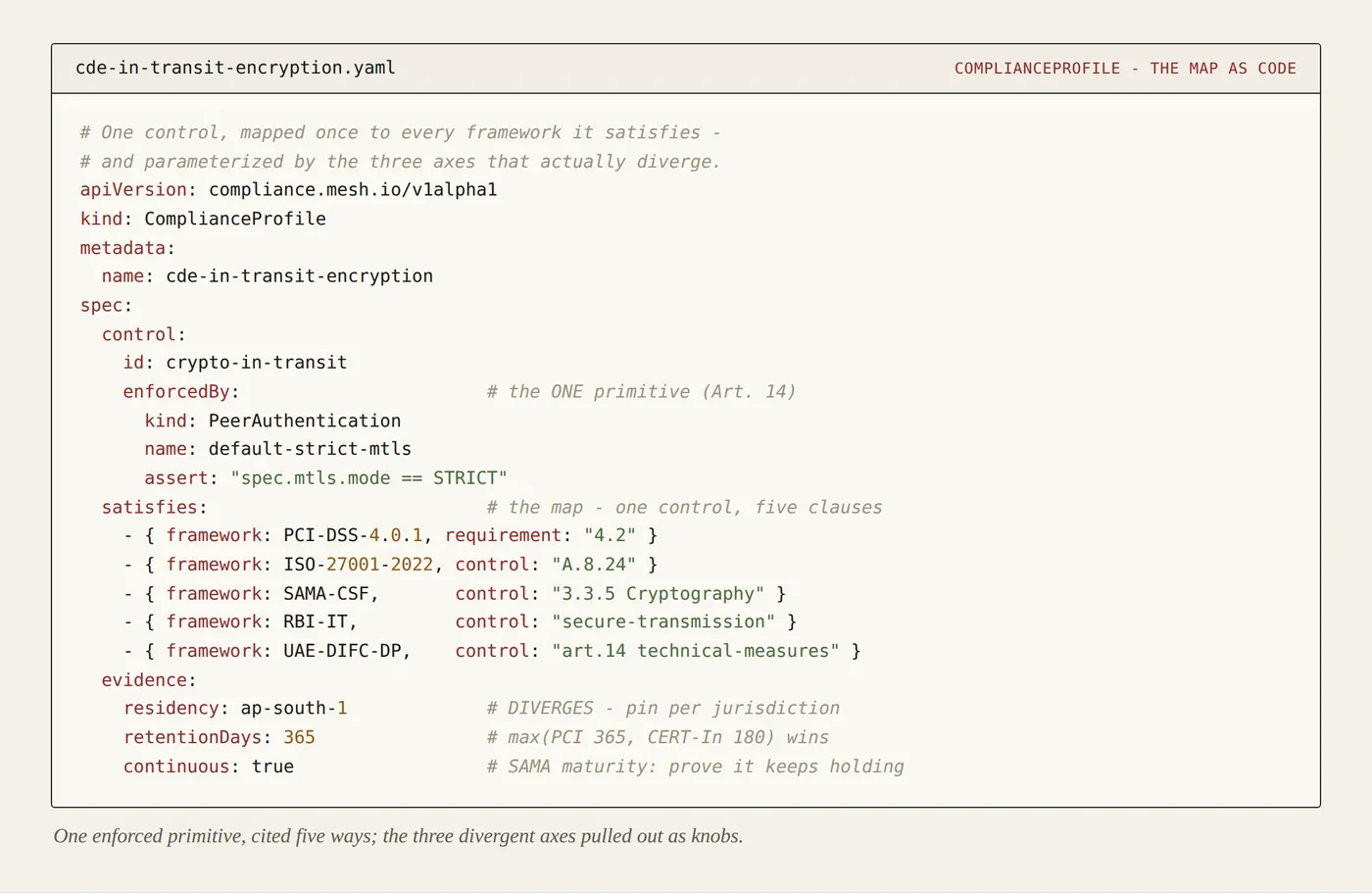
Two design choices in that manifest carry the whole article. The satisfies list is the map — one enforced primitive, cited five ways, so evidence is generated once and labelled for each framework rather than collected five times. The evidence block is the divergence, pulled out as the only jurisdiction-specific knobs: which region the proof rests in, how long it is kept (take the maximum across every framework in scope — 365 days satisfies both PCI's one year and CERT-In's 180), and whether continuity is required.
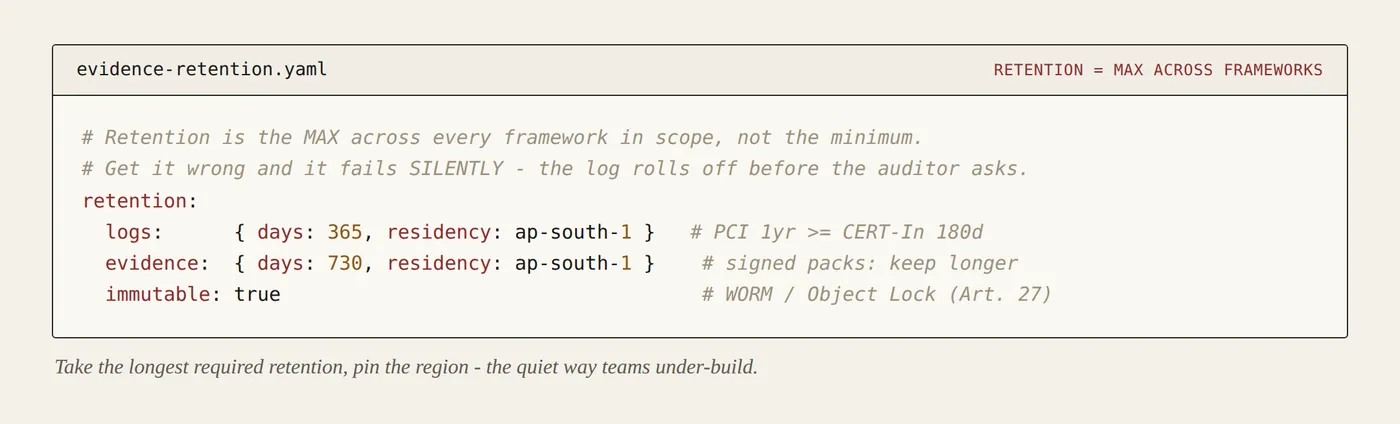
The retention rule deserves a line of its own, because it is where teams quietly under-build:
Security · Audit · Integration
Security property. Mapping does not add a control; it proves the controls you built are sufficient across every regime you operate in, and — just as usefully — surfaces the gaps a single-framework view hides. Residency and continuity are themselves security properties: data that cannot leave the country cannot be exfiltrated to a region you do not govern.
Audit evidence. The satisfies map turns one signed evidence pack into a cross-framework artifact: the same immutable record answers the RBI inspector, the SAMA assessor, and the ISO auditor, each pointed at the clause they care about. The demo-to-audit gap, closed four ways from one pipeline.
Integration. This article is the join across the whole series. The primitives (14–23) are the controls; the observability and evidence layer (24–28) is the proof; this mapping is what makes that proof legible to four regulators without four builds.
Alternatives, and where the map is the wrong tool
Four parallel compliance workstreams. The default, and the one to argue against: a separate team, a separate spreadsheet, and a separate evidence pull per framework. Choose this only when the frameworks genuinely share no technical substrate — which, for mesh-enforced controls, they do not. For everything the mesh covers, parallel workstreams are duplicated effort billed four times.
GRC crosswalk platforms. Vanta, Drata, and OneTrust maintain multi-framework control crosswalks and will map ISO to SOC 2 to PCI for you. Choose these — alongside the mesh, not instead of it — for the program layer: the attestations, the policy documents, the vendor questionnaires. Their crosswalk maps controls on paper; the mesh proves the control on the cluster. The GRC tool says the control should exist; the signed pack proves it did. You want both, and you should not confuse the crosswalk for the evidence.
"Certify to ISO 27001 and claim equivalence." The seductive shortcut: get the ISO certificate and wave it at everyone. It fails on exactly the axes this article is about. ISO is a management-system standard — it will never satisfy RBI's localization mandate or SAMA's maturity grading or CERT-In's six-hour clock, because those are prescriptive local obligations ISO does not speak to. An ISO certificate is a strong foundation and a poor substitute; regulators do not accept equivalence for residency and reporting.
From a crosswalk to a compliance plane
The toy version is a crosswalk spreadsheet: one row per control, one column per framework, a cell where they intersect. Build it — it is the map that tells you the four rulebooks share a spine. But a spreadsheet drifts the moment the cluster changes, and it proves nothing on its own.
The industry-standard version is the ComplianceProfile above, evaluated continuously by an operator that watches the enforcing primitive, emits one signed evidence pack per control, and labels that pack with every framework clause it satisfies — retained in the right country, for the longest required duration, with the continuity SAMA demands. One control surface. Four rulebooks. One pipeline that answers all of them and can add a fifth framework as a new satisfies entry rather than a new project.
Which raises the question this series has deferred long enough: if the profiles, the policies, and the evidence rules are all code now, where does that code live, and how is it enforced from source? Next up: GitOps for the mesh — policy, ComplianceProfiles, and Entra config as one Git-driven, Entra-secured delivery loop, where the map itself is version-controlled and the cluster is reconciled to match.
If you operate across India and the Gulf, the interesting question isn't which framework is strictest — it's which one forced an architecture change the others didn't. For me it's residency. What was it for you?
Key skills & topics in this article
SAMACompliance evidenceCERT-In & DPDPRBIMulti-cluster & residencyPCI DSSAuthorizationPolicyDrift & posture
Also on LinkedIn.