One detection pipeline, four confession clocks — incident reporting across DORA, NIS2, CERT-In and DPDP
The Mesh Series · Article 38 · Part F
DORANIS2CERT-In & DPDPLGTM stackCompliance evidenceIncident reportingSPIFFESupply-chain signing
In Article 37 a red team walked through an allow rule that was too wide, and the mesh logged every step of it. The debrief is going well. Then someone from legal asks the question that ends the good mood: when did we become aware?
The access log says 02:14 UTC — the first denied call with a SPIFFE identity nobody recognised. The on‑call engineer's chat message says 02:51. The incident ticket says 06:30, which is when a manager opened it. The first Teams call where someone said the word "breach" was 09:05. Four timestamps, one incident. And a reporting deadline hangs off whichever one you pick.
One idea: an incident has one start time; four regulators are about to disagree on it
If your group runs a DACH bank and an Indian technology arm on one shared AKS platform — a pattern Articles 30 and 33 built for — a single detection can start four reporting regimes. They do not agree on how fast, on what counts as reportable, or even on which moment starts the count.
CERT‑In's 2022 Directions want a report within six hours of noticing the incident, or of being told about it. No classification grace, no materiality threshold beyond the Annex I category list. The fastest clock, and the least forgiving.
DORA wants an initial notification within four hours of classifying the incident as major — and no later than 24 hours from becoming aware of it, whatever your classifier is still debating. Then an intermediate report within 72 hours of that initial notification, and a final report a month after the last intermediate one (Reg. 2022/2554 Art. 19; timelines in Delegated Reg. 2025/301 Art. 5). In Austria, it goes to the FMA.
NIS2 Article 23(4) wants an early warning within 24 hours, an incident notification within 72 hours, and a final report within a month of the notification — all counted from awareness of a significant incident.
The DPDP Rules 2025, Rule 7, want a detailed report to the Data Protection Board within 72 hours of becoming aware of a personal data breach — any personal data breach — once Rule 7 commences.
Now look at what the four have in common. Every one of them counts from awareness. Awareness is a fact about your organisation, and facts about your organisation are exactly what a supervisor will reconstruct later from your records. So the architecture job is not four clocks. It is one instant, pinned, and four clocks derived from it.
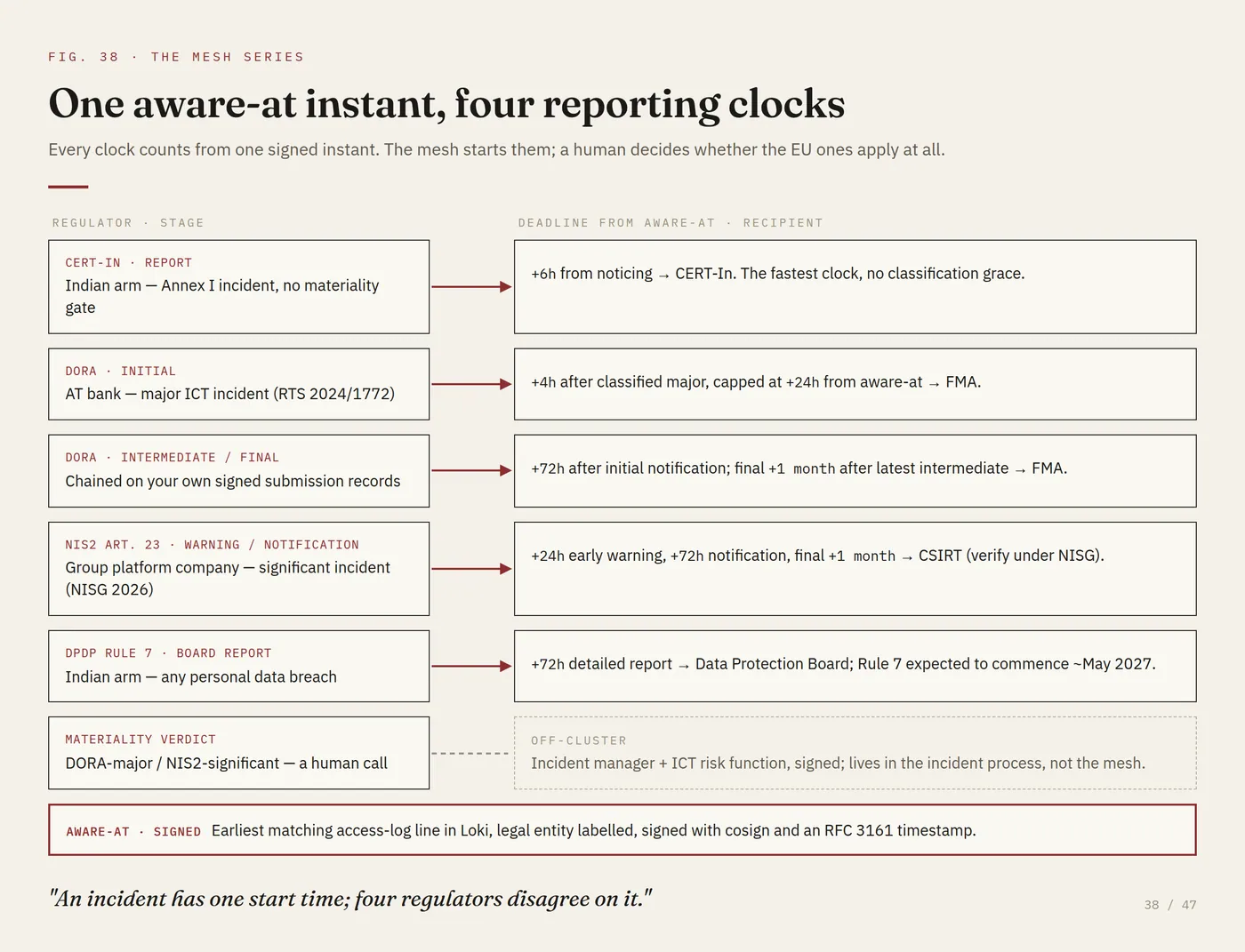
The dashed box is the part I will not let the platform pretend to do. More on that below.
Why it matters: the clock you did not start is the one you miss
Here is the contrarian nuance, and it is the one that saves you a wasted quarter. Four‑at‑once is a group reality, not a single‑entity one. For a financial entity, DORA is lex specialis: NIS2 Article 4 says that where a sector‑specific Union act imposes equivalent requirements, the NIS2 provisions on risk management and reporting do not apply. So the Austrian bank reports its major ICT incident under DORA to the FMA, and does not also file a NIS2 notification for the same event. Anyone selling you "DORA plus NIS2 dual reporting" for one bank has read neither.
The four clocks come back the moment you look at the group chart instead of the bank. The group's in‑house platform company — the one that actually runs the shared AKS clusters — is often not a financial entity at all. It can sit in NIS2 scope as a managed service provider under the Austrian NISG 2026, and its incidents then run on the Article 23 clock. The Indian arm is a body corporate under the CERT‑In Directions and, for customer data, a data fiduciary under the DPDP Act. One compromised workload identity on a shared cluster, four legal entities' worth of reporting. Which of them actually applies is a legal call per entity and per function; confirm it with counsel against the texts themselves, not a summary.
The second nuance is sharper. The EU clocks carry a materiality gate: DORA reports only major incidents, classified against Delegated Reg. 2024/1772; NIS2 reports only significant ones. The Indian clocks mostly do not. CERT‑In runs from noticing an Annex I incident type; DPDP Rule 7 applies to any personal data breach. So the same event can be "below threshold, log it and move on" in Vienna and "six hours, go" in New Delhi. A single severity field in your ticketing tool cannot carry both answers.
The third is the one engineers miss. DORA's intermediate and final reports are anchored not to awareness but to your own previous submission. The clock chain re‑anchors on a record you create. If you cannot prove when you submitted the initial notification, you cannot prove when the next deadline fell. Evidence of the report is itself evidence.
And DPDP deserves honesty: if Rule 7 commences in May 2027, as the eighteen‑month phasing suggests, that clock is not running today. Build it now anyway. Wiring a regulator into a pipeline is cheap before the rule bites and expensive the week after.
How it comes together: the mesh starts the clocks, a human sets the gate
The honest split is simple to say and hard to keep. The mesh detects, timestamps, labels and starts clocks. It does not judge materiality. DORA‑major and NIS2‑significant are verdicts that weigh clients affected, reputational impact, duration, geographic spread, data losses, criticality of services and economic impact. A service mesh sees none of that. An incident manager and the ICT risk function do, and the verdict — with its own timestamp and its own signer — belongs to them.
What the platform owns is the part people argue about afterwards: the aware‑at instant.
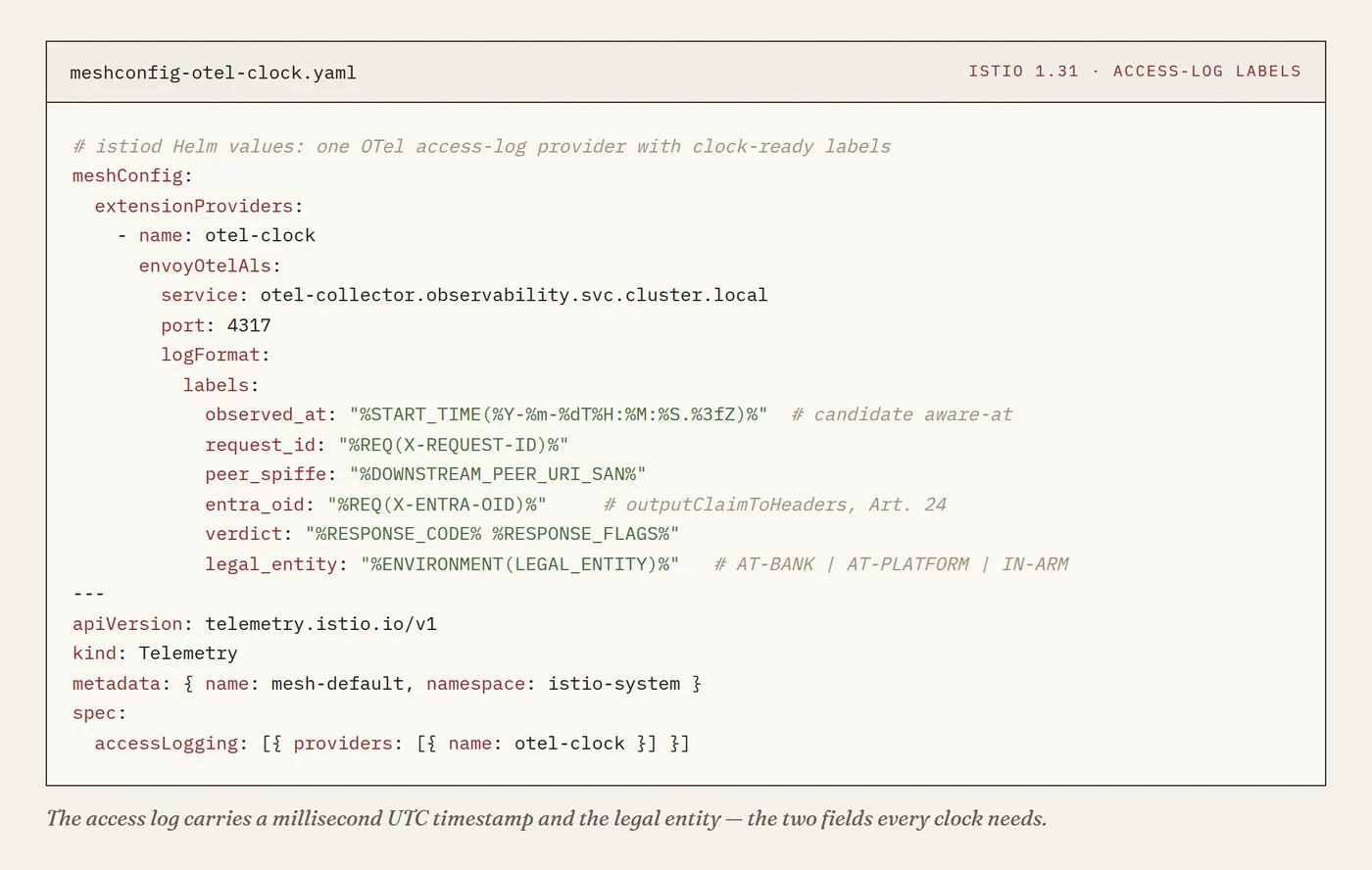
Start with the Article 24 telemetry. Every request through the mesh already emits an access‑log record carrying the SPIFFE peer, the Entra principal, the path and the verdict. Add two labels that the clocks need and Article 24 did not: an unambiguous millisecond UTC timestamp, and the legal entity that owns the workload. The legal entity is what turns a log line into a routing decision — an AT‑bank workload starts the DORA clock, an IN‑arm workload starts CERT‑In and possibly DPDP, a platform‑company workload starts NIS2.
Those records land in Loki (Article 25). Loki is the record. The Grafana panel that shows the alert is not; it is a view of the record, rendered at whatever time someone looked. When an alert rule fires on a pattern — a denied‑call burst from an unknown SPIFFE ID, a JWKS‑resolver failure like CVE‑2026‑31837 from Article 23 — the alert carries the timestamp of the earliest matching log line, not the time Alertmanager got round to it. That earliest line is your candidate aware‑at.
Candidate, because awareness is legally an organisational fact, not a machine one. An anomaly in a log nobody reads is arguably not awareness. So the pipeline records both: observed_at (the machine's first sighting) and acknowledged_at (the first human who looked). Supervisors will reach their own view of which counts. Your job is to make sure neither is reconstructed from memory.
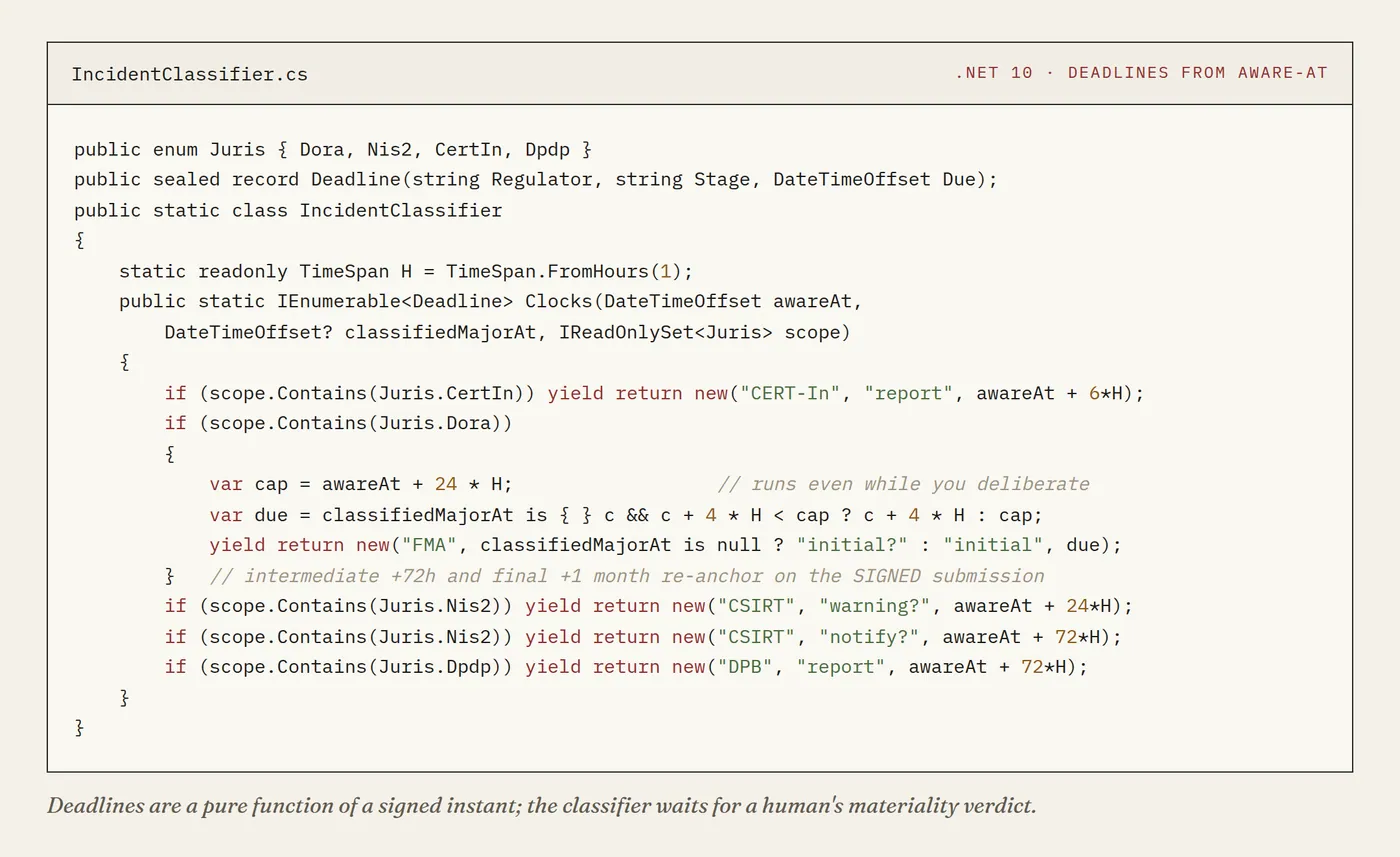
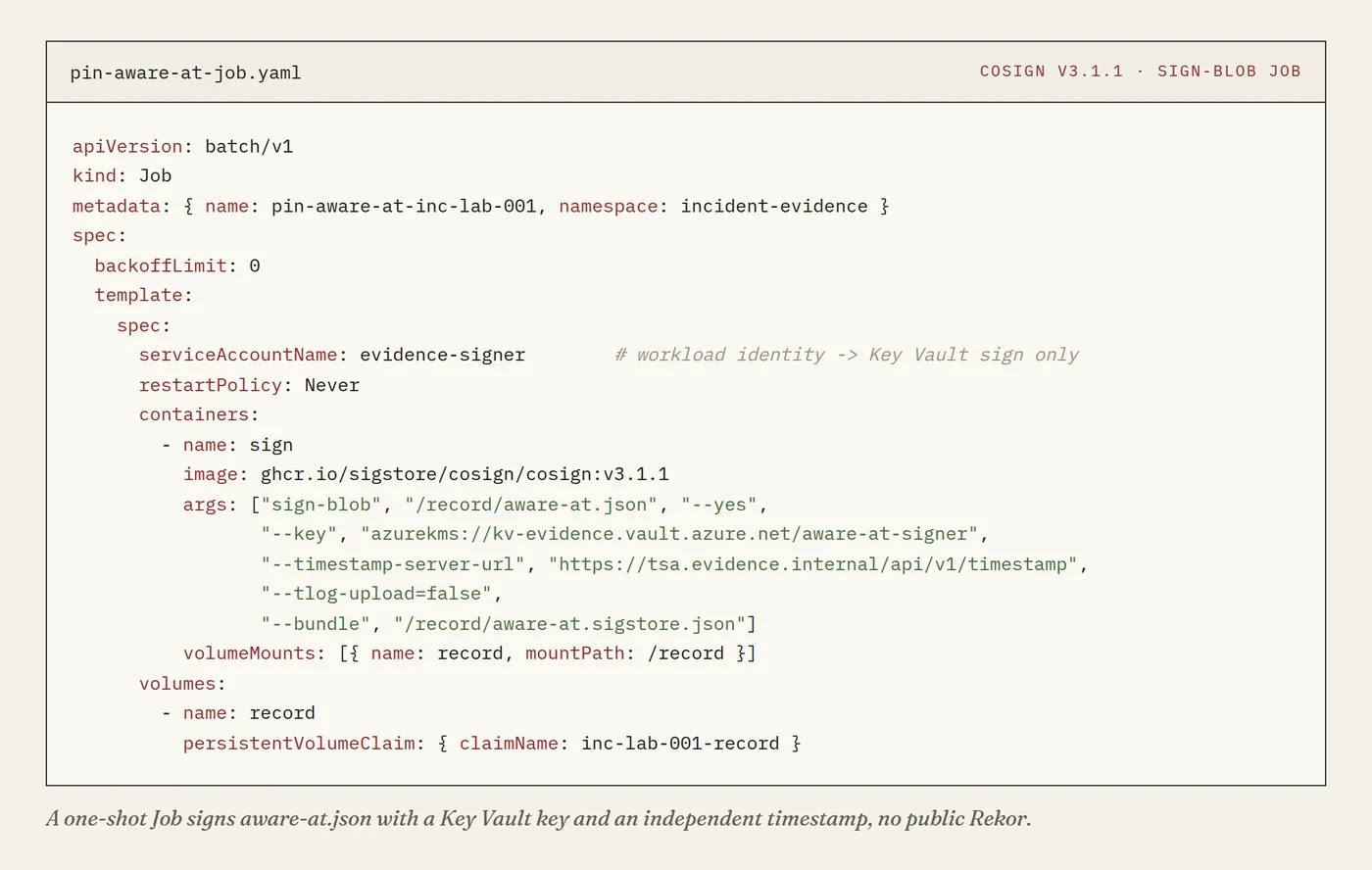
Then pin it. The moment the incident is opened, a job writes an aware-at.json — incident ID, observed_at, acknowledged_at, the Loki query and the hash of the result set, the legal entities in scope — and signs it with cosign, exactly as Article 27 signs an evidence pack, with an RFC 3161 timestamp from a timestamp authority so the signing time is not your own clock's word. From that signed instant, the classifier in C# derives every deadline. When a human later sets classifiedMajorAt, the DORA initial deadline tightens from the 24‑hour backstop to four hours after the verdict, and that verdict is signed too.
This is the Article 30 breach‑clock motif, grown up. In Article 30 there was one clock per region. Here there is one instant per incident, and the clocks are a pure function of it.
Show the config: one instant, labelled, derived and pinned
First, give the access log the fields the clocks need. The legal_entity value comes from proxyMetadata, set per namespace, so the entity travels with the workload rather than living in someone's spreadsheet.
Next, derive the deadlines in .NET 10. Note what the classifier refuses to do: it never decides classifiedMajorAt. Until a human supplies it, the DORA clock shows the 24‑hour backstop — the deadline you are racing while you deliberate. A trailing ? on a stage means "only if a human says it crosses the threshold".
Finally, pin the instant. A one‑shot Job signs aware-at.json with a Key Vault key and an independent timestamp. Transparency‑log upload is off: an incident's existence is not something you publish to a public Rekor.
Security · Audit · Integration
Security: the aware‑at record is signed by a key the incident team cannot export and timestamped by an authority that is not the cluster's clock, so nobody can quietly move the start line after the fact — including a well‑meaning manager.
Audit: every deadline is a pure function of a signed instant, a signed human verdict and the signed submission records; a supervisor can recompute the whole schedule from three artefacts and a Loki query.
Integration: the mesh supplies observed_at and legal_entity; the incident manager supplies the materiality verdict; legal supplies which entities are in scope. Three owners, three signatures, one timeline.
Alternatives, and when you'd pick them
Let the SOAR or SIEM own the clock. Sentinel, Splunk SOAR and friends can start timers on incident creation. That is fine, and in a mature SOC it may be the right owner. The weakness is the anchor: most start the timer at ticket creation, which is the 06:30 in the opening scene, not the 02:14. If you go this way, feed the SOAR the signed observed_at and make it count from that.
A GRC or regulatory‑reporting tool with DORA templates. Buy one for the forms — the 2025/302 templates are tedious and the tools fill them well. They are downstream of the timestamp problem, not a solution to it. A reporting tool that starts counting when someone types into it is measuring your typing.
One global "report within six hours" policy. Tempting: meet the fastest clock everywhere and stop thinking. It works for CERT‑In. It is wrong for DORA, where the content of an initial notification presupposes a classification you may not have in six hours, and it trains the organisation to file noise. I'd pick it only for a small group with one Indian entity and nothing in EU scope.
Leave aware‑at to the post‑incident review. This is what most organisations actually do, and it is how you get four timestamps and a legal team choosing the kindest one. Having detection and proving when you detected are two different jobs.
From simple to standard, and what's next
The toy version is a Grafana alert and a spreadsheet of deadlines. The standard version is an access log that carries legal entity and a millisecond timestamp, Loki as the record, a signed aware‑at artefact per incident, a classifier that derives every clock and waits for a signed human verdict, and submission receipts signed back into the same evidence pack so the chained DORA deadlines can be proved too. None of it is exotic; it is Articles 24, 25 and 27 pointed at a stopwatch.
That closes Part F. DORA, NIS2, the Register of Information, TLPT and now reporting — all of it assumes the evidence can travel to wherever the report is written. It often cannot. Next, Part G opens with Article 39: the multi‑cluster mesh for data residency — when the in‑country evidence that proves your CERT‑In report is not allowed to leave to feed the EU one.
An incident has one start time. Sign it before four regulators start arguing about it.
Next in the series: Art. 39, multi‑cluster mesh for data residency (Part G). Earlier: Art. 34 (DORA for platform engineers), Art. 35 (NIS2 and the NISG 2026), Art. 24–27 (telemetry, LGTM, signed evidence packs), Art. 30 (the breach‑clock motif).
Key skills & topics in this article
DORANIS2CERT-In & DPDPLGTM stackCompliance evidenceIncident reportingSPIFFESupply-chain signing
Also on LinkedIn.