Threat-led penetration testing under DORA — what the red team does once the mesh says yes
The Mesh Series · Article 37 · Part F
Red teaming & TLPTAuthorizationPolicyDORAmTLSSPIFFECompliance evidenceMicrosoft Entra IDNIS2
The letter from the supervisor is two paragraphs long. Your institution has been identified for threat-led penetration testing. A white team is to be formed. Scope will cover critical or important functions. Testing will run against production.
Somebody in the meeting says, "We do an annual pentest. We're fine." You have spent thirty-six articles building a platform where every call is authenticated, authorised, encrypted and logged. You are tempted to agree with them for a different reason: the mesh denies everything by default, so what exactly is a red team going to do?
Quite a lot, as it turns out. And the useful half of this article is the list of things the mesh cannot stop.
One idea: the mesh decides who may call; the red team asks what they can do once they're allowed
A default-deny, STRICT-mTLS, fully-logged mesh (Articles 14, 16 and 24) is a very good answer to one question: may this workload identity open a connection to that one, for this path and verb? It answers on every request and writes the answer down with a SPIFFE ID.
A threat-led red team is not asking that question. It is asking what a real adversary — the one named in the threat-intelligence report — does with the access it already has, or can obtain. The mesh makes some of those moves expensive and loud. It makes others invisible, because from the mesh's point of view they are allowed.
The mesh decides who may call. The red team asks what they can do once they're allowed.
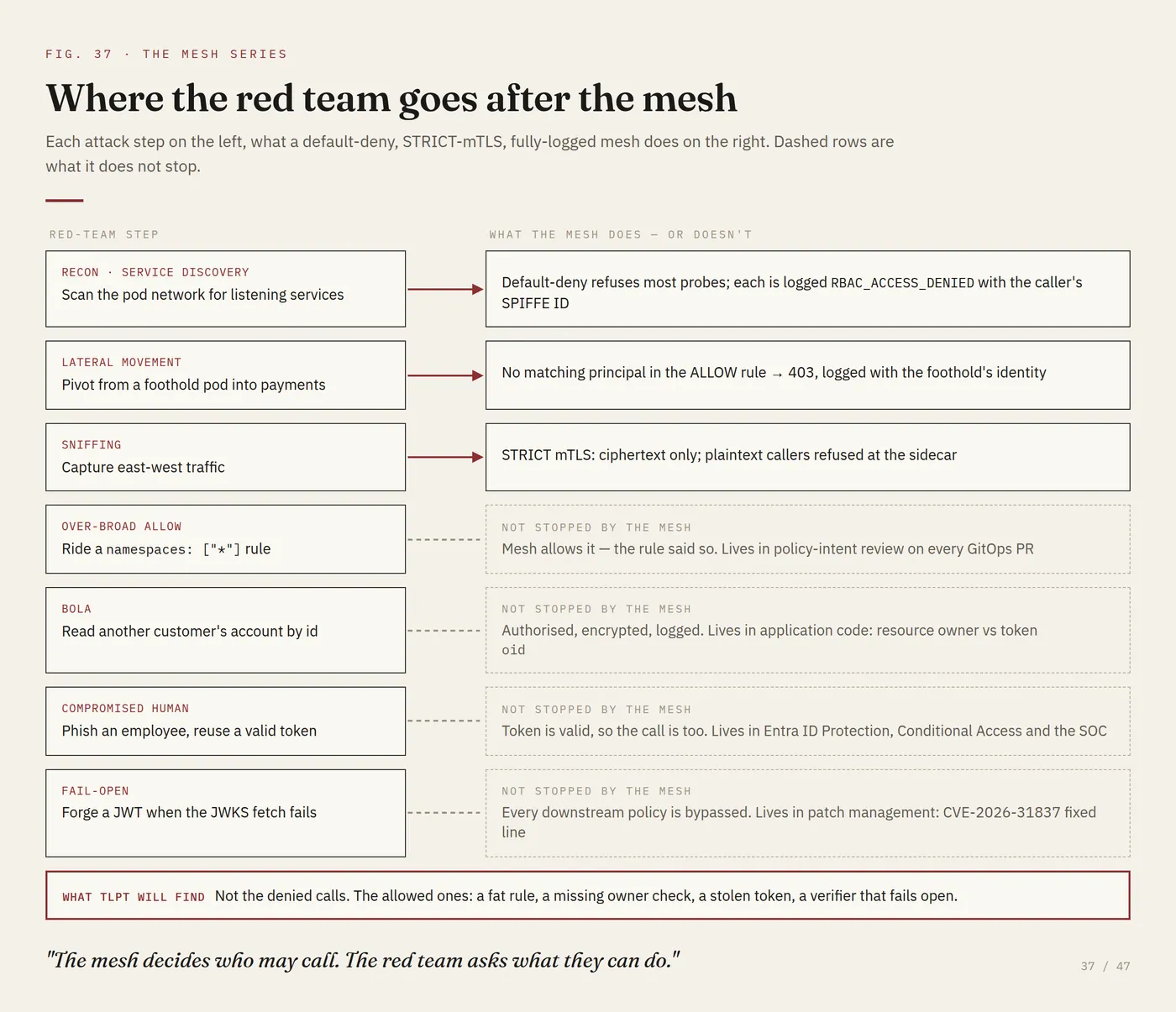
Solid rows are where the platform earns its keep. Dashed rows are where TLPT will find something — say so before the red team does.
Why it matters: "we do annual pentests" is Article 24, not Article 26
DORA splits testing into two tiers, and most confusion comes from collapsing them.
The baseline tier is Articles 24–25. Every in-scope financial entity runs a digital operational resilience testing programme: vulnerability assessments and scans, open-source analyses, network security assessments, gap analyses, scenario-based tests, source-code reviews where feasible, and penetration tests (Art. 25(1)). Systems supporting critical or important functions are tested at least yearly (Art. 24(6)). Your annual pentest lives here. Necessary. Not TLPT.
The advanced tier is Articles 26–27. DORA defines TLPT in Art. 3(17) as a test that mimics the tactics, techniques and procedures of real-life threat actors perceived as posing a genuine threat, delivered as a controlled, bespoke, intelligence-led red-team test of the entity's critical live production systems. Four properties separate it from the pentest your vendor ran in March.
First, you do not volunteer for it; you are identified. Art. 26(8) has competent authorities identify the entities required to perform TLPT, based on impact-related factors, financial-stability concerns and the entity's ICT risk profile. Commission Delegated Regulation (EU) 2025/1190 — the TLPT RTS, in force since 8 July 2025 — sets the criteria the authority applies. In Austria, TLPT sits alongside TIBER-AT, operated by the FMA and the OeNB.
Second, it runs on live production. Art. 26(2) is explicit: the test covers several or all critical or important functions and is performed on live production systems. Not staging, not a clone: the system your customers use on the Tuesday the red team is inside it.
Third, it is threat-led. The scenarios come from targeted threat intelligence about actors who would plausibly go after this entity, not from a generic OWASP checklist. The red team works from that intelligence for an extended active phase — the RTS sets a minimum of twelve weeks — while the blue team, by design, does not know the test is happening. Only a small control (white) team does.
Fourth, it recurs and it is attested. At least every three years (Art. 26(1)), with the authority able to change the frequency for a given entity. At the end, the entity submits a summary of findings and remediation plans, and the authority issues an attestation (Art. 26(6)) — which is what allows mutual recognition of the test by other competent authorities where the entity operates across borders. For a DACH group, that is the difference between one test and several.
TIBER-EU is the template, not a coincidence. Art. 26(11) required the ESAs to draft the RTS in accordance with TIBER-EU, and the ECB updated TIBER-EU in 2025 to align with the RTS. If you already ran a TIBER-AT test, the machinery is familiar; it is simply no longer optional.
Article 27 governs who may test. Testers must be of the highest suitability and reputability; possess technical and organisational capabilities with specific expertise in threat intelligence, penetration testing and red teaming; be certified by an accreditation body in a Member State or adhere to formal codes of conduct or ethical frameworks; provide independent assurance or an audit report on the sound management of risks associated with the test; and carry professional indemnity insurance covering misconduct and negligence (Art. 27(1)).
Internal testers are allowed, with conditions stacked high. The competent authority must approve their use, having verified sufficient dedicated resources and that conflicts of interest are avoided throughout design and execution; and the threat-intelligence provider must be external to the entity (Art. 27(2)). Art. 26(8) then requires external testers every three tests, and credit institutions classified as significant under the SSM must use external testers only. If your platform team was hoping to run TLPT itself, it cannot mark its own homework.
How it comes together: what the mesh makes expensive, and what it doesn't
Picture the red team's week three: a foothold in a low-value pod, or a developer laptop with a session.
Quiet recon becomes loud recon. In a flat cluster, a foothold can scan the pod CIDR and enumerate every listening service without producing a single application log. Under default-deny AuthorizationPolicy and NetworkPolicy (Article 16), most of those probes fail, and every refused request at the sidecar produces an access-log entry with RBAC_ACCESS_DENIED and the caller's SPIFFE ID. Recon that was free now costs detection risk on every probe.
Lateral movement needs an identity, not an IP. Reaching payments from marketing is no longer a routing question. It is a question of whether spiffe://cluster.local/ns/marketing/sa/campaign-worker appears in an ALLOW rule. If not, the red team must compromise a different pod to steal a different identity — more noise.
Sniffing stops being a technique. STRICT mTLS (Article 14) means east-west traffic is ciphertext. Plaintext callers are refused at the sidecar. Having mTLS and proving mTLS are two different jobs, but for the red team only the first one matters, and it is done.
Now the honest part. Four things the mesh does not stop, and TLPT is well designed to find all four.
An over-broad ALLOW rule. If someone wrote source.namespaces: ["*"] to get a release out on a Friday, the mesh will faithfully allow every identity in the cluster. Default-deny is only as tight as its exceptions. The red team does not attack your policy engine; it reads your policy's consequences and walks through the door you left open.
Broken object-level authorisation. The mesh can say that portal-bff may GET /api/accounts/*. It cannot say which account. If the service returns any account to any caller holding accounts.read, one customer's token reads every customer's data — through a fully authorised, encrypted, beautifully logged request. BOLA tops the OWASP API Security Top 10 for good reason. It lives in your code.
A compromised human with a legitimate token. TLPT scenarios routinely start with social engineering, and the RTS allows the control team to hand the red team a leg-up when a phase stalls. A phished employee's Entra session produces tokens your RequestAuthentication accepts, because they are valid. The mesh logs the call with the right principal. It cannot know the principal is a person in another country using a stolen refresh token. That is Entra ID Protection, Conditional Access and your SOC.
Fail-open verification. Article 23 walked through CVE-2026-31837: a JWKS-resolver failure that let an attacker present a JWT signed with a default key and have it accepted. Every policy downstream of that check was correct, and none of them mattered. A patient red team probes exactly that edge: the moment a dependency times out and a control waves traffic through. Patch management and failure-mode testing live off the cluster, in the change process.
After the active phase, the closure phase brings red, blue and white teams together to replay the attack, and the RTS builds purple teaming into that closure. The replay asks one question at every step: could the blue team have seen this? The input to that question is your Telemetry access log — the identity-bearing, per-request record from Article 24. If it exists, with retention and integrity, the replay is a forensic exercise. If it does not, the replay is a discussion.
Show the config: tighten the rule, check the owner, log the window
Start with the rule the red team will look for. The commented line is the fat version; the resource is what least privilege looks like when it names principal, verb, path and scope.
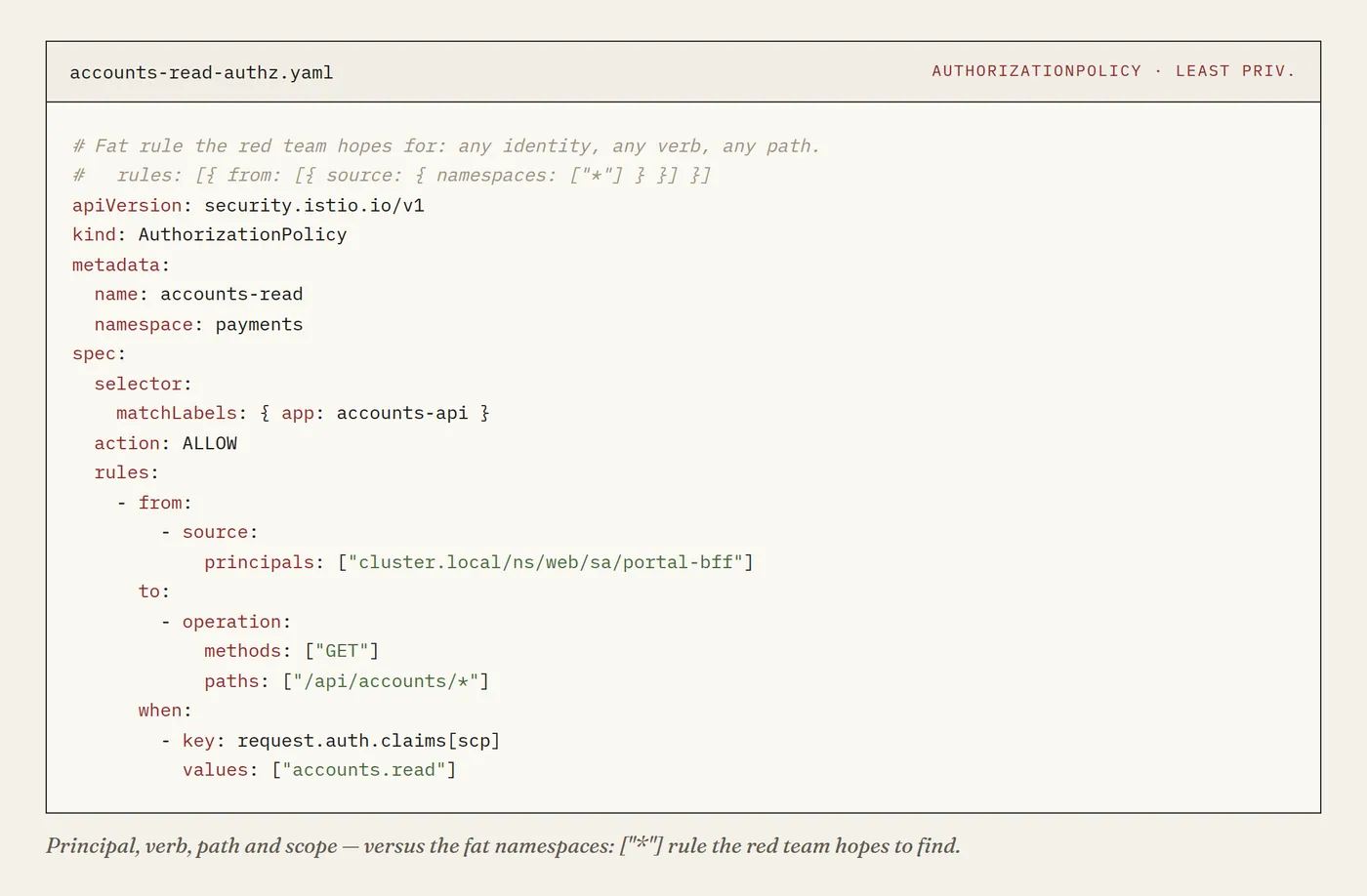
That policy still allows portal-bff to fetch any account id. The object-level check belongs in the service, in a .NET 10 minimal API, against the delegated user's oid:
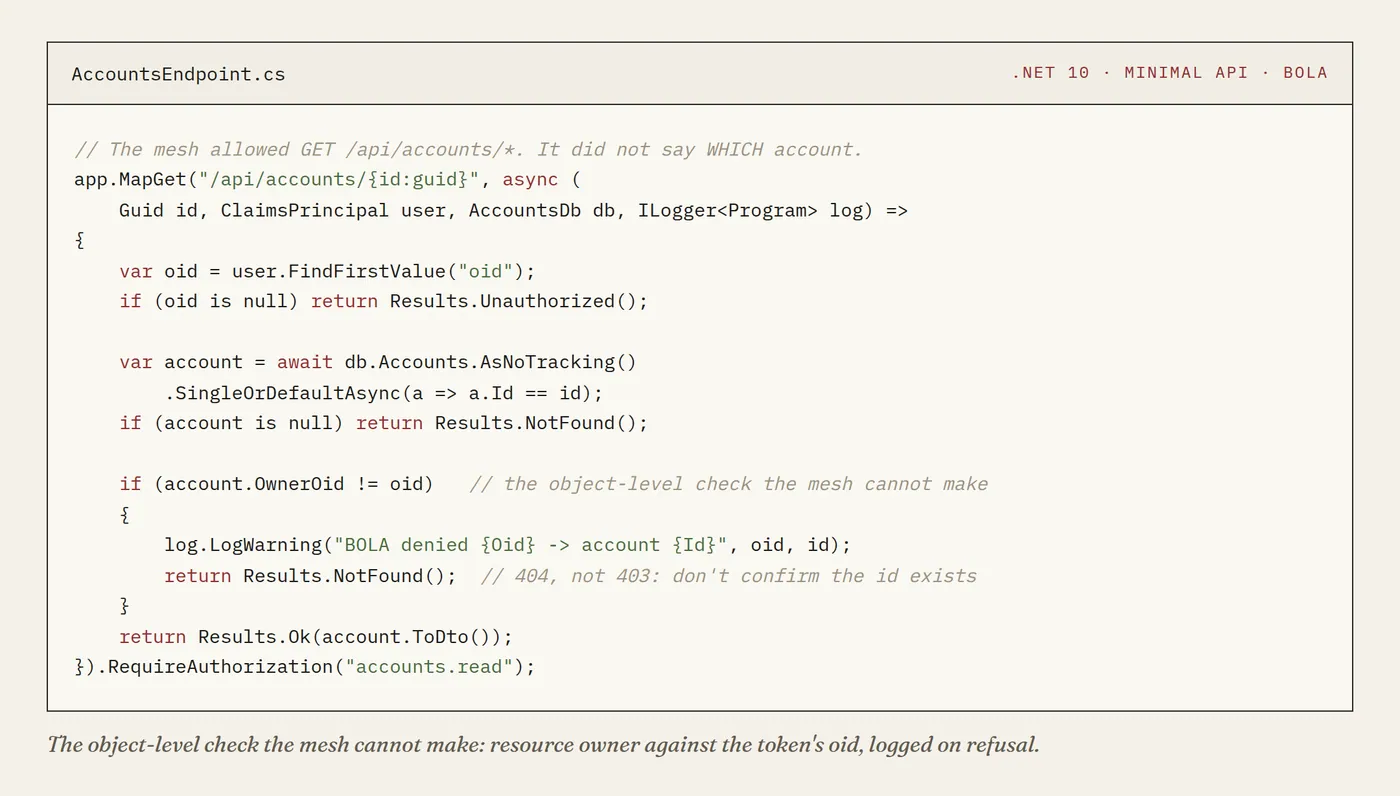
The warning line matters as much as the check. A red team enumerating account ids produces a burst of these, each tied to one oid. That is a detection your SOC can alert on, and a line the purple-team replay can point to.
Finally, make sure the replay has something to read. A namespace-scoped Telemetry overrides the mesh default, so payments logs every call, allowed and denied, and traces at full rate:
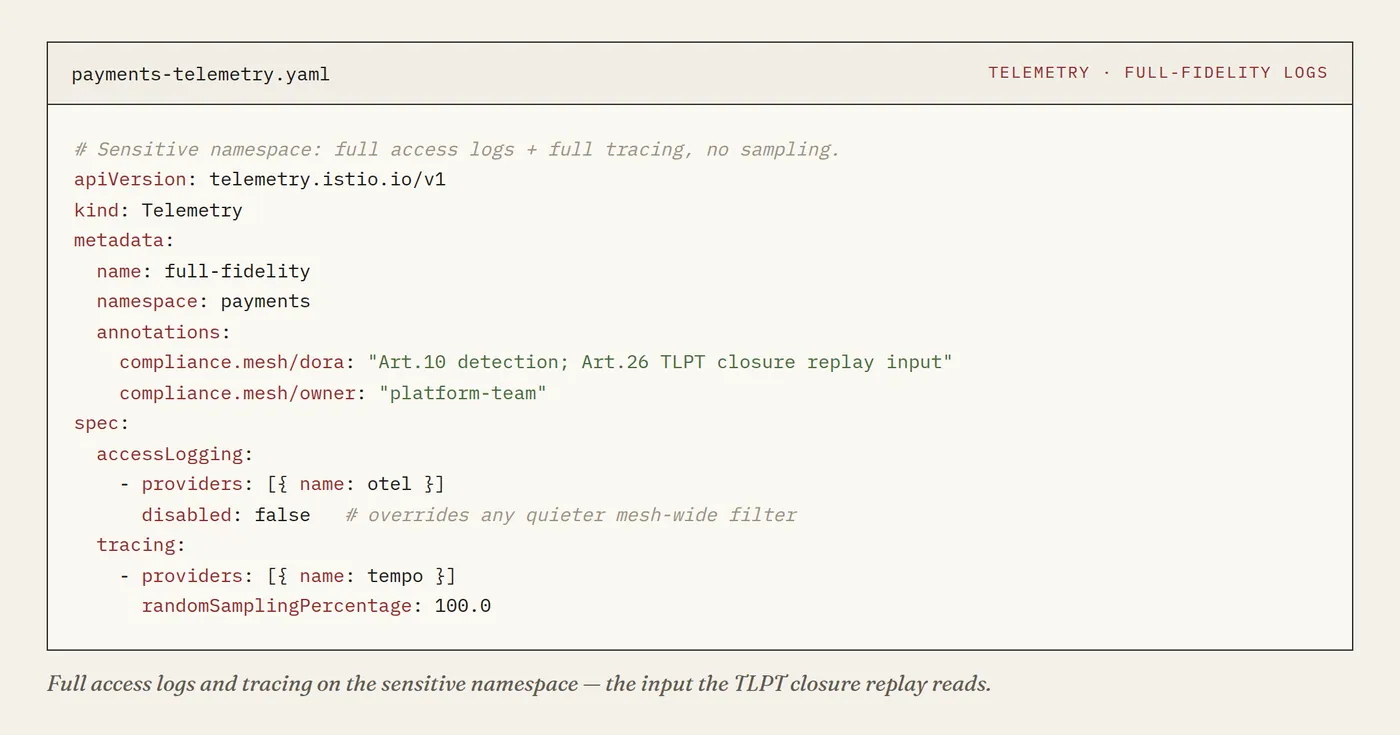
One contrarian note. The obvious move is to apply this only for the test window. Don't. A Telemetry change that lands the week the red team starts is a tell to any blue-team engineer who reads the GitOps log — and the blue team is not supposed to know. Make full fidelity the steady state on sensitive namespaces, and the test window becomes invisible. If cost forces a window, the white team ships it inside a routine change, not a PR titled "TLPT prep".
Security · Audit · Integration
Security: default-deny and STRICT mTLS turn free recon and lateral movement into logged, identity-attributed failures; the object-level check in code closes the gap the mesh structurally cannot.
Audit: every denied call carries the caller's SPIFFE ID and every BOLA refusal carries an oid, so the TLPT closure replay reconstructs the attack from signed records rather than recollection.
Integration: over-broad rules, compromised identities and fail-open dependencies are named explicitly as off-cluster owners — policy review, Entra ID Protection, patch management — so the test report lands on the right desk.
Alternatives, and when you'd pick them
Rely on the annual pentest programme. Correct and sufficient if the authority has not identified you under Art. 26(8). A scoped pentest satisfies Art. 24–25. The mistake is presenting it as TLPT readiness: a pentest with a two-week window and a staging target tells you almost nothing about a twelve-week, threat-led, production campaign.
Continuous automated red teaming (breach-and-attack simulation). Useful between TLPT cycles for regression-testing default-deny and denied-call logging after policy changes. It does not satisfy Art. 26 — no threat-intelligence phase, no qualified testers under Art. 27, no attestation. Pick it to keep the solid rows solid.
A self-run internal red team. Allowed under Art. 27(2), with authority approval, external threat intelligence, and external testers every third test. Pick it if you have a mature offensive team and the governance to keep it independent of the platform it attacks. A red team reporting to the platform lead is a conflict the authority will notice.
Pooled testing with your ICT provider. Art. 26(4) allows a pooled test where a provider serves several entities. If you run a shared platform for multiple financial clients, this is your model — and your mesh logs become evidence for several attestations at once.
From simple to standard, and what's next
The simple version is one tight AuthorizationPolicy, one owner check and one Telemetry resource on the namespace that holds the money. The standard version is a platform where every ALLOW rule is reviewed for intent in its GitOps PR, every service with object identifiers has an owner check with a tested log line, full-fidelity logging is the steady state for anything touching a critical or important function, and the white team can hand the closure replay a signed evidence pack per week of the active phase. A screenshot is a claim. A signed pack is a proof. TLPT is where that difference stops being a slogan.
The red team will find something. The question DORA actually asks is whether you saw it, and how fast you told someone. Next: one detection pipeline, four confession clocks — DORA Art. 19, NIS2 Art. 23, CERT-In and the DPDP Rules, from the same access log.
The mesh decides who may call. The red team asks what they can do once they're allowed.
Next in the series: Article 38 — incident reporting, one detection pipeline and four confession clocks. Earlier: Art. 34 (DORA for platform engineers), Art. 35 (NIS2 and the NISG 2026), Art. 36 (the Register of Information), Art. 16 (default-deny), Art. 23 (threat modelling and CVE-2026-31837), Art. 24 (audit logging with identity), Art. 27 (signed evidence packs).
Key skills & topics in this article
Red teaming & TLPTAuthorizationPolicyDORAmTLSSPIFFECompliance evidenceMicrosoft Entra IDNIS2
Also on LinkedIn.