DORA third-party risk and the Register of Information — observed, not declared
The Mesh Series · Article 36 · Part F
Egress controlThird-party riskDORARed teaming & TLPTCompliance evidencePolicy as code
In Article 22 you switched the mesh's outbound traffic policy to REGISTRY_ONLY and wrote a ServiceEntry for every external host a workload is allowed to reach. You called it egress control. It was also something else: the only list in the organisation of which services talk to which outside providers that is enforced by the thing it describes.
Meanwhile, two floors up, someone in procurement is filling in a spreadsheet called the Register of Information. It has fifteen tabs. It was due at the regulator in the first quarter. It was assembled from contract files, a vendor-management tool, and an email to every product owner asking "which third parties does your service use?"
Those two lists describe the same reality. They have never been compared. This article compares them.
One idea: the register is only as true as your egress policy is strict
DORA's Register of Information asks for two kinds of fact. Some are legal: who the provider is, which contract governs the service, who signed it, whether the provider subcontracts, how you would exit. Some are technical: which ICT service supports which of your functions, which of your entities actually uses it, whether a critical or important function depends on it.
Procurement is the right owner for the legal facts. It is the wrong source for the technical ones, because every technical fact it records is declared — someone said so, once, in a form. The mesh holds the same facts observed: a ServiceEntry is a declaration that is enforced, and the Telemetry access log is a record of what actually left the cluster, from which workload, when.
So the thesis is blunt. Your Register of Information is only as true as your egress policy is strict. Under ALLOW_ANY, the register is a narrative. Under REGISTRY_ONLY, every outbound dependency must be declared before it can work, which means the declared list and the real list cannot silently drift apart. The difference between what you declared and what you observed is not noise. It is the finding.
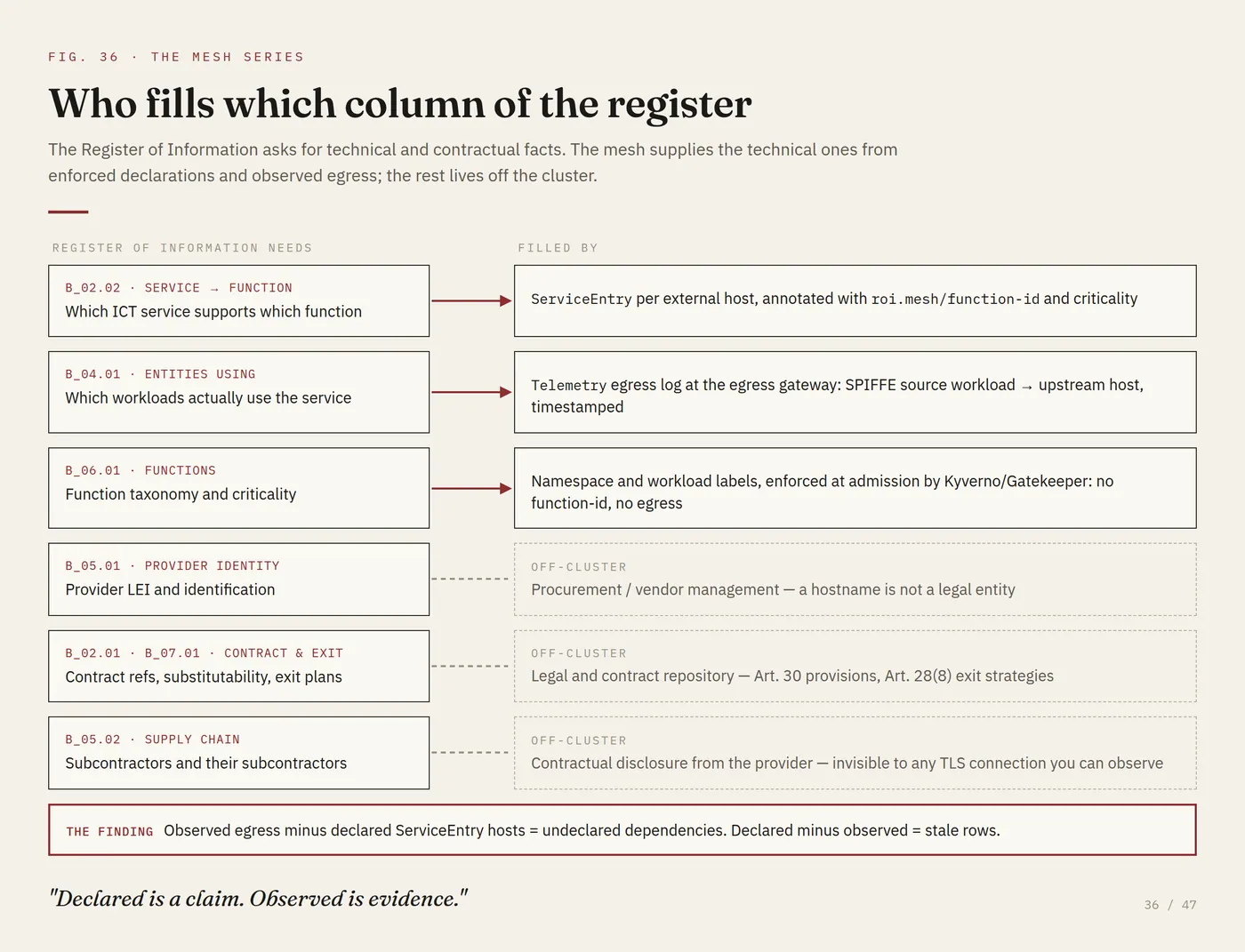
The dashed boxes are not a failure of the mesh. They are the honest boundary: the cluster cannot read a contract, and you should not pretend it can.
Why it matters: Articles 28 to 30 turned a vendor list into a supervisory dataset
DORA's third‑party regime sits in Chapter V. Article 28(1) makes ICT third‑party risk an integral part of the ICT risk‑management framework you met in Article 34 — not a procurement side process. Article 28(3) then imposes the register duty: maintain and update a register of information on all contractual arrangements for ICT services from third‑party providers, at entity, sub‑consolidated and consolidated level, distinguishing those that support critical or important functions. You report on it to the competent authority at least yearly, and you make the full register available when the authority asks. In Austria that authority is the FMA.
Article 28(9) told the ESAs to standardise the templates, and they became Commission Implementing Regulation (EU) 2024/2956. It defines fifteen linked templates, joined on keys like a relational schema: B_01.01 to B_01.03 for the reporting entity, its consolidation scope and branches; B_02.01 to B_02.03 for contractual arrangements, general, specific and intra‑group; B_03.01 to B_03.03 for who signs what; B_04.01 for which entities actually use each service; B_05.01 for provider identification and B_05.02 for the ICT supply chain; B_06.01 for your function taxonomy and criticality; B_07.01 for the assessments of services supporting critical or important functions; B_99.01 for definitions. The reference date is 31 December; the submission is xBRL‑CSV through the national authority, which passes it to the ESAs. The ESAs use the aggregate to see concentration across the Union and to designate critical ICT third‑party providers under Article 31.
Read that as an architect. The register is no longer an internal vendor list you tidy before an audit. It is a structured dataset that leaves your organisation every year, is validated mechanically, and is aggregated with every other bank's. A wrong row is not an embarrassment in a binder. It is a false statement in a regulatory return.
Article 29 adds concentration risk — before you sign, assess whether you are becoming dependent on a provider that is hard to substitute, and look down the subcontracting chain. Article 30 fixes what the contract must contain. Article 30(2) sets the floor for every ICT arrangement: a clear description of the services, the locations where data is processed, service levels, assistance in incidents, cooperation with the authority, termination rights. Article 30(3) raises it for critical or important functions: full service‑level descriptions with precise targets, business contingency plans, participation in your threat‑led penetration testing, audit and access rights, and exit strategies — which Article 28(8) independently requires you to have.
Here is the failure mode. The default register is a spreadsheet, and a spreadsheet is a snapshot of what people remembered on the day they filled it in. The service team adds an address‑validation API in March through a feature flag. A library upgrade starts calling a telemetry endpoint of a vendor you have no contract with. A team migrates from one document‑signing provider to another and nobody tells procurement, because the old contract has not expired. By December the register describes a system that no longer exists. Every row is a claim. None is a proof.
How it comes together: declared, enforced, observed
The integration has three layers, and each one exists already if you followed Season 1.
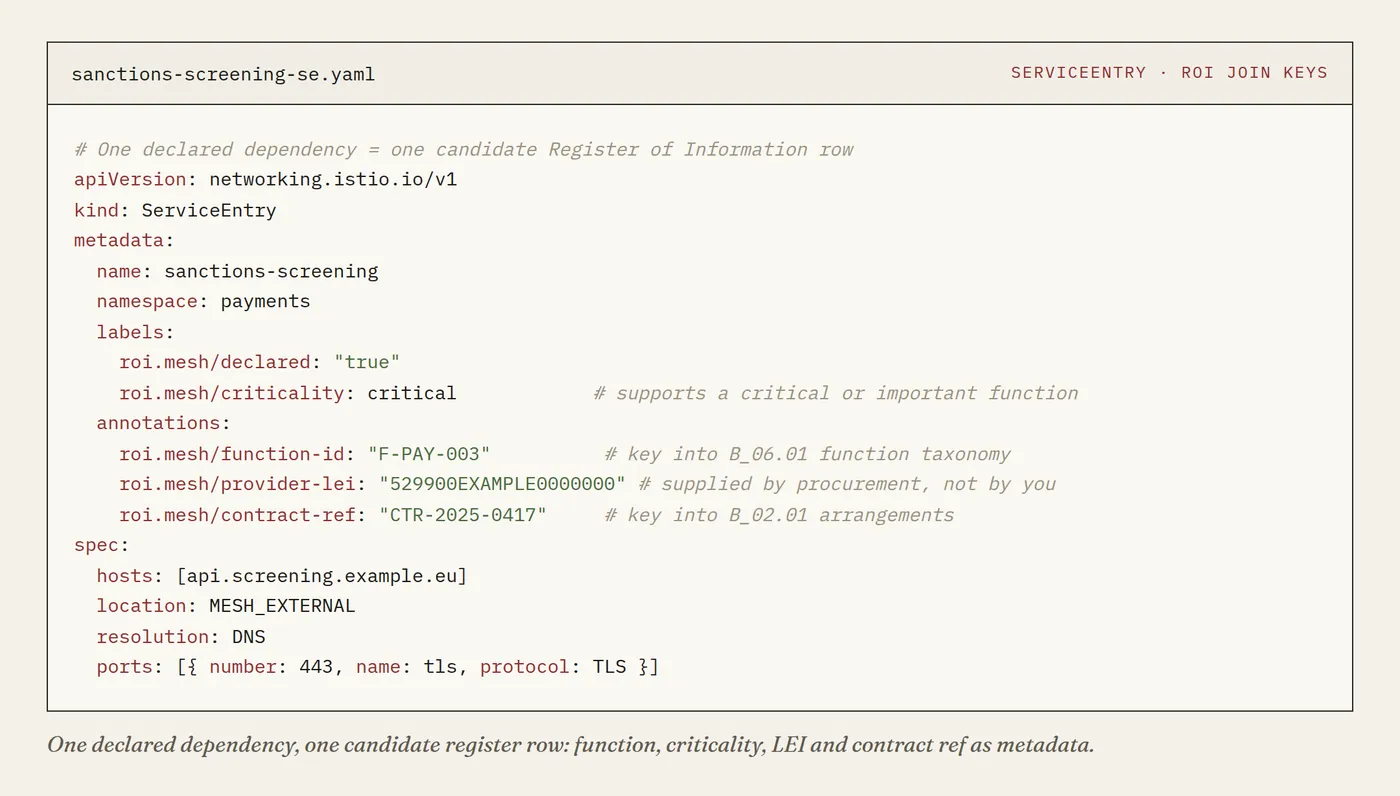
Declared. Every external dependency is a ServiceEntry. Under REGISTRY_ONLY a workload cannot reach a host that no ServiceEntry names — the request lands in the BlackHoleCluster and fails. So the set of ServiceEntry hosts is, by construction, a complete list of outbound dependencies that are allowed to work. Add the register's join keys to it as metadata: the function identifier from your B_06.01 taxonomy, the criticality, and — once procurement supplies them — the provider's LEI and the contract reference. Now the object that grants the dependency also names its place in the register.
Enforced. Article 21 of this series gave you Kyverno or Gatekeeper at admission. Use it here: reject any ServiceEntry with location: MESH_EXTERNAL that lacks a function identifier and a criticality. Pair that with the pull‑request review from Article 31 and a new outbound dependency cannot exist without someone deciding which function it serves. That is the point in the workflow where procurement should be notified, not eleven months later.
Observed. The Telemetry access log from Article 24 already records, for every outbound request, the source workload's SPIFFE identity, the upstream host or SNI, the response code and a timestamp. Route egress through a dedicated egress gateway, as in Article 22, and you get one choke point whose log is the ground truth of what left. Blocked attempts to undeclared hosts appear too, as BlackHoleCluster failures. That matters: a blocked call is code that expects a dependency the register does not know about.
Then the diff, in both directions. Observed minus declared is undeclared dependencies — attempted egress to hosts no one registered. Under strict mode these are failing calls; during a rollout, in namespaces still on ALLOW_ANY, they are live traffic to providers who may have no contract at all. Declared minus observed is stale rows — a ServiceEntry, and probably a register entry, for a provider nothing has called in ninety days. That is either a dead contract you are still paying for, or a disaster‑recovery path you have never exercised, which is its own Article 28(8) exit‑strategy question.
The mesh fills the technical columns from observation. Procurement and legal fill the contractual ones from documents. The join key between them is the annotation on the ServiceEntry. Neither half is complete alone, and that is the design, not a compromise.
Show the config: from ServiceEntry to register row to finding
Start with the declaration. The labels are for selection and policy; the annotations carry the register's join keys, some of which only procurement can supply.
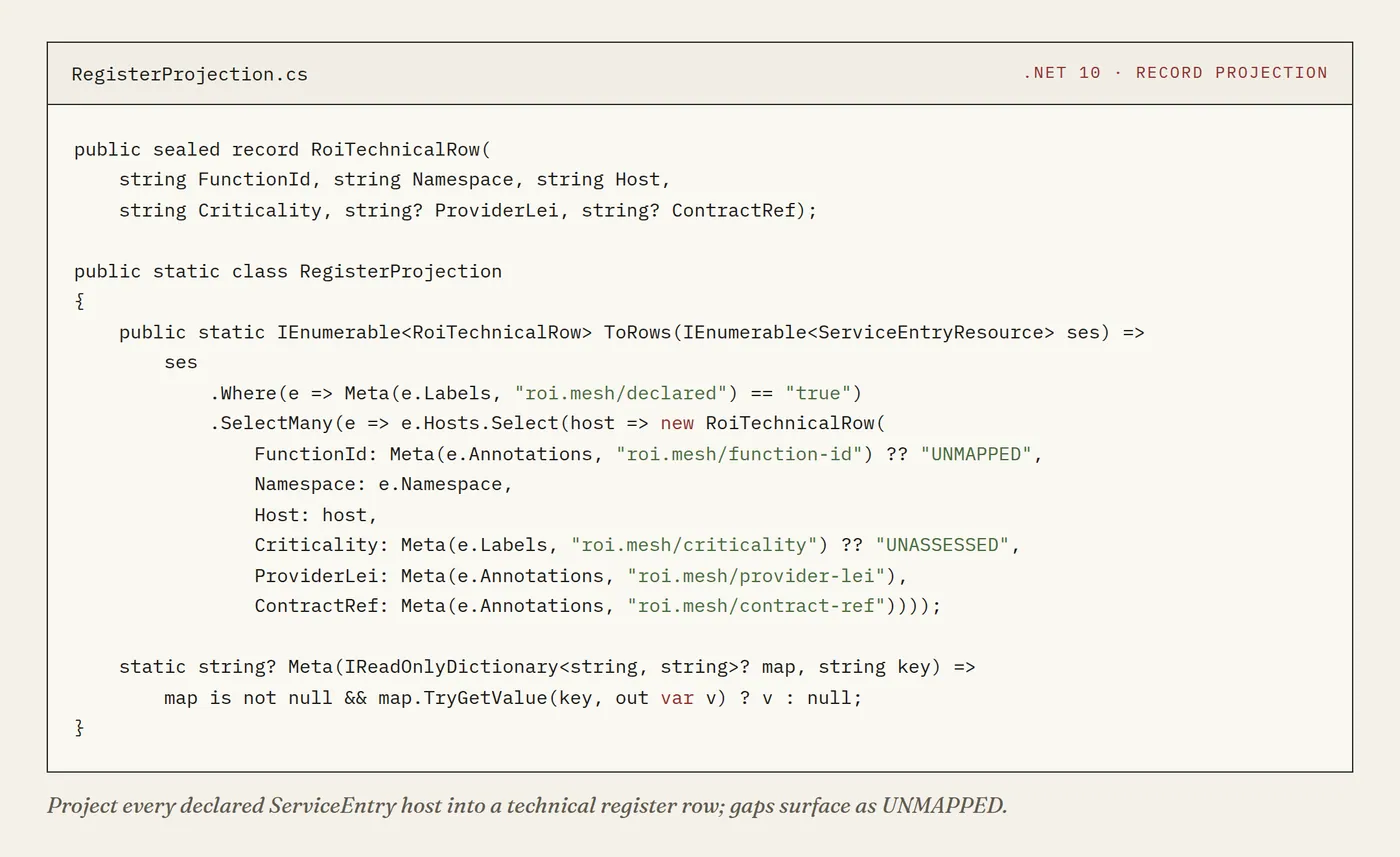
Next, project the declarations into technical register rows. ServiceEntryResource is a thin type you deserialise from the CRD list; the record is the row.
Finally, the finding: hosts the mesh saw traffic attempt to reach that nobody declared.
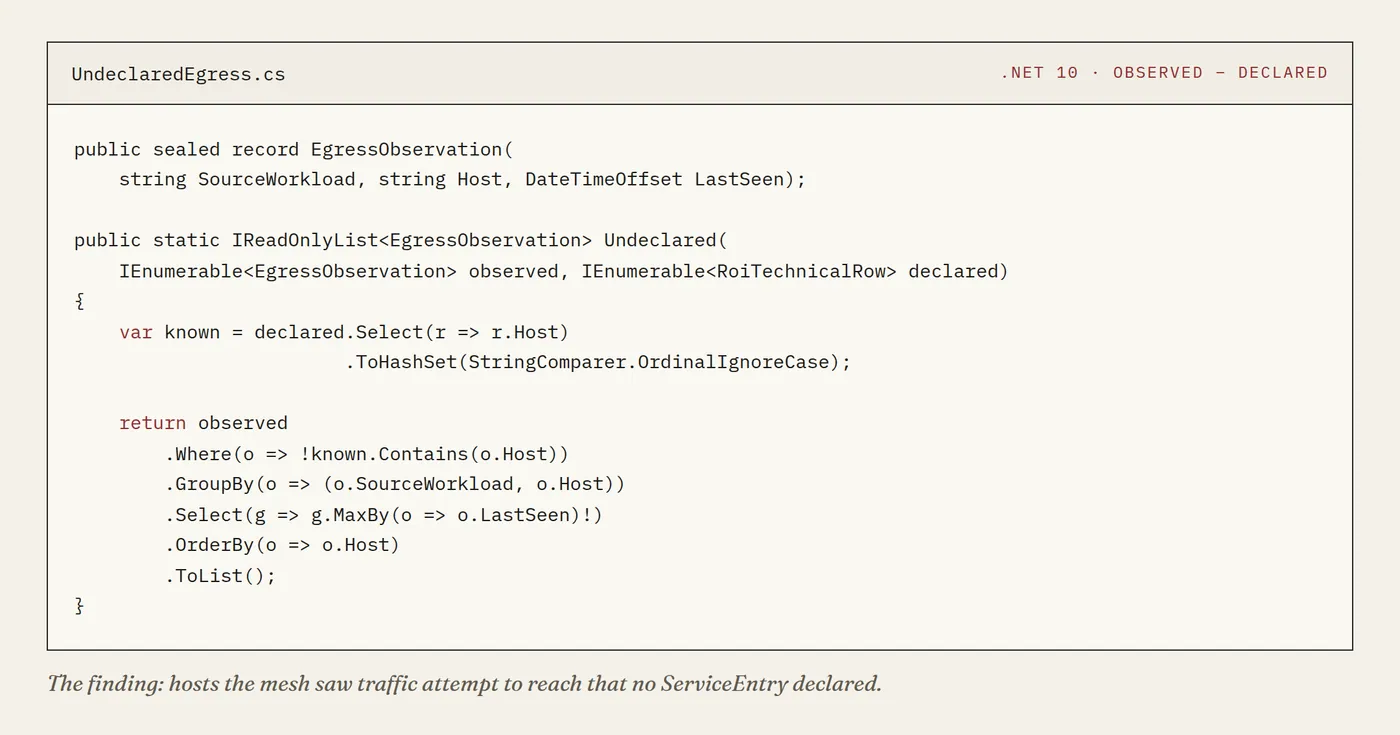
Two honest caveats on that last snippet. Exact host matching ignores wildcard ServiceEntry hosts like *.blob.core.windows.net; a production version matches suffixes, and should flag wildcards as a register smell in their own right, because a wildcard hides which tenant of a provider you depend on. And the reverse diff — declared hosts with no observation in the window — is the same set difference turned round. Run both. Sign the output into the evidence pack from Article 27, because a diff you cannot date and verify is just another spreadsheet.
Security · Audit · Integration
Security: REGISTRY_ONLY means an undeclared provider cannot receive your data; the register stops being a list of hopes and becomes a list of permissions.
Audit: technical register columns are generated from enforced objects and observed traffic, with a dated, signed diff showing exactly where declaration and reality disagree.
Integration: the ServiceEntry annotation is the join key between the cluster and procurement's contract data — each side fills the columns it can actually know.
Alternatives, and when you'd pick them
The spreadsheet, maintained by procurement. It is the default for a reason: the contractual columns genuinely live there, and the ESAs' templates were plainly designed with it in mind. Keep it for LEIs, contract references, signatories, substitutability and exit plans. Stop using it as the source for "which service calls which provider". Every technical row in it should be reconciled against the mesh at least before each annual submission, and ideally continuously.
A third‑party risk or GRC platform with a DORA register module. Worth buying if you have hundreds of arrangements and a group structure with several reporting entities; consolidation and xBRL‑CSV validation are tedious to build. But the tool stores what it is told. Feed its technical fields from the mesh projection rather than from questionnaires, and it becomes considerably more trustworthy.
Network‑layer discovery: firewall logs, proxy logs, DNS logs. Pick this where the mesh does not reach — and it does not reach far enough to be the only source. The mesh cannot see egress from workloads outside it: VMs, hostNetwork pods, CI runners, managed PaaS calling out on your behalf. It cannot see SaaS used by humans through a browser, which is a large share of any bank's ICT services and firmly in the register's scope. And it cannot see your provider's providers: B_05.02 asks for the supply chain, and a TLS connection to one hostname tells you nothing about who processes the data behind it. A hostname is not a legal entity either — mapping api.screening.example.eu to an LEI is procurement's fact, not yours. Firewall and DNS logs cover some of the first gap. Contractual disclosure under Article 30 is the only answer to the last one.
From simple to standard, and what's next
The toy version is one annotated ServiceEntry and a query you run by hand in November. The standard version is an admission policy that refuses an external dependency without a function identifier, a nightly projection of every ServiceEntry into register rows, a two‑way diff against egress telemetry, and a signed evidence pack per quarter that procurement reconciles against the contract data before the annual return. The register becomes something the platform produces and the legal team completes, rather than something the legal team guesses and the platform contradicts.
The register tells the supervisor who you depend on. The next question is whether your defences survive someone who is actively trying to get past them, and DORA's answer is a red team the authority can require. Next: TLPT and TIBER‑EU — what threat‑led penetration testing under Articles 26 and 27 asks of a mesh that thinks it is zero‑trust.
Declared is a claim. Observed is evidence. The register needs both, and it needs to know which is which.
Next in the series: Article 37, TLPT and TIBER‑EU. Earlier: Art. 22 (egress control as a dependency inventory), Art. 24 (audit logging), Art. 27 (signed evidence packs), Art. 34 (DORA for platform engineers), Art. 35 (NIS2 and the NISG 2026).
Key skills & topics in this article
Egress controlThird-party riskDORARed teaming & TLPTCompliance evidencePolicy as code
Also on LinkedIn.