NIS2 and the Austrian NISG 2026 — when the platform is the compliance measure and the board is on the hook
The Mesh Series · Article 35 · Part F
NIS2DORAPolicy as codeCompliance evidencemTLSSupply-chain signingIstioMicrosoft Entra ID
Last time you mapped DORA onto the cluster and drew one box with a dashed border: governance, owned by the management body, living in GRC rather than YAML. You treated that box as somebody else's problem.
NIS2 turns the dashed box around and points it at you.
On 1 October 2026 the Austrian NISG 2026 takes effect. It transposes NIS2, Directive (EU) 2022/2555, and it does something DORA only implies: it names the management body as the party that approves your security measures and makes that body answerable for them. The board does not merely own the risk in the abstract. It signs off the controls — the cryptography, the access policy, the incident process — and it can be held liable when they fail. Which means the PeerAuthentication you merged on a Tuesday afternoon is, legally, something a director approved.
That changes the conversation you have upstairs. It should also change what you build.
One idea: the board approves the controls — and is liable for them
Article 20(1) of NIS2 is three short obligations in one sentence. The management body approves the cybersecurity risk‑management measures an entity takes under Article 21. It oversees their implementation. And it can be held liable for infringements of that article. Article 20(2) adds a fourth: members of the management body must follow training, so they can identify risks and assess the measures they approved.
Read that as an engineer and the consequence is blunt. A director cannot credibly approve what cannot be shown to them. "We use mTLS" is not something a board can approve in any meaningful sense; "every namespace carrying payment traffic is admission‑controlled to STRICT mutual TLS, and here is last quarter's signed evidence that no exception was admitted" is. The first is a sentence. The second is a measure with an owner, a mechanism and a record.
Article 21(2) lists ten measures, (a) through (j). Some of them live in the data path and can be proved from the running cluster. Some live in contracts, policies, training records and crisis plans, and no amount of YAML changes that. The useful thing — the thing a board actually needs from its platform team — is an honest split.
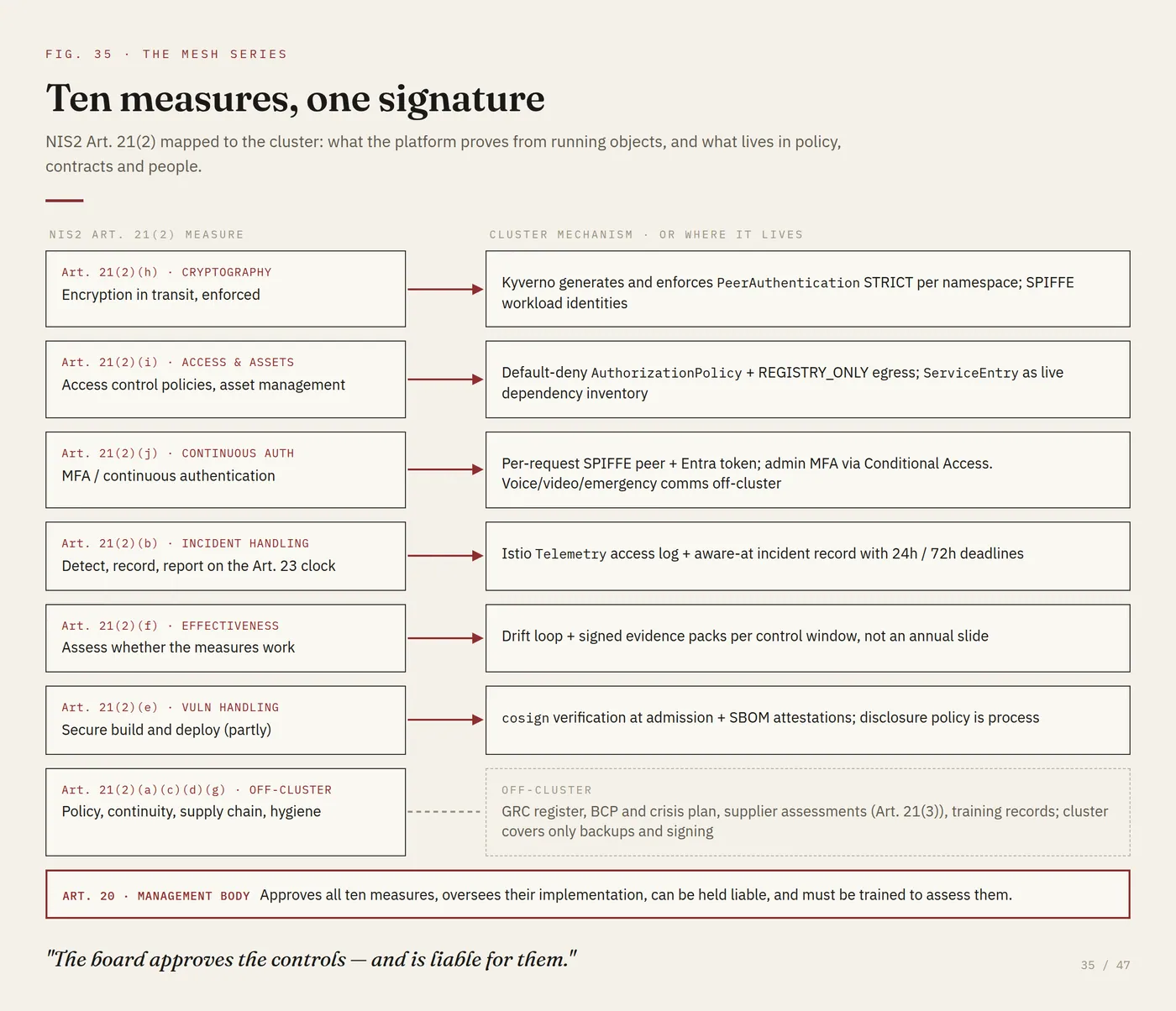
Both columns converge on the same box. That is the point: the board approves all ten, whether or not your cluster can prove them. Your job is to make the left column cheap to prove and the right column impossible to confuse with it.
Why it matters: NIS2 bites hardest on the people who serve the banks
Before you forward this to your favourite Austrian bank, check who is actually in scope. It is not always who you think.
For DORA financial entities, DORA wins. NIS2 Article 4 says that where a sector‑specific Union act imposes cybersecurity risk‑management and reporting obligations at least equivalent to NIS2, the sector‑specific act applies instead. DORA is that act for banks, insurers and payment firms, and the FMA supervises it. So a bank's ICT risk management and major‑incident reporting run through DORA, not the NISG. Exactly how far the Austrian text carves them out — registration included — is on my verification list, not in my assertions.
NIS2 bites on everyone around them. The cloud provider, the data‑centre operator, the managed service provider running the bank's Kubernetes estate, the managed security provider watching its logs — these are Annex I digital‑infrastructure and ICT‑service‑management entities in their own right. So are the non‑financial companies inside a financial group: the IT subsidiary, the shared‑services arm, the insurer's facilities company. For the cloud, data‑centre and managed‑service categories, Commission Implementing Regulation (EU) 2024/2690 turns the ten Article 21(2) measures into detailed technical requirements, which is much less room to interpret than the Directive leaves.
So the reader of this article is most likely the architect at an ICT provider or group IT company that serves a DORA entity. You get DORA's contractual obligations through Articles 28–30 of that Act and NIS2's direct obligations through the NISG. Two regimes, one platform. That is the argument for building controls once and labelling them for both.
The Austrian numbers. The NISG sorts entities into essential and important. Fines reach up to €10 million or 2 % of worldwide annual turnover for essential entities, and €7 million or 1.4 % for important ones — mirroring NIS2 Article 34(4)–(5). Supervision sits with the new Bundesamt für Cybersicherheit under the Interior Ministry, and entities must register within three months of commencement, so by the end of 2026. For essential entities, NIS2 Article 32(5)(b) also allows a temporary ban on a person exercising managerial functions. That last clause is what makes directors read the security budget line by line.
The clocks. Article 23(4) sets the reporting sequence for a significant incident: an early warning within 24 hours of becoming aware of it, an incident notification within 72 hours, and a final report no later than one month after the notification. Every one of those clocks starts at awareness. Not at detection by a tool, not at the end of triage. If you cannot say when the entity became aware, you cannot say whether you were late — and neither can your board.
How it comes together: each measure gets a mechanism, an annotation and a record
Take the left column one measure at a time.
(h) Cryptography and encryption. STRICT mutual TLS through Istio, with SPIFFE workload identities (Article 14 of this series). The NIS2 addition is not the encryption; it is enforcement you can show. A Kyverno policy that generates a STRICT PeerAuthentication in every namespace and rejects anything weaker turns "we encrypt" into an admission decision with an audit trail. Having mTLS and proving mTLS are two different jobs — and the board is signing for the second.
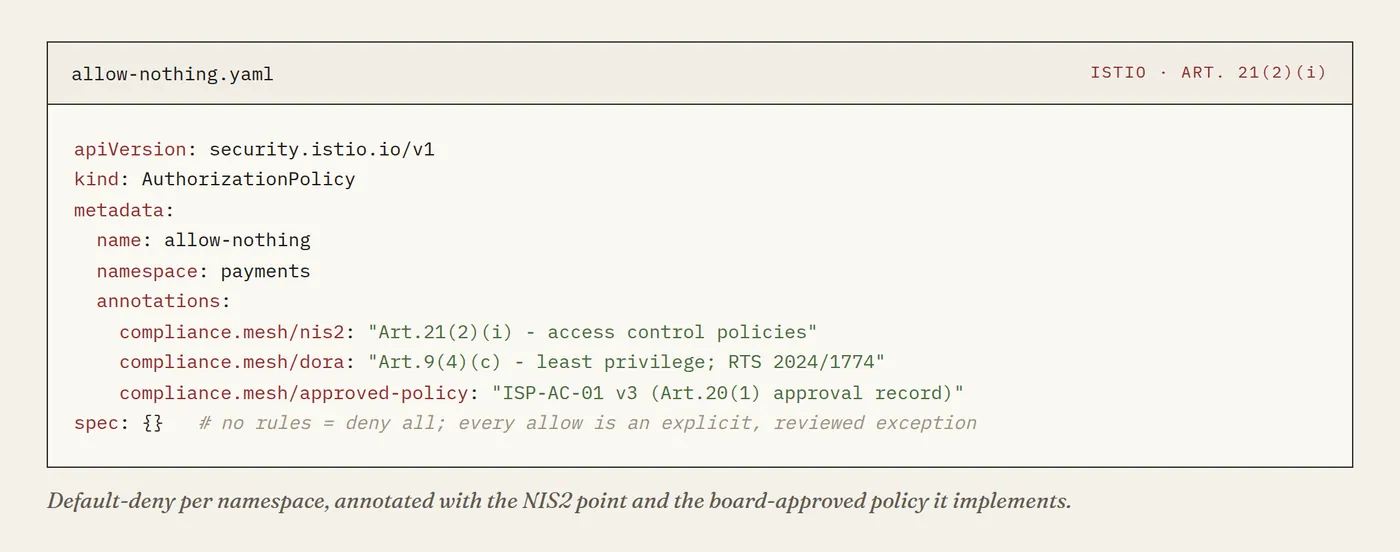
(i) Access control and asset management. Default‑deny AuthorizationPolicy per namespace (Article 16), with every allow rule explicit and reviewed through GitOps (Article 31). Asset management is the part teams forget: REGISTRY_ONLY egress plus ServiceEntry objects (Article 22) is a live inventory of what every workload talks to. The HR‑security half of (i) — joiners, movers, leavers — lives in Entra lifecycle and HR processes, not here.
(j) MFA and continuous authentication. On the workload side, every request carries a SPIFFE identity and, where a user is involved, an Entra token validated per request. That is continuous authentication in the most literal sense. Phishing‑resistant MFA for administrators is Entra Conditional Access. Secured voice, video and emergency communications are entirely off‑cluster; be honest that the mesh covers half of (j), not all of it.
(b) Incident handling. The Istio Telemetry access log with SPIFFE peer and Entra principal (Article 24) is the detection record. What NIS2 adds is the awareness timestamp and the deadlines that hang from it — a small piece of code, shown below, that belongs in whatever service opens your incident.
(f) Assessing effectiveness. This is the measure most organisations answer with an annual pen test and a slide. The drift loop (Article 28) and signed evidence packs (Article 27) answer it continuously: the control existed, it was enforced, here is the signed record for the window. A screenshot is a claim. A signed pack is a proof.
(e) Vulnerability handling — partly. Cosign signature verification at admission and SBOM attestations cover the build and deploy half. Vulnerability disclosure — the coordinated‑disclosure policy, the security contact, the CSIRT relationship — is process.
Then the right column, stated fairly. (a) risk analysis and information‑security policies are documents the board approves; your annotations can reference them, not replace them. (c) business continuity is partly yours — GitOps rebuild and tested backup‑and‑restore — but crisis management and the continuity plan are not. (d) supply‑chain security is partly yours — signed images, the egress inventory — but Article 21(3) asks you to assess each direct supplier's security practices, and that is contracts and questionnaires. (g) cyber hygiene and training is people. Article 20(2) training for directors cannot be kubectl‑applied.
Show the config: three controls a director can actually approve
First, cryptography under Article 21(2)(h). This Kyverno 1.18 ClusterPolicy generates a STRICT PeerAuthentication in every namespace, keeps it there, and blocks any PeerAuthentication that asks for less.
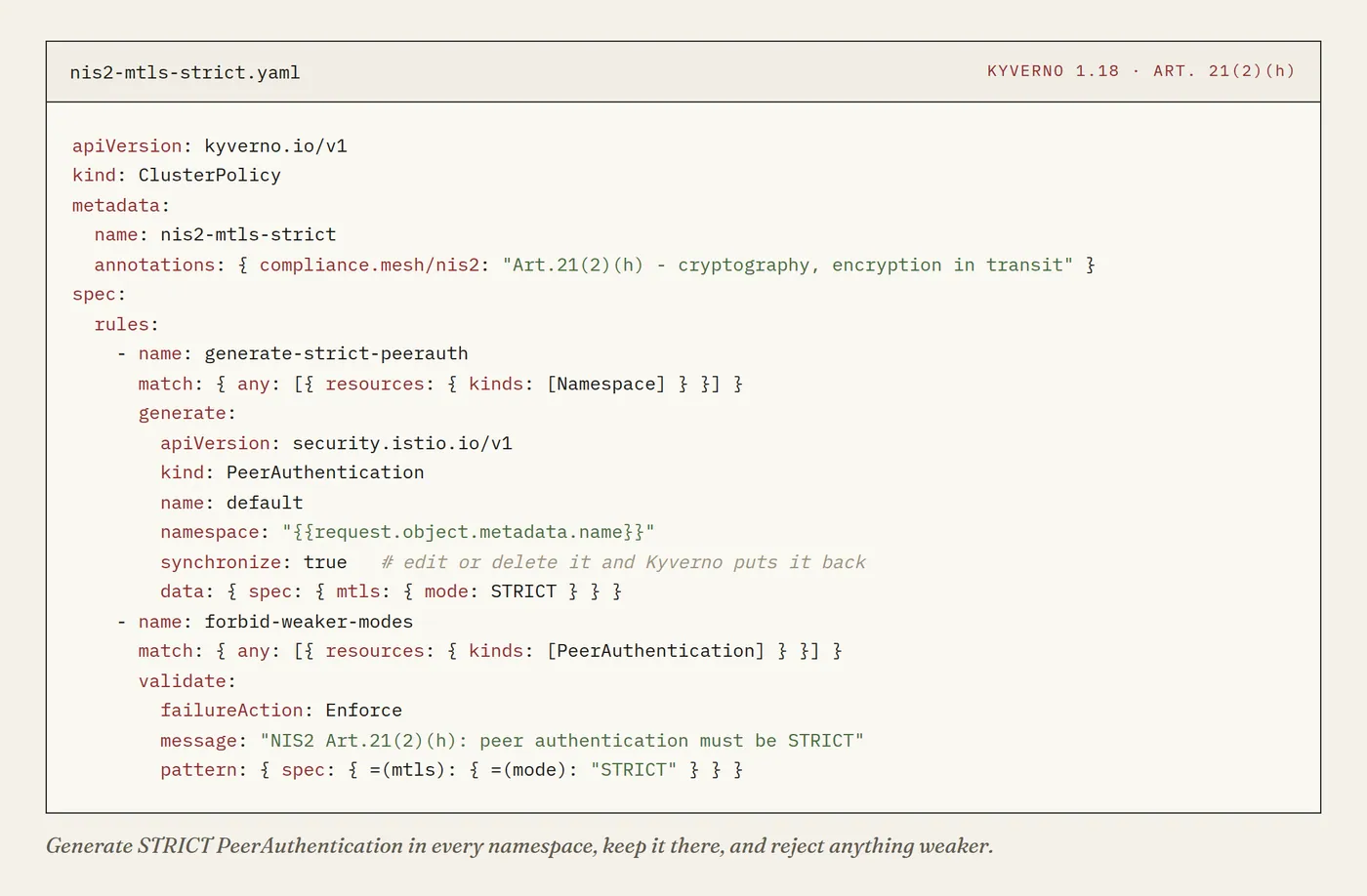
Two caveats you should state to the board rather than bury. Kyverno's background controller needs RBAC to create Istio resources, and portLevelMtls is a side door this pattern does not close — add a rule for it before you call the control complete.
Second, access control under Article 21(2)(i). An empty spec denies every request to workloads in the namespace; each allow must then be written, reviewed and merged. The annotation links the object to the board‑approved policy it implements.
Third, the incident clock under Article 23. A .NET 10 record that captures the moment of awareness and derives the deadlines from it, so nobody computes them on a whiteboard at 2 a.m.
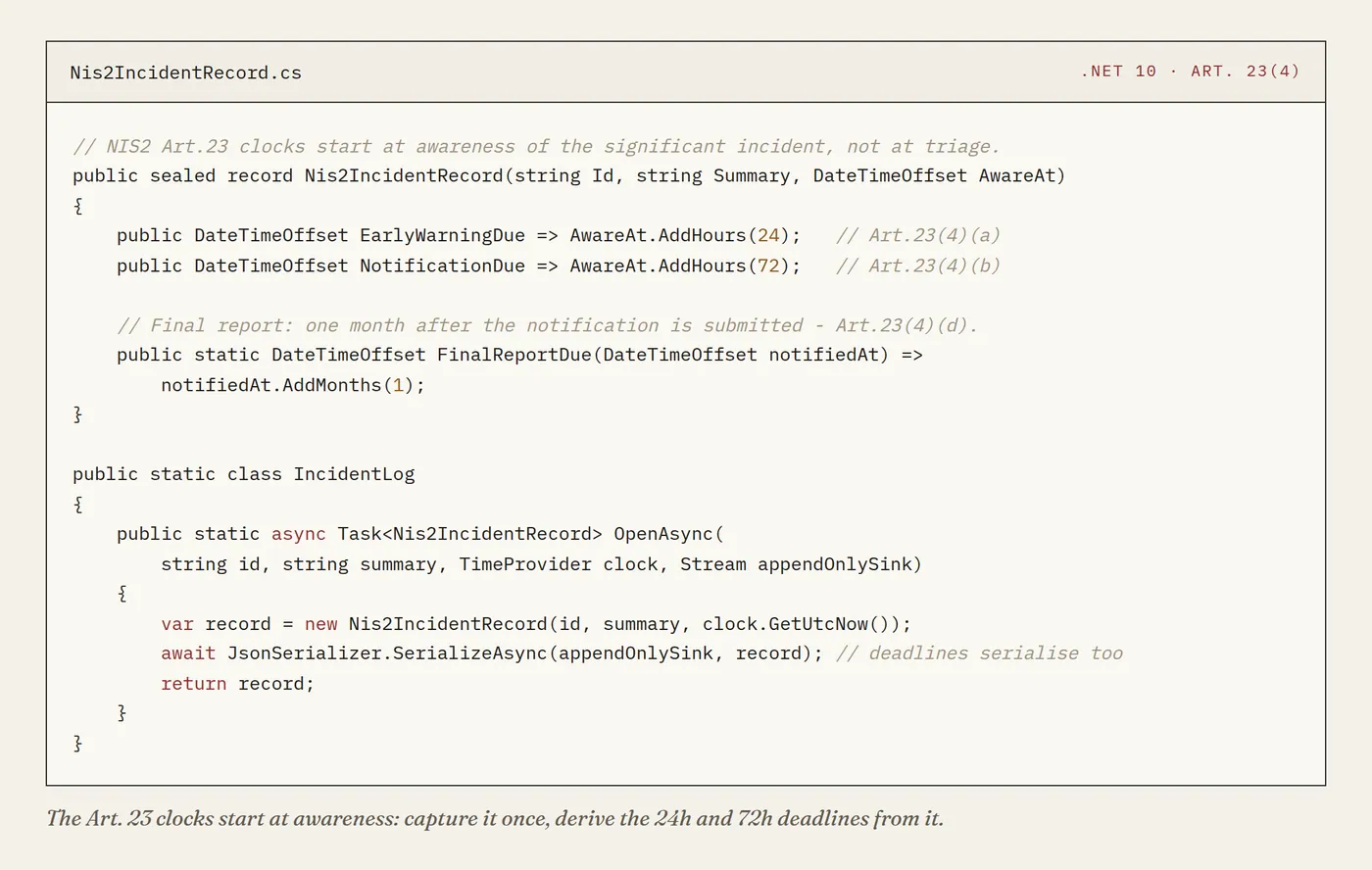
TimeProvider is there so the clock is testable and the timestamp comes from one place. The sink is append‑only and feeds the same signing pipeline as the evidence packs, so the awareness time cannot be quietly moved later.
Security · Audit · Integration
Security: the measures that live in the data path — encryption, access control, workload authentication — are enforced at admission and per request, not asserted in a policy document.
Audit: every control names its NIS2 point, and where relevant its DORA article, as metadata on the running object; the incident record fixes the awareness time the Article 23 clocks depend on.
Integration: Article 20 approval, supplier assessment, continuity planning and training stay explicitly off‑cluster, referenced by ID, so the board can see exactly which measures the platform proves and which the organisation must prove another way.
Alternatives, and when you'd pick them
A GRC tool as the NIS2 system of record. Right for the right column. Policies, supplier assessments, training attendance and board approvals belong in a register with workflow and sign‑off, and most NIS2 tooling does that well. It still cannot tell a director whether STRICT mTLS held last Thursday. Pick it for the programme; wire your signed evidence into it rather than retyping it.
Gatekeeper instead of Kyverno. Equally defensible (Article 21 of this series compared them). Gatekeeper validates well but does not generate resources, so the "every namespace gets a STRICT PeerAuthentication" half becomes a GitOps template or a namespace controller. Pick it if your organisation has already standardised on Rego.
Mesh‑wide STRICT in istio-system only. One PeerAuthentication at the root namespace is simpler and perfectly sound technically. Pick it for a single‑tenant cluster. In a multi‑tenant estate, per‑namespace objects give you per‑namespace evidence, which is what an auditor sampling one business service will ask for.
Treat NIS2 as a DORA subset and do nothing extra. Reasonable if you are a financial entity and your counsel confirms the carve‑out. Wrong if you are the provider or the group IT company, because the NISG applies to you directly and your client's DORA programme does not register you with the Bundesamt für Cybersicherheit.
From simple to standard, and what's next
The toy version is one annotated AuthorizationPolicy. The standard version is a short, honest page the management body can actually approve: ten Article 21(2) measures, each marked on‑cluster, partly on‑cluster or off‑cluster; for each on‑cluster measure, the enforcing object, its annotation and the location of its signed evidence; for each off‑cluster measure, the owner and the document ID. Directors approve that page, take their Article 20(2) training against it, and review it when the evidence says something moved. Your platform stops being a cost centre the board tolerates and becomes the part of the NIS2 programme it can actually see.
NIS2 covers the provider directly. DORA reaches the same provider through the bank's contracts — and the bank has to list every one of them in a register the supervisor reads. Next: DORA third‑party risk and the Register of Information — what your client has to file about you, and how the cluster can fill in half of it.
The board approves the controls — and is liable for them. Give it controls it can see.
Next in the series: Article 36, DORA third‑party risk and the Register of Information. Earlier: Art. 34 (DORA for platform engineers), Art. 14 (mTLS and SPIFFE), Art. 16 (default‑deny), Art. 21 (Gatekeeper vs Kyverno), Art. 27–28 (evidence packs and drift).
Key skills & topics in this article
NIS2DORAPolicy as codeCompliance evidencemTLSSupply-chain signingIstioMicrosoft Entra ID
Also on LinkedIn.