Microsoft Entra ID
22 articles in The Mesh Series by Arshad Badar Khan cover Microsoft Entra ID.
Filter with other topics-
What Regulated Enterprises Can't Ignore
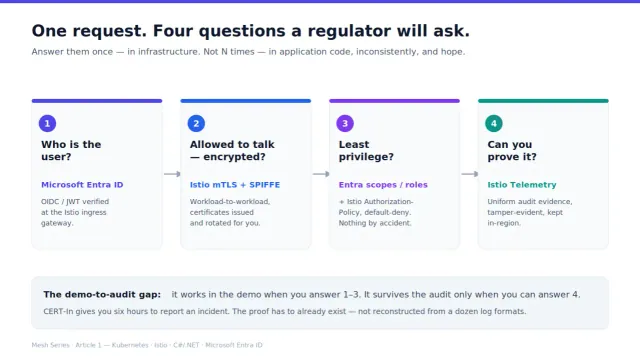
You're moving your web apps to Kubernetes. The kind of apps that ran happily on Windows servers for years. Back there, authentication was almost free. They sat inside the domain, Windows-integrated auth did the quiet work, LDAP…
-
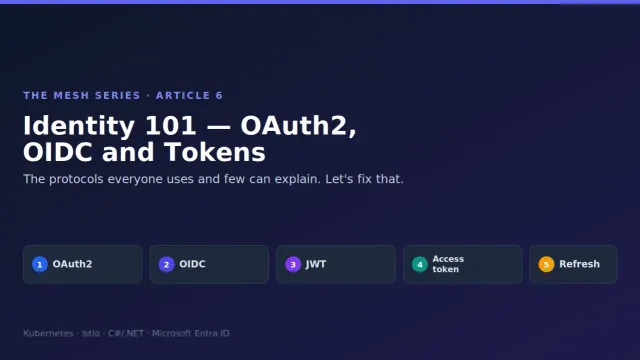
Identity 101 — OAuth2, OIDC, and Tokens
Ask five engineers on your team which OAuth flow their service uses. You will get three shrugs, one confident wrong answer, and one person who actually knows. That last person is the one who has read a token expiry error at 2am.…
OAuth 2.0 & OIDCJWT validation.NET & C#Microsoft Entra IDScopes & app roles
-
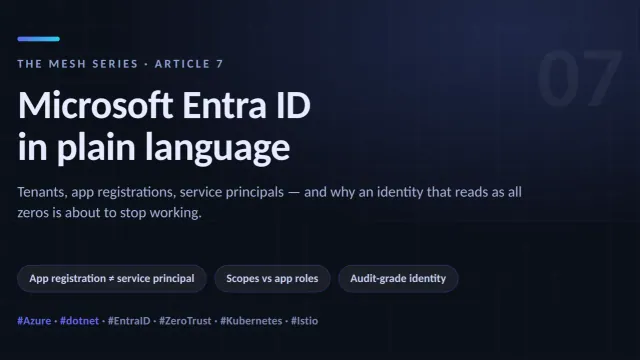
Microsoft Entra ID in plain language
You moved your web apps to Kubernetes and the authentication story fell apart on the way in.
Microsoft Entra ID.NET & C#Scopes & app rolesAzureKubernetes
-
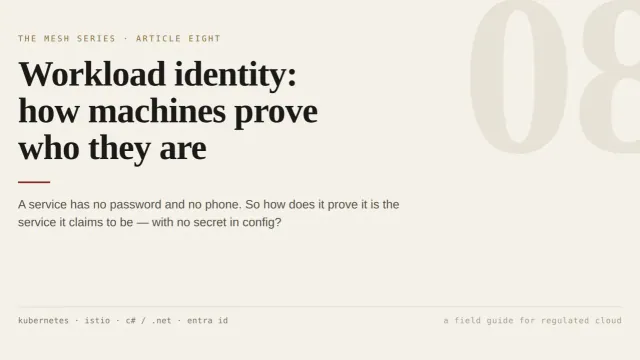
Workload identity — how machines prove who they are
A user proves who they are with something they know, something they have, or something they are — a password, a passkey, a fingerprint. A service has none of those. It has no fingers, no phone, no memory between restarts. Yet the…
-
Going passwordless — for users and workloads
"Just add an OTP" is now the compliance answer that fails the audit.
-
The integration thesis — Entra for users, Istio for workloads
The most common identity mistake in a Kubernetes estate isn't a weak policy. It's a merged one.
-
Terminating user identity at the mesh edge
A bug that ships to production quietly, in regulated shops, all the time:
Microsoft Entra IDJWT validationOAuth 2.0 & OIDCAuthorizationPolicy.NET & C#
-
Validating Entra JWTs in C#
An unverified token is just a string. A HALF-verified one is worse — it looks trusted, gets waved through, and carries an authority it never earned.
-
mTLS and SPIFFE — identity on the wire
Everyone claims they have mTLS. Almost nobody can prove it to an auditor. Those are two different jobs.
-
Entra Workload ID Federation on AKS
A workload can present a SPIFFE cert to its neighbours. It can't present one to Key Vault. So how does it prove itself to Azure — still with no secret in config?
Microsoft Entra IDWorkload identityAzureSPIFFESecrets & certificates
-
Default-deny — the AuthorizationPolicy that fails closed
In default-allow, a forgotten rule leaves a workload open — and you find out when infosec does, or an attacker does. In default-deny, a forgotten rule breaks a deployment in testing, in your face, where you fix it.
AuthorizationPolicyNetwork policyIstioMicrosoft Entra IDSPIFFE
-
Identity propagation across hops — keeping the user alive
Your service needs to call the next service on a user's behalf. The instinct — forward the user's token — is the confused-deputy bug.
On-behalf-of flowMicrosoft Entra IDScopes & app rolesWorkload identitymTLS
-
Scopes, roles, and app roles — from claim to decision
A valid token is not a permission. Authentication proves who you are; it doesn't say you're allowed to do THIS. Two Entra claims decide that — and confusing them is how a valid token does the forbidden thing.
-
If you can’t prove it, it didn’t happen — audit logging in the mesh
Your service mesh is already logging every request. Method, path, status code — for free.
-
GitOps for the mesh — when the pull request becomes the change record
In a regulated shop, a merged pull request IS the change-management record. Author, reviewer, diff, timestamp — maker-checker, enforced by branch protection, mapped straight onto PCI 6.5 and ISO A.8.32.
GitOpsMicrosoft Entra IDCompliance evidenceAuthorizationPolicyDrift & posture
-
Sidecar to ambient — what gets cheaper, what just moves house
"Sidecarless mesh, zero downtime" is a half-truth — and the missing half is exactly the one a regulated cluster cares about.
Ambient meshService meshMicrosoft Entra IDmTLSAuthorizationPolicy
-
The reference architecture — thirty-two pieces, one system
33 articles ago this series opened on a distributed monolith held together with auth tokens and prayer. This is where the pieces become one picture.
Ambient meshCompliance evidenceMicrosoft Entra IDAuthorizationPolicyPasswordless
-
DORA for platform engineers — what the Act actually asks of your cluster
You have spent thirty‑three articles building one system: a regulated .NET platform on AKS, Istio and Entra, where every request is authenticated, authorised, encrypted and logged, and where the logs are signed and the posture is…
-
NIS2 and the Austrian NISG 2026 — when the platform is the compliance measure and the board is on the hook
Last time you mapped DORA onto the cluster and drew one box with a dashed border: governance, owned by the management body, living in GRC rather than YAML. You treated that box as somebody else's problem.
-
Threat-led penetration testing under DORA — what the red team does once the mesh says yes
The letter from the supervisor is two paragraphs long. Your institution has been identified for threat-led penetration testing. A white team is to be formed. Scope will cover critical or important functions. Testing will run…
-
Upgrading Istio without a control‑failure event — the traffic shift that is not a mutation
Istio 1.31.1 fixes GHSA‑qm8v‑g4f9‑qhjx: a BackendTLSPolicy that quietly reverts to plaintext when its CA reference fails to resolve. The control that encrypts was, under one specific failure, not encrypting. You read the advisory…
-
Shipping continuous evidence as a product — a report is something you send; evidence is something an auditor comes and takes
The ComplianceProfile status says Satisfied. It is signed. It is in the cluster. An external auditor from the FMA's appointed firm arrives, and the first thing she does is decline the dashboard, decline the kubectl session, and…
Compliance evidenceSupply-chain signing.NET & C#Kubernetes operatorsMicrosoft Entra ID