Kubernetes
12 articles in The Mesh Series by Arshad Badar Khan cover Kubernetes.
Filter with other topics-
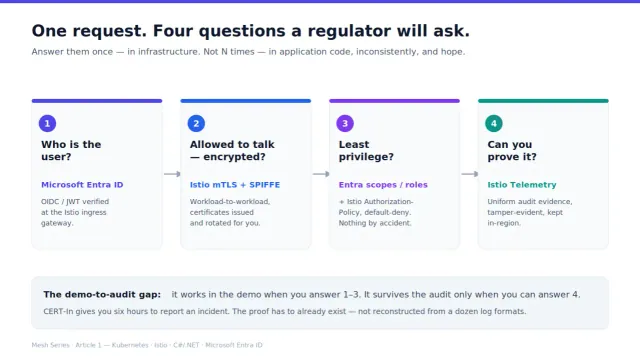
What Regulated Enterprises Can't Ignore
You're moving your web apps to Kubernetes. The kind of apps that ran happily on Windows servers for years. Back there, authentication was almost free. They sat inside the domain, Windows-integrated auth did the quiet work, LDAP…
-
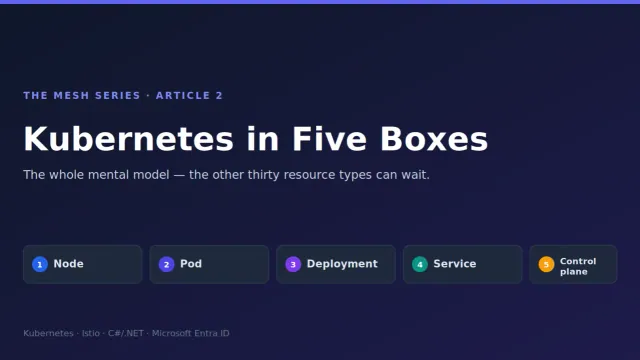
Kubernetes in Five Boxes
You've decided to move to Kubernetes. Good. Then you open the documentation and meet forty resource types, three networking layers, and a YAML file that wants to know your pod's DNS policy. This is the moment most people quietly…
-
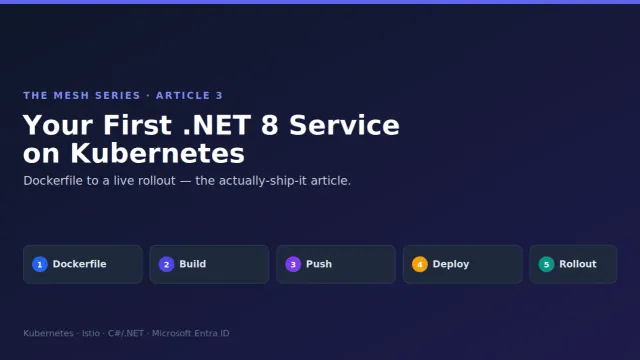
Your First .NET 8 Service on Kubernetes
You have the mental model now. Article 2 gave you a .NET 8 minimal API and the Deployment plus Service YAML that fronts it. Both sit on your disk, doing nothing. A YAML file is not a running service. A cluster does not care about…
-
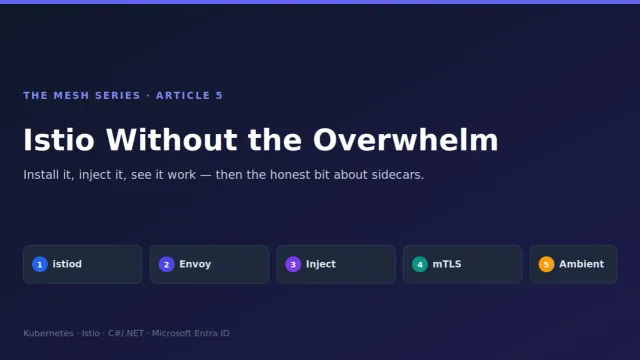
Istio Without the Overwhelm
Istio has a reputation problem. You open the docs and drown: control planes, sidecars, gateways, virtual services, destination rules, telemetry pipelines, a CRD zoo that reads like someone was paid per resource kind. Most…
-
Microsoft Entra ID in plain language
You moved your web apps to Kubernetes and the authentication story fell apart on the way in.
Microsoft Entra ID.NET & C#Scopes & app rolesAzureKubernetes
-
Workload identity — how machines prove who they are
A user proves who they are with something they know, something they have, or something they are — a password, a passkey, a fingerprint. A service has none of those. It has no fingers, no phone, no memory between restarts. Yet the…
-
Entra Workload ID Federation on AKS
A workload can present a SPIFFE cert to its neighbours. It can't present one to Key Vault. So how does it prove itself to Azure — still with no secret in config?
Microsoft Entra IDWorkload identityAzureSPIFFESecrets & certificates
-
Secrets and certificates — for the ones you couldn't eliminate
Eighteen articles deleting secrets. But "fewer" isn't "none." Some secrets must exist — a third-party API key, a legacy DB password, a signing key you own. For those, and for certificates, there's an order of preference most teams…
Secrets & certificatesKubernetesWorkload identityGitOpsNetwork policy
-
Network policy and mesh policy — belt and suspenders
Your mesh AuthorizationPolicy has a blind spot: a pod without a sidecar. A DaemonSet, a node agent, a debug pod — it can open a raw socket to your ledger and the mesh never gets a vote, because the request never hit a proxy.
Network policyAuthorizationPolicyPolicy as codeSPIFFECompliance evidence
-
The policy you wrote isn’t the policy you enforce
You wrote a default-deny policy. You reviewed it. You merged it. And nothing in your cluster stops someone from deploying a workload that ignores it.
Policy as codeKubernetesAuthorizationPolicyNetwork policyCompliance evidence
-
Designing the ComplianceProfile operator — compliance is a reconcile loop with a different noun
You have a PeerAuthentication that says STRICT. You have a Gatekeeper constraint that says every namespace must carry a default‑deny AuthorizationPolicy . You have Envoy access logs with SPIFFE identities, signed evidence packs…
Kubernetes operatorsCompliance evidencePolicy as code.NET & C#Supply-chain signing
-
Building a Kubernetes operator in C# — Kubernetes has no opinion about Go
The platform team reviews the Article 43 design and says, kindly, that operators are written in Go. Kubebuilder, controller‑runtime, the Operator SDK, the language the API server itself is written in. They are not wrong about the…