Service mesh
6 articles in The Mesh Series by Arshad Badar Khan cover Service mesh.
Filter with other topics-
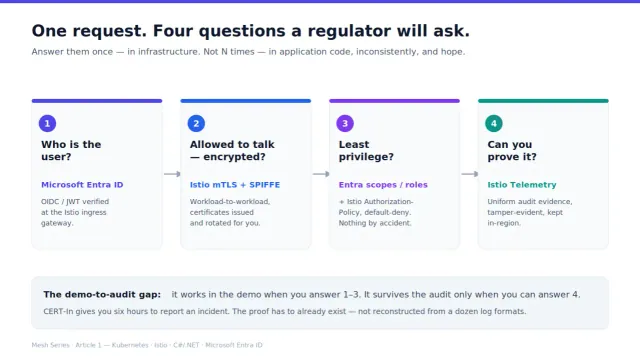
What Regulated Enterprises Can't Ignore
You're moving your web apps to Kubernetes. The kind of apps that ran happily on Windows servers for years. Back there, authentication was almost free. They sat inside the domain, Windows-integrated auth did the quiet work, LDAP…
-
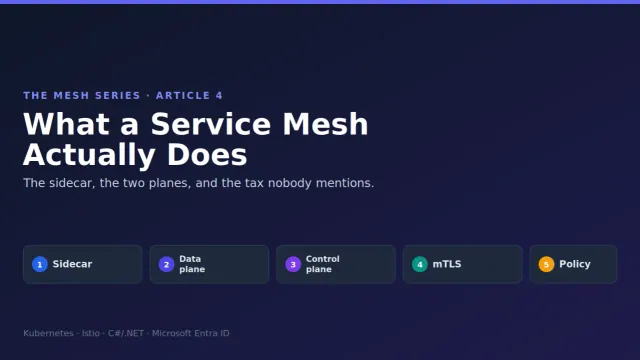
What a Service Mesh Actually Does (and What It Doesn't)
A service mesh is a layer of proxies. That's the whole idea, stripped of the conference-stage mystique. Next to every pod, you run a second container — an Envoy proxy, the "sidecar" — and you route all of that pod's traffic…
-
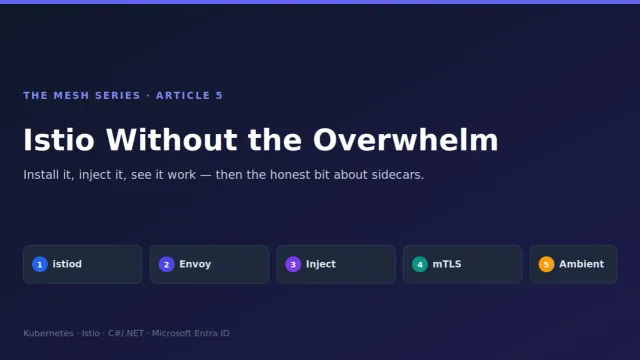
Istio Without the Overwhelm
Istio has a reputation problem. You open the docs and drown: control planes, sidecars, gateways, virtual services, destination rules, telemetry pipelines, a CRD zoo that reads like someone was paid per resource kind. Most…
-
Egress control and the locked-down cluster
You locked the front door of your Kubernetes cluster. Ingress gateway, token validation, default-deny — the works.
-
Sidecar to ambient — what gets cheaper, what just moves house
"Sidecarless mesh, zero downtime" is a half-truth — and the missing half is exactly the one a regulated cluster cares about.
Ambient meshService meshMicrosoft Entra IDmTLSAuthorizationPolicy
-
What the mesh actually costs — two curves on two axes, and the one the CFO sees
The platform lead has one slide. It says the sidecar costs about 100 millicores and 128 mebibytes per pod, multiply by your pod count, and ambient makes most of that go away. Finance nods. The slide is correct. It is also the…
Ambient meshService meshFinOps & costCompliance evidenceMulti-cluster & residency