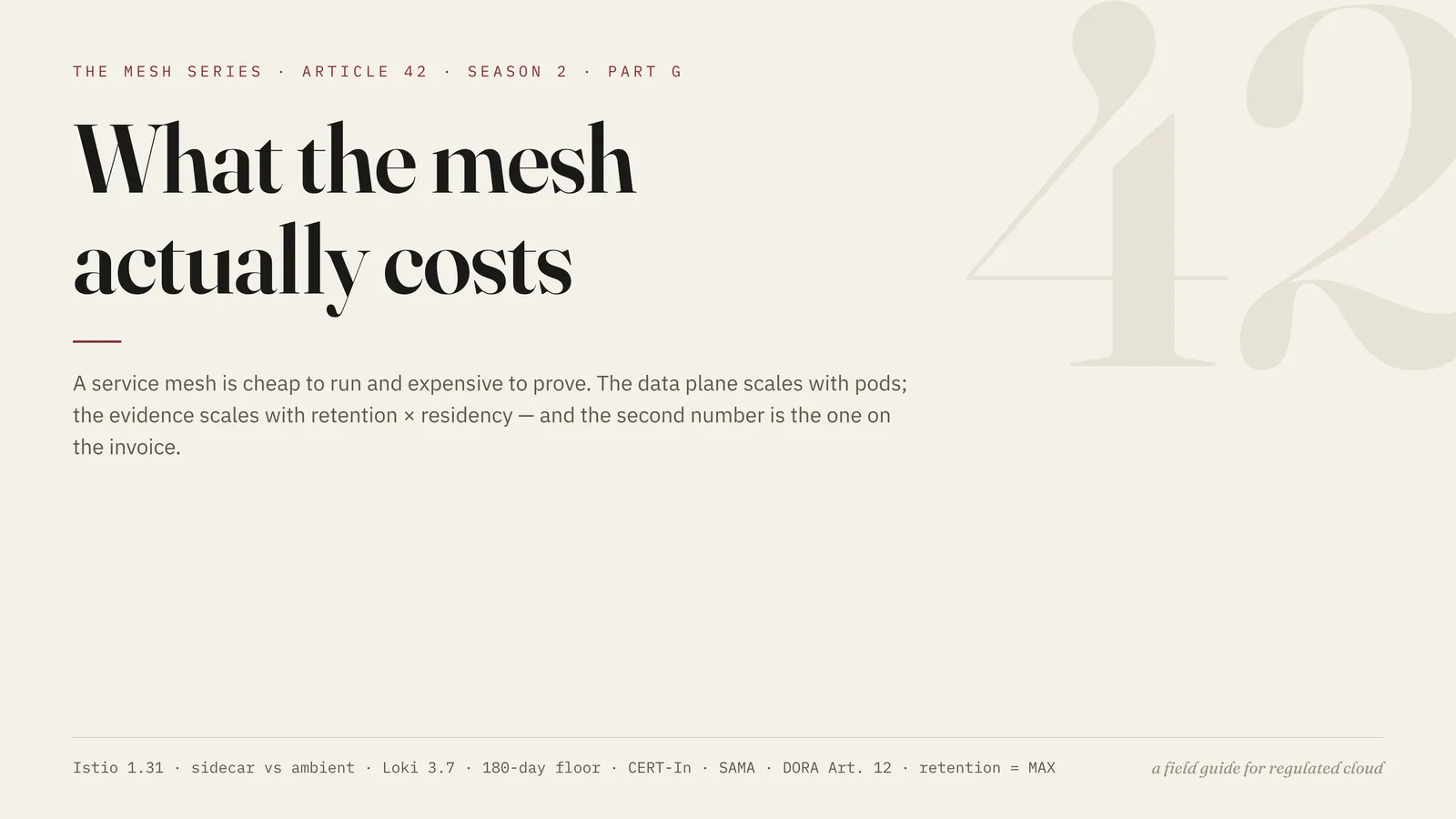
What the mesh actually costs — two curves on two axes, and the one the CFO sees
The Mesh Series · Article 42 · Part G
Ambient meshService meshFinOps & costCompliance evidenceMulti-cluster & residencyLGTM stackDistributed tracingKubernetes operators
The platform lead has one slide. It says the sidecar costs about 100 millicores and 128 mebibytes per pod, multiply by your pod count, and ambient makes most of that go away. Finance nods. The slide is correct. It is also the smaller of the two numbers, and the one nobody in the room is actually going to pay.
The number they are going to pay is on no slide, because it does not scale with pods. It scales with how long the regulator makes you keep the proof, and where.
One idea: a service mesh is cheap to run and expensive to prove
There are two cost curves, and they run on two different axes.
The data plane scales with workloads. Every sidecar is a per‑pod tax: a proxy with its own CPU request, its own memory request, its own share of the node. Ambient moves that tax to a per‑node ztunnel for L4 — mTLS, identity, L4 authorisation — and a per‑lane waypoint only where you need L7. The sidecar‑versus‑ambient argument is entirely about this curve, and ambient wins it convincingly. It is also platform‑team money: visible, optimisable, and a rounding error on a cluster that already runs the application tier.
The evidence scales with retention × residency. Articles 24 to 27 turned every request into an access‑log line with a SPIFFE identity and an Entra principal, every control verdict into a signed record, every incident into a timestamped pack. Those bytes have to be kept. CERT‑In says 180 days, in India. SAMA says in‑Kingdom and grades you on continuity. DORA's Article 12 wants backups and restoration tested. The retention floor is the longest clock across every framework you answer to (Article 30), and residency decides which storage tiers you are allowed to use to meet it. That curve does not care how many pods you have. It cares how many bytes per day you produce, how many months you must hold them hot, and whether the cheap archive tier is in a country you are permitted to use.
The contrarian core: the mesh is cheap to run and expensive to prove, and the second number is the one that decides whether the project survives its second budget cycle. Optimise the data plane; budget the evidence.
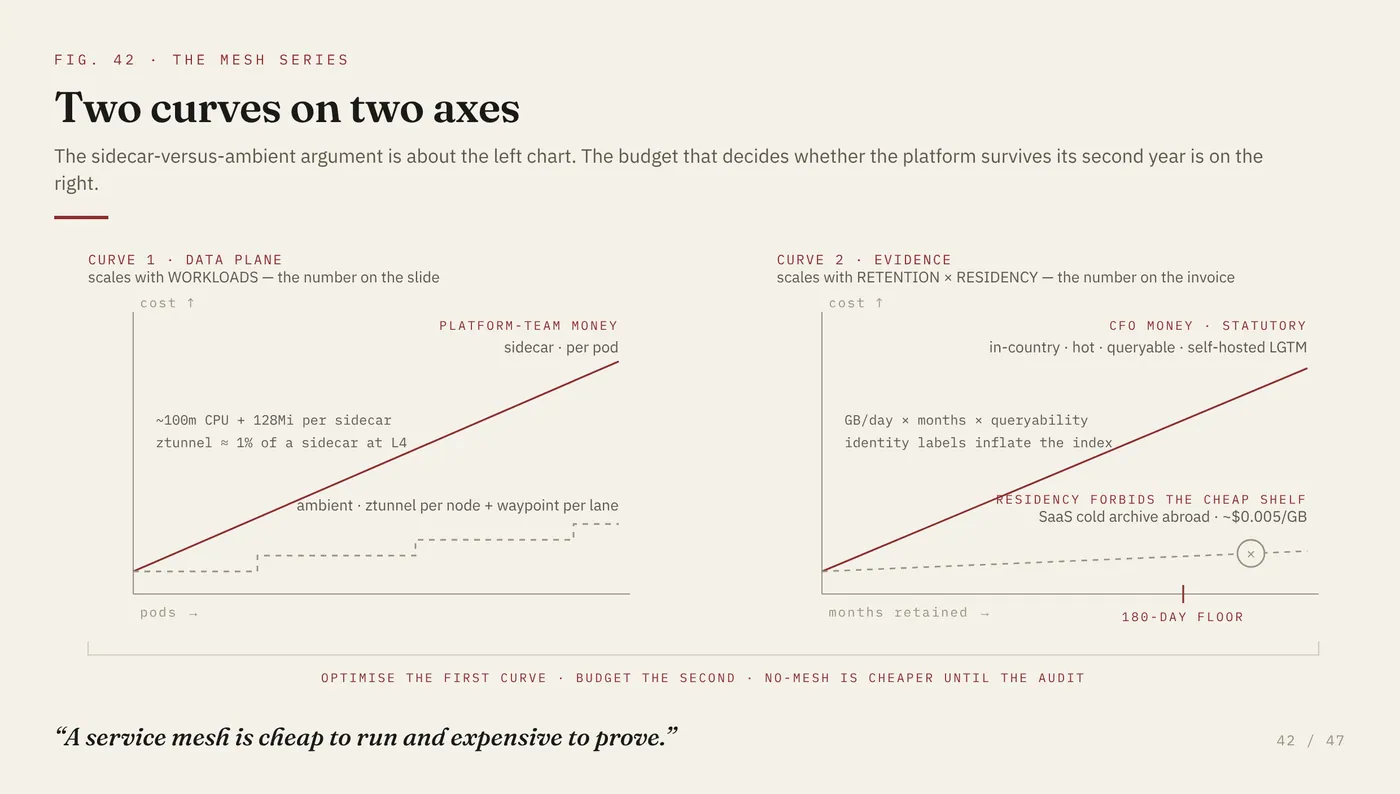
Why it matters: no‑mesh is cheaper until the audit
Put rough numbers on both curves so the shape is honest. Do not multiply them by a fleet size you do not have; multiply by yours.
Curve 1. A sidecar requests roughly 100m CPU and 128Mi, and commonly runs with limits of 2 vCPU and 1Gi. At on‑demand cloud prices of the order of $23 per vCPU‑month and $3 per GB‑month, that is a few dollars per pod per month at request, and more under load. Ambient's ztunnel is a DaemonSet: one per node, measured at about one percent of a sidecar's footprint for the L4 path — Solo.io's benchmark has all three ztunnels in a small cluster using less than one sidecar between them. Add waypoints for the lanes that need L7 (JWT validation, path‑level authorisation) and the saving is still around 80% of the sidecar allocation; L4‑only lanes get closer to 90%. This is the Article 32 payoff in money. It is real. It is also small in absolute terms unless you run a very large fleet, in which case you already knew.
Curve 2. Evidence cost is GB × months × queryability. At 100 GB a day of logs and traces — not exotic once every request carries identity labels — the self‑hosted LGTM stack from Article 25 runs on the order of $500 to $2,000 a month in infrastructure, plus a fraction of an engineer. That is the cheap option, and it is cheap because it is self‑hosted in your region. Now apply the floor. 180 days hot is six months of ingest held queryable, so the index and the object store are sized at six multipliers of a month, not one. The identity labels from Article 26 — the ones that make a trace an audit record — are high‑cardinality and inflate the index further; that is the price of being able to answer "who called what" rather than "something called something." And the tier that makes SaaS archive pricing look free — half a cent per gigabyte, cold, in whichever region the vendor chose — is the tier residency forbids. The cheap shelf is in the wrong country.
The SaaS comparison, honestly. A hosted observability platform at roughly $15–27 per host per month plus APM plus around ten cents per ingested gigabyte of logs is not outrageous for the data plane. The objection is not the bill. It is that the evidence leaves the jurisdiction unless the vendor has an in‑country region, and for the Indian arm or the Saudi entity that is a residency finding, not a procurement preference. Where a vendor does have the region, compare like for like: their retention pricing at 180 days hot against your LGTM at 180 days hot, both in‑country.
Which leaves the line that ends most "do we even need a mesh" meetings: no‑mesh is cheaper until the audit. Without the mesh there is no per‑request identity, no access log that names a principal, no signed verdict — and the evidence curve does not vanish. It is replaced by people reconstructing it by hand, under a deadline, from logs that were never designed to be proof. That cost is real too. It just arrives as overtime and a finding instead of a line item.
How it comes together: optimise the first curve, budget the second
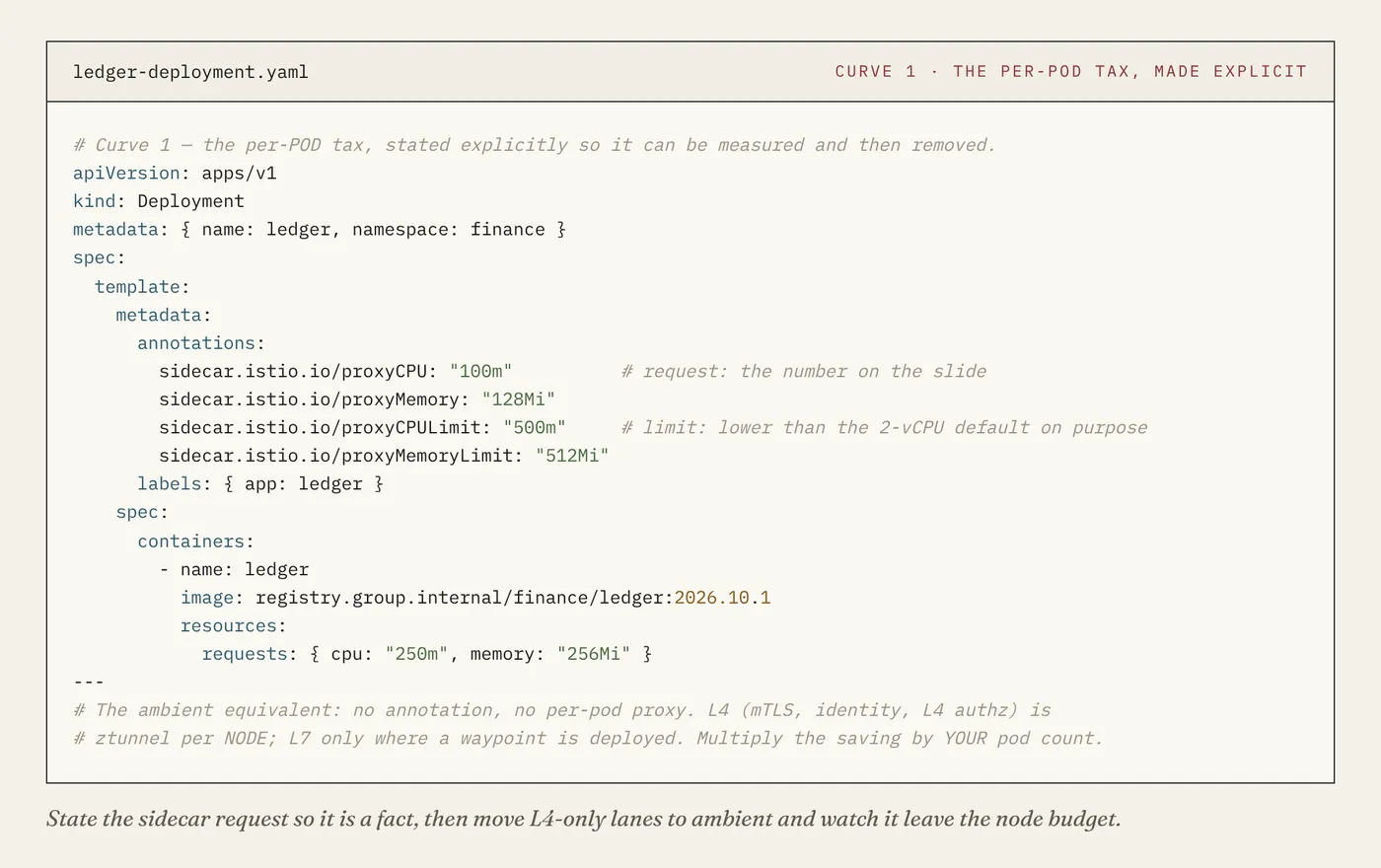
Measure the data plane, then move it. Put explicit resource requests on sidecars rather than accepting defaults, so the per‑pod number is a fact and not a guess. Then move L4‑only namespaces to ambient (Article 32) and watch the requests disappear from the node budget; keep waypoints only where the Entra JWT path lives (Article 11). The first curve is now a line you can show finance going down.
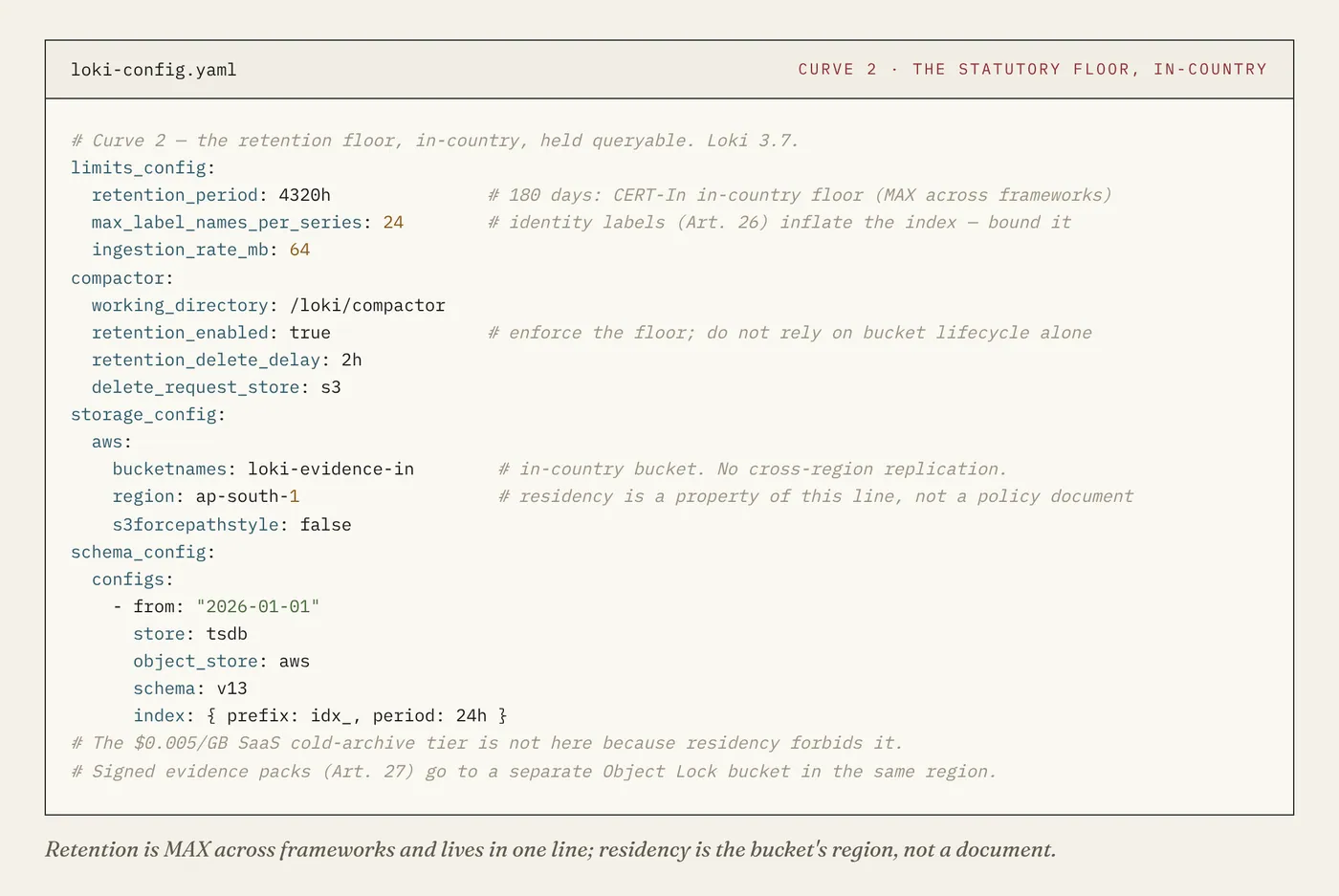
Treat retention as a statutory input, not a tuning knob. The retention floor is MAX across frameworks (Article 30's shape, the one Article 43 will encode in a CRD): 180 days for CERT‑In, whatever SAMA's assessor expects for continuity, whatever your DORA risk assessment set. Configure Loki, Tempo and the evidence bucket to that floor, in the region the floor belongs to, and stop treating "could we keep less" as a cost lever. You cannot. You can only decide what you keep in addition.
Separate what must be hot from what must merely exist. Access logs with identity labels: hot for the floor, because an auditor's query is a query. Signed evidence packs: tiny, hot for the floor, then WORM for as long as the longest retention clock says. Raw traces: sample on sensitive lanes (Article 26's force‑keep for response_code >= 400), keep the rest short. The index is where the money goes; decide what earns a place in it.
Put the second curve on the slide. A platform proposal that shows sidecar savings and hides evidence retention is a proposal that gets approved and then surprises the CFO in month seven. Show both curves, label the second one statutory, and the conversation shifts from "why is observability so expensive" to "which regulator set this floor."
Show the config: make both curves explicit
The first curve, as facts rather than defaults. Per‑pod sidecar sizing on a workload that will stay on sidecars because it needs L7 — note that the same annotations are irrelevant in ambient, which is the point.
The second curve, as a floor rather than a knob. Loki at the statutory retention, in region, with the compactor enforcing it.
Security · Audit · Integration
Security: the evidence store sits in the jurisdiction that mandates it, on infrastructure you operate, with the signing key in a vault in the same region — the cost of residency is the cost of not having to explain a foreign archive tier to a regulator.
Audit: both curves appear in the platform's cost model; the retention floor is labelled with the framework and clause that set it, so a finance question becomes a regulatory citation rather than a tuning argument.
Integration: sidecar sizing is explicit on L7 workloads and absent on ambient ones; Loki, Tempo and the WORM bucket share one retention floor per region (Article 39's shape); the Article 43 ComplianceProfile will carry that floor as retention: { days, residency } so the number lives in one place.
Alternatives, and when you'd pick them
SaaS observability end to end. Pick it when the vendor has a region inside every jurisdiction you answer to and you have compared 180‑day hot retention like for like. Many institutions find it wins for the data plane and loses for the evidence floor; splitting the two is allowed.
Keep sidecars everywhere and skip ambient. Reasonable if the fleet is small enough that curve 1 is noise, or if every lane needs L7 anyway. You lose the Article 32 saving and keep the per‑pod upgrade tax from Article 41. Make the decision on your pod count, not on the slide.
Shorter retention, cheaper tier, argue later. The option that looks like a saving and is a finding waiting to be written. The floor is not yours to lower.
No mesh. Cheaper to run. The evidence does not disappear; it becomes manual, late and unsigned, and it is produced during the audit by the people who were supposed to be running the platform. Cheaper until then.
From simple to standard, and what's next
The simple version is one slide with the sidecar number. The standard version is two curves: the data plane measured per pod and then moved to ambient where it can be, and the evidence budgeted at the statutory floor, in‑country, hot, with the index bounded and the archive tier chosen by residency rather than price. Nothing exotic. It is Article 25's four stores and Article 32's ambient dividend, with the CFO's number written down next to the platform team's.
That closes Part G. Residency, recovery, upgrades and cost have all pointed at the same thing: a set of controls you can prove, continuously, in the right place, for the right number of days — and a growing pile of primitives that each say something true about one control. Nothing yet composes them into the shape a framework asks for. Next, Part H opens with Article 43: designing the ComplianceProfile operator — compliance as a reconcile loop with a different noun.
A service mesh is cheap to run and expensive to prove. Budget the second number.
Next in the series: Art. 43, designing the ComplianceProfile operator (Part H opener). Earlier: Art. 41 (upgrades — the standing cost of currency), Art. 39 (residency topology), Art. 32 (sidecar → ambient), Art. 30 (retention = MAX across frameworks), Art. 26 (identity labels), Art. 25 (the LGTM cost curve).
Key skills & topics in this article
Ambient meshService meshFinOps & costCompliance evidenceMulti-cluster & residencyLGTM stackDistributed tracingKubernetes operators
Also on LinkedIn.