Istio Without the Overwhelm
The Mesh Series · Article 5
IstioService meshAmbient meshmTLSKubernetes.NET & C#AuthorizationPolicy
Article 5 · A series on Kubernetes, Istio, C#/.NET, and Microsoft Entra ID — for architects who have to make this work, and then defend it in an audit.
Istio has a reputation problem. You open the docs and drown: control planes, sidecars, gateways, virtual services, destination rules, telemetry pipelines, a CRD zoo that reads like someone was paid per resource kind. Most architects bounce off it before they run a single command.
Here is the part nobody leads with. Getting Istio working the first time is three commands and one YAML file. That is the whole on-ramp. Everything else is optional surface area you adopt when a specific problem forces you to.
What you're actually installing
Istio splits into two halves, and if you hold that split in your head the rest stops being confusing.
istiod is the control plane. One deployment. It watches the Kubernetes API, decides what every proxy should do, and pushes that config out. It never sits in the path of a request. It issues the certificates, distributes policy, and configures the proxies. That is its whole job.
The data plane is the fleet of Envoy proxies — one injected next to each of your pods. Every byte your service sends or receives goes through its local Envoy. That is where mTLS happens, where retries happen, where the telemetry gets collected. The proxy does the work; istiod just tells it how.
Say it plainly: istiod configures, Envoy enforces. When mutual TLS "just happens" later in this article, it is because two Envoys negotiated it using certs istiod handed them. Your accounts-api process never learns TLS existed. It keeps talking plaintext HTTP to localhost, and the proxy wraps the wire.
Why a BFSI architect should care
You are not adopting a mesh because it is fashionable. You are adopting it because someone is going to ask you to prove that traffic between services is encrypted, and "we use HTTPS internally, mostly" is not an answer that survives an audit.
RBI's IT Framework expects encryption of data in transit and network segmentation you can demonstrate. SAMA's Cyber Security Framework is a maturity model — it does not ask whether you have a control, it asks whether that control operates continuously and whether you can show it. CBUAE, DIFC, and ADGM all land in the same place: default-deny between workloads, encryption you can point to, evidence on demand.
A service mesh gives you one enforcement point for all of that, applied uniformly, without asking every .NET team to re-implement TLS and authorization in their service. That last part matters more than it sounds. The alternative — every team wiring up transport security by hand — is how you end up with a distributed monolith held together with auth tokens and prayer. The mesh moves that concern out of application code and into infrastructure, where one team owns it and one policy governs it.
The three commands
Install Istio with the demo profile. Yes, demo — it turns on the full feature set with generous defaults so you can see everything working. You slim it down to a production profile later, once you know which knobs you actually touch.
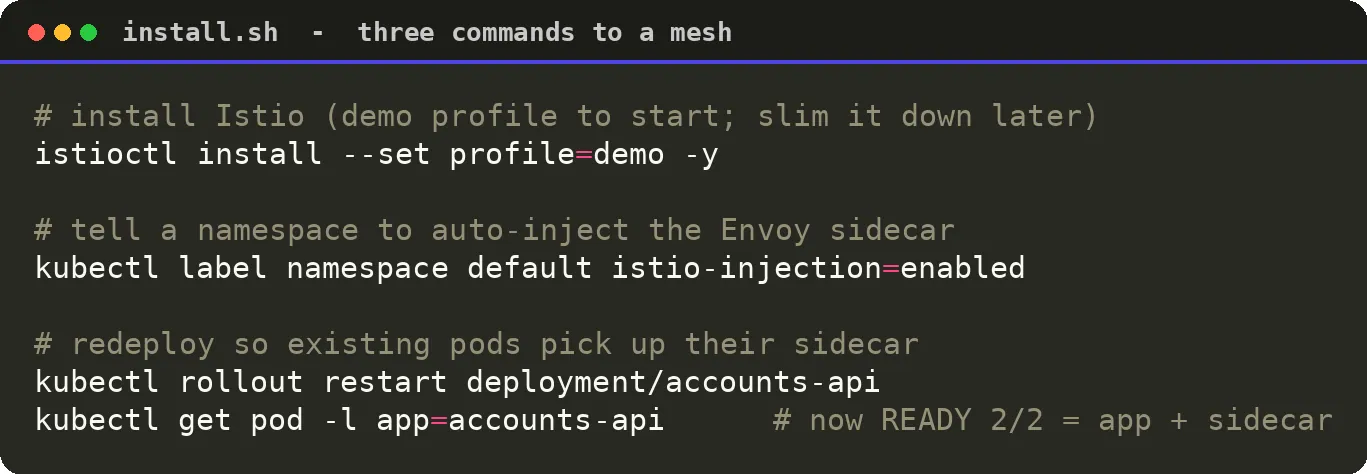
Read the last line carefully. Before the label, your pod was READY 1/1 — one container, your app. After the label and the restart, it is READY 2/2. The second container is the Envoy sidecar, injected automatically by a mutating webhook that istiod registered when you installed. You wrote no Dockerfile change, no deployment YAML change. You labelled a namespace and rolled the pods.
The label is namespace-scoped on purpose. You opt namespaces in one at a time. kube-system stays untouched. Your accounts-api namespace joins the mesh; the noisy batch namespace you are not ready for stays out. This is how you adopt a mesh in a running cluster without a big-bang cutover — namespace by namespace, verifying 2/2 as you go.
Turning on mTLS
The pods have proxies now, but a proxy that can do mutual TLS is not the same as a mesh that requires it. By default Istio runs in permissive mode: it accepts mTLS but also accepts plaintext, so nothing breaks during migration. That is the right default for rollout and the wrong default for an audit.
One resource flips it.
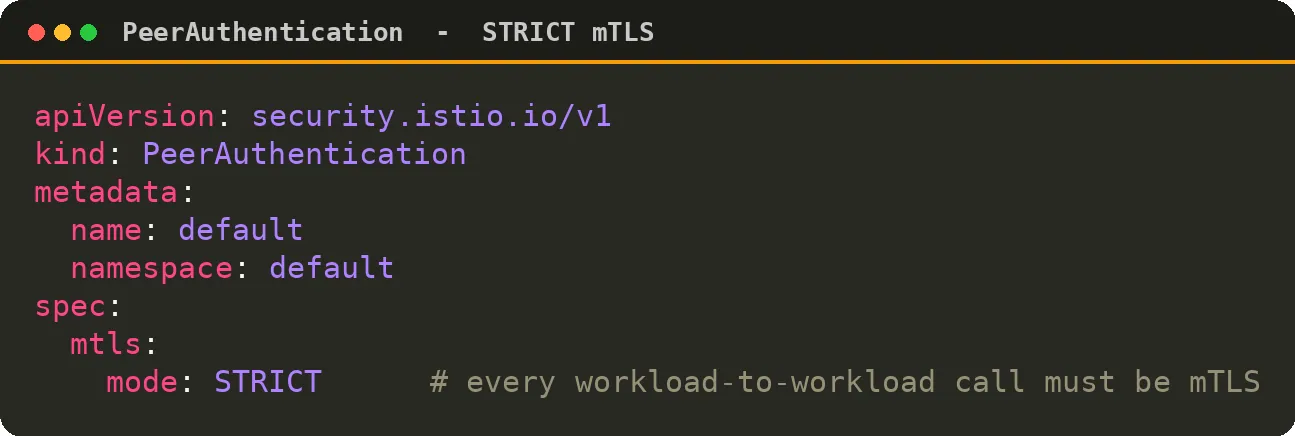
Apply that, and every workload-to-workload call in the default namespace must present a valid client certificate or the call is refused. No plaintext. No exceptions inside the namespace. The certs rotate automatically — istiod is a CA, the proxies fetch short-lived certs, and you never touch a .pfx file or a rotation cron job. That whole class of "the internal cert expired at 2 a.m." incidents disappears.
This is the first control in the series you can hand an auditor by name. PeerAuthentication in STRICT mode is a declarative, version-controlled statement that inter-service traffic is encrypted and mutually authenticated. It lives in Git. It is diffable. It is enforced by infrastructure, not by developer discipline.
Security · Audit · Integration
The honest caveat: this is the starting point, not the destination
Here is where I stop selling. The sidecar model you just stood up has a real tax, and I am not going to pretend otherwise.
Every pod now runs a second container. That is CPU and memory per pod — not catastrophic at ten services, very much noticeable at four hundred. Every request takes two extra proxy hops. Sidecars have to start before your app is ready and drain cleanly on shutdown, which complicates lifecycle and, done wrong, adds latency and flaky deploys. At scale you feel it in the cluster bill and in the p99.
Istio's answer to its own tax is ambient mode, and it is where this series lands in Article 32. Ambient rips the per-pod sidecar out. A per-node ztunnel handles L4 mTLS for every workload on that node — you get encrypted, mutually authenticated traffic nearly for free, no container injected next to your app. When you need L7 features — HTTP routing, header-based authorization, richer telemetry — you add a waypoint proxy per namespace or per service account, and only there. Fewer proxies, not none. You pay for L7 where you use L7 and nowhere else.
So run the sidecar setup. It is the fastest way to understand what the mesh does and to get a STRICT mTLS control in front of an auditor this quarter. Just hold it as a stepping stone. The destination is fewer proxies carrying less tax.
Pick this instead when…
Istio is not the only mesh, and it is genuinely more surface area than some shops need.
Linkerd — simpler, opinionated, Rust micro-proxy, famously light. Pick this instead when you want mTLS and golden-metrics observability without Istio's configuration surface, and you are confident you will never need Istio's L7 policy depth, ambient's flexibility, or its Gateway API breadth. Linkerd gets you to encrypted-by-default faster with fewer ways to shoot yourself.Cilium ambient / eBPF — meshing pushed into the kernel, sidecarless from day one. Pick this instead when the proxy tax is the dealbreaker and you are already committed to Cilium as your CNI. You trade Istio's mature policy ecosystem for kernel-level efficiency.Consul — pick this instead when your estate spans VMs and multiple runtimes as much as Kubernetes, and HashiCorp is already load-bearing in your stack. Consul's service-discovery heritage earns its keep outside pure-Kubernetes shops.Istio sidecar vs. Istio ambient — the choice inside the choice. Sidecar is battle-tested and every feature works there today. Ambient is where the efficiency story lives. Pick sidecar for a small estate you want running this week; pick ambient when proxy count is a line item someone in finance has started asking about.
If you are a BFSI shop already running Istio's Gateway API for north-south traffic, staying on Istio for east-west mesh is the low-friction call. One control plane, one policy language, one team's expertise. Fragmenting across two meshes to save a bit of overhead is a trade that rarely pays.
From simple to standard
You went from "Istio is overwhelming" to a meshed namespace with enforced mutual TLS in three commands and one YAML. That is the simple version, and it is real — those Envoys are encrypting traffic right now.
The standard version is everything the simple version quietly skipped. Slimming the demo profile to production defaults. Scoping PeerAuthentication per workload instead of one blanket namespace policy. Pairing it with AuthorizationPolicy for default-deny, so encrypted-but-unauthorized traffic still gets refused. Wiring the telemetry into your LGTM stack without exploding cardinality. And eventually, migrating the whole thing to ambient so the tax stops growing with your service count. Each of those is a deliberate step, and each earns its own treatment later in the series.
Next up, Article 6: Identity 101 — OAuth2, OIDC, and tokens. The mesh proved which workload is calling. It said nothing about which human is behind the request. That is a different identity problem, it is where Entra ID enters the story, and every BFSI auditor cares about it at least as much as they care about mTLS.
Key skills & topics in this article
IstioService meshAmbient meshmTLSKubernetes.NET & C#AuthorizationPolicy
Also on LinkedIn.