Sidecar to ambient — what gets cheaper, what just moves house
The Mesh Series · Article 32
Ambient meshService meshMicrosoft Entra IDmTLSAuthorizationPolicyCompliance evidenceAudit loggingGitOps
Since Article 5 this series has run on one assumption: a proxy in every pod. That is the sidecar model, and it works — but you pay for it per pod, in memory, in CPU, in the restart dance every time you upgrade Envoy, in the startup race where your app comes up before its sidecar is ready. Istio's ambient mode is the answer to that tax, it has been generally available since v1.24, and by the 1.30/1.31 line it is a production-ready thing you can actually migrate a regulated workload onto.
But the pitch you will hear — "sidecarless mesh, zero downtime" — is half true in a way that matters enormously for a regulated cluster. Ambient does not remove the proxies. It removes most of them and shares the rest. And the "zero downtime" promise holds at Layer 4 and breaks at Layer 7 — which, for a workload whose whole point is enforcing Entra identity at L7, is exactly the layer you care about.
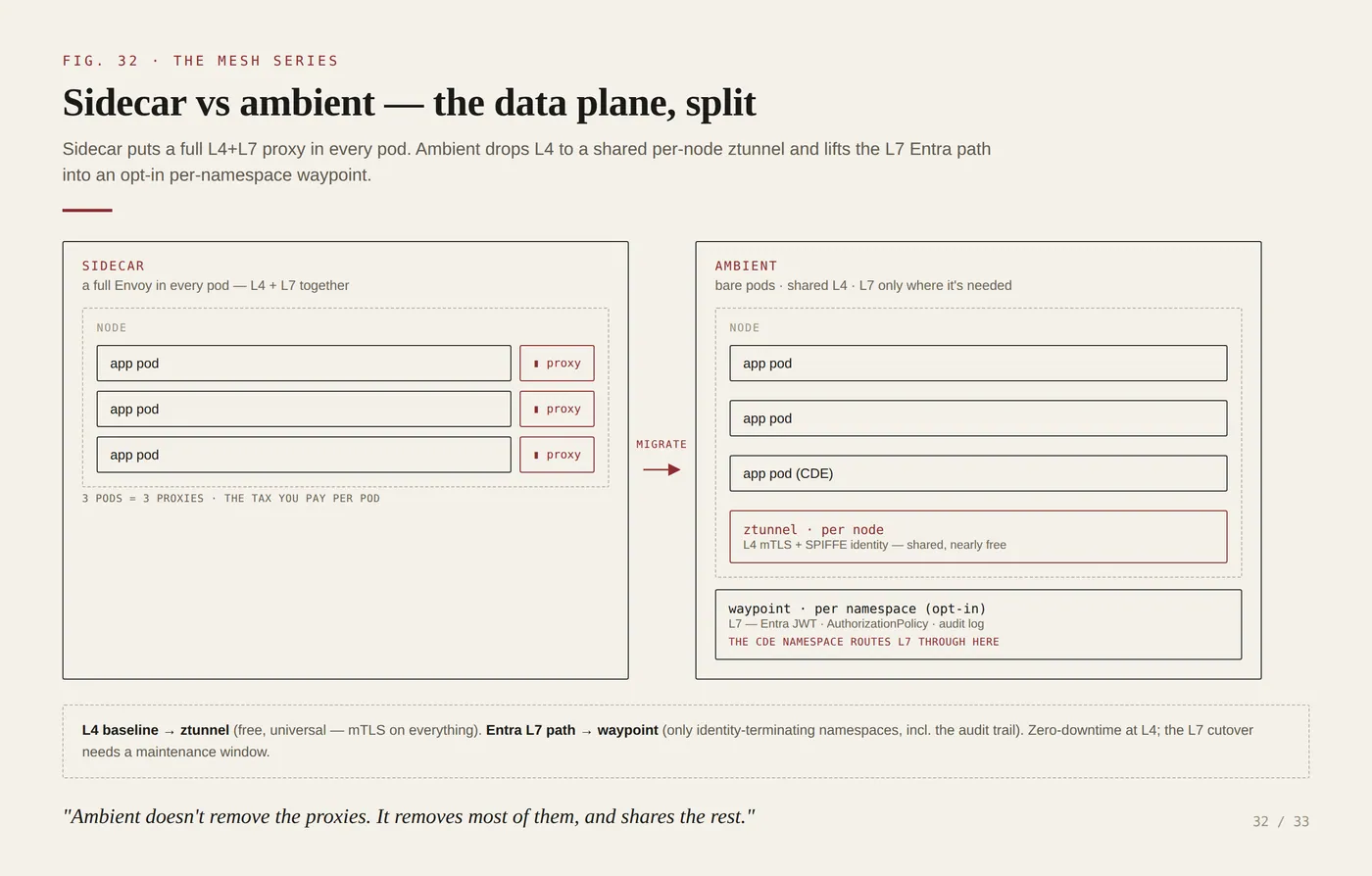
Read the split on the right. The L4 baseline — mutual TLS, workload identity — drops down to ztunnel, one per node, shared by every pod on it. The L7 work — Entra JWT validation, HTTP-aware authorization — moves up into a waypoint, one per namespace, and only for the namespaces that need it. Fewer proxies, not none.
Why this matters, and why the honesty matters more
The sidecar tax is not imaginary. Every meshed pod carries an Envoy: real memory and CPU multiplied across every replica of every service, an Envoy version coupled to your pod lifecycle so a data-plane CVE patch means rolling every workload, and the perennial init-order problem where traffic beats the proxy at startup. For an institution running a large fleet, that overhead is the reason someone eventually asks whether mTLS-on-everything is "worth it" — which is the wrong question to ever have to ask about your zero-trust baseline.
Ambient's real win is that it makes the L4 baseline nearly free. ztunnel runs per node, not per pod, so mutual TLS and SPIFFE identity — Requirement 4, Article 14, the encryption-in-transit control every framework in Articles 29 and 30 demanded — stops costing a proxy per workload. That is not just an efficiency gain; it is what lets you turn mTLS on for everything instead of only the services someone remembered to inject. Universal beats selective when an auditor asks "is all internal traffic encrypted?"
Now the honesty. Istio's own migration guidance states it plainly: if you have L7 policies, zero-downtime migration is not currently possible. There is a window, during the cutover, where L7 policies are unenforced. For a general web app that is an operational footnote. For a cardholder-data workload, an interval where your Entra RequestAuthentication and your L7 AuthorizationPolicy are not enforcing is a control-failure event — the exact thing Article 28 taught you to detect and Article 29 has to prove to a QSA. The migration is not hard. Doing it without opening a compliance gap is the part nobody budgets for.
How it comes together
Everything the series built still applies; some of it just changes address.
ztunnel carries the L4 story. It establishes mutual TLS between workloads over HBONE — an HTTP/2 CONNECT tunnel on port 15008 — using the same SPIFFE identities from Article 14. PeerAuthentication in STRICT mode and L4 AuthorizationPolicy (allow by principal, by namespace) are enforced here, per node, for free. If a namespace only ever needed L4 — service A may talk to service B, encrypted, and nothing finer — it needs no waypoint at all. That is the majority of most clusters, and migrating those namespaces genuinely is zero-downtime.
The waypoint carries the L7 story, and this is where Article 13's foreshadow finally lands. Back then the note was: under ambient, the in-code-versus-mesh validation tension resolves because the mesh's L7 checks move into a waypoint. Here it is. Your Entra RequestAuthentication (Articles 11–12), your L7 AuthorizationPolicy with HTTP method and path and scope conditions (Articles 16, 18) — these attach to a waypoint proxy, deployed per namespace through the Gateway API, and only for the namespaces that terminate user identity. Your CDE namespace gets a waypoint. Your internal L4-only plumbing does not.
There is one more thing that moves address, and it is easy to miss: your audit logging. The rich L7 access logs from Article 24 — the ones carrying the SPIFFE peer, the Entra request principal, the verdict, the response flags, everything that made the log evidence rather than noise — are produced by the L7 proxy. Under ambient, ztunnel emits L4 telemetry (who connected to whom, encrypted), but the identity-annotated L7 record comes from the waypoint. So for any namespace where Requirement 10 wants "every access tied to a user," a waypoint is not optional — it is the thing generating your audit trail. Migrate a CDE namespace to ambient without a waypoint and you have quietly downgraded your access logging from evidence to connection metadata. That is a subtle way to fail an audit while every dashboard stays green.
So the sidecar tax becomes a waypoint tax: real, but smaller and shared — one proxy per namespace instead of one per pod — and concentrated exactly where the regulated L7 enforcement and the L7 audit trail both live. That is a genuinely better shape for a bank's cluster, where identity enforcement is dense in a few namespaces and most east-west traffic just needs to be encrypted.
From map to code
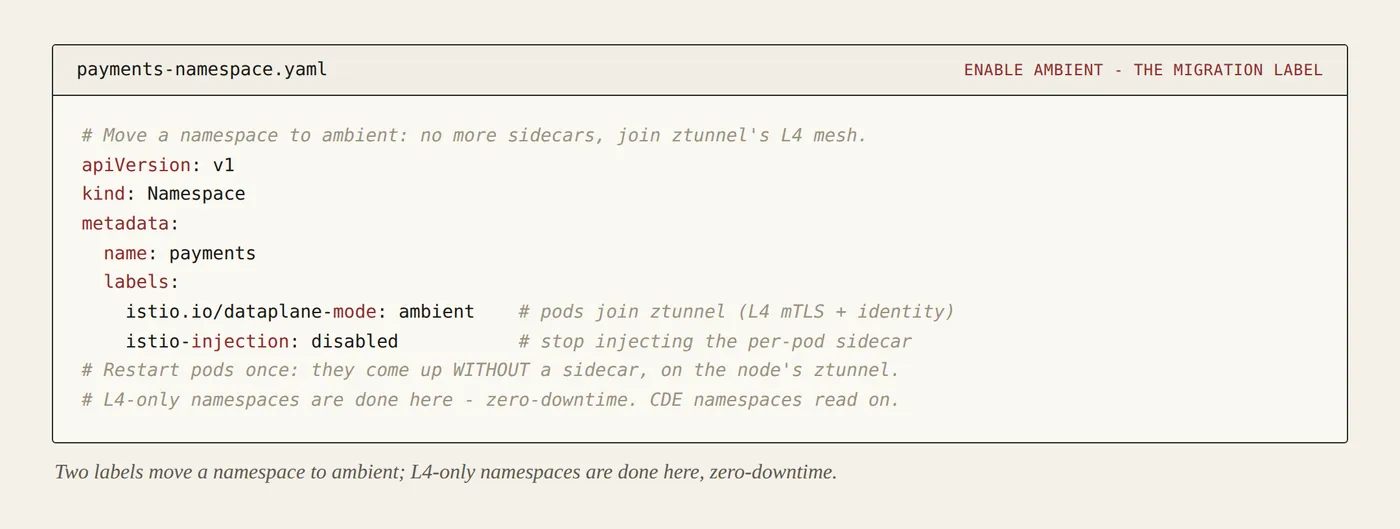
Migrating a namespace to ambient is two label changes — stop injecting sidecars, join the ambient data plane:
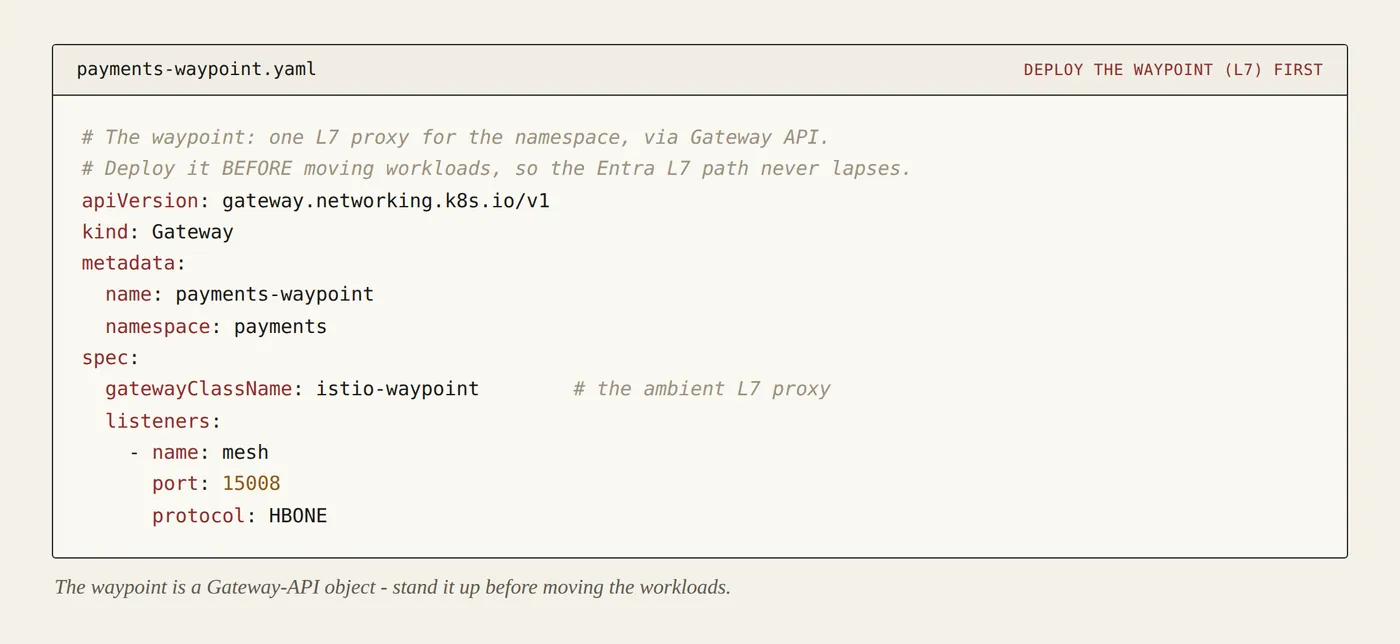
For any namespace that enforces the Entra L7 path, deploy a waypoint before you move the workloads, so L7 never lapses. The waypoint is a Gateway-API object:
Then re-home the Entra L7 policies onto the waypoint with a targetRef — the same rules from Articles 12 and 16, now attached to the waypoint instead of riding in each pod's sidecar:
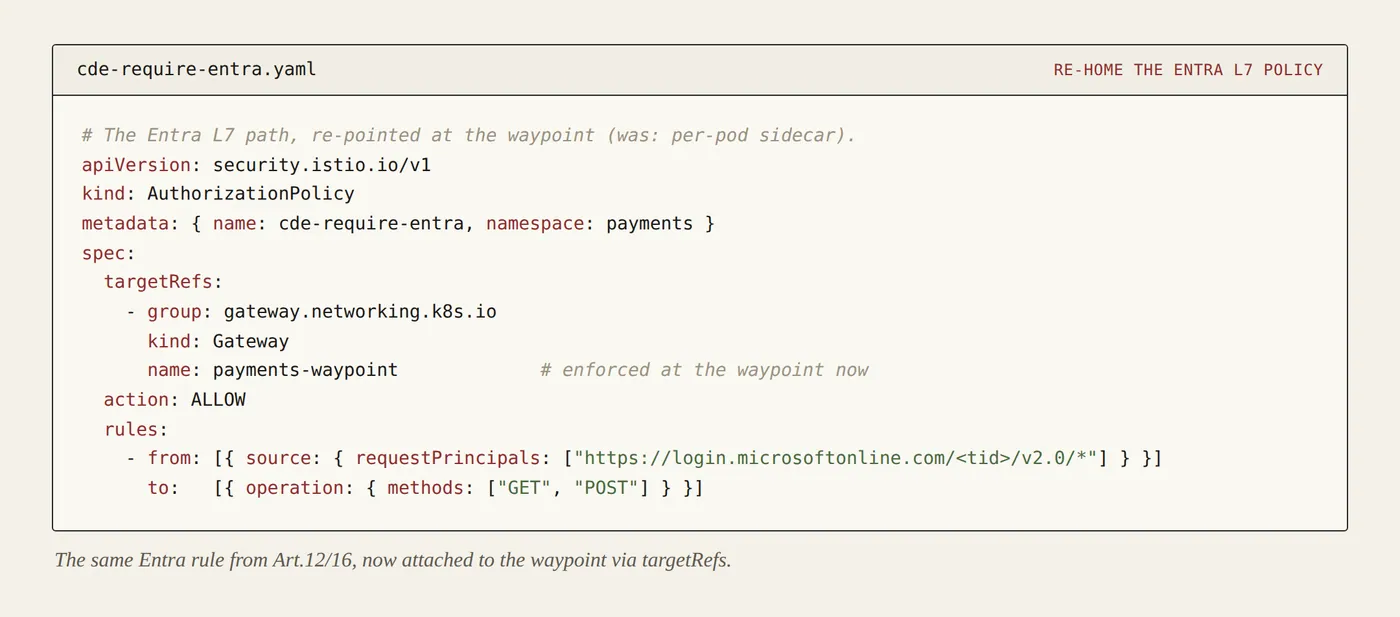
The ordering is the whole regulated discipline: waypoint up, L7 policy attached and verified, then flip the namespace label and restart. Even so, cut over the CDE namespace in a declared maintenance window, and lean on the in-code JWT validation from Article 13 as the backstop that holds the line if the mesh L7 lapses for a beat. That in-code check was insurance for years; during this migration it is the insurance that pays out.
Security · Audit · Integration
Security property. Ambient makes the zero-trust L4 baseline cheap enough to be truly universal — mTLS and workload identity on every pod on every node, not just the ones that got injected. Cheaper controls get applied more completely, and completeness is a security property in its own right.
Audit evidence. The migration itself is a change to a security control's enforcement, so it belongs in the Article 31 GitOps loop: the namespace labels, the waypoint, and the re-homed policies are reviewed commits, and the maintenance-window cutover is a recorded, authorized change — the enforcement gap becomes a documented, bounded event rather than a silent one. That is the difference between a finding and a footnote.
Integration. This is where the L4/L7 split the series kept flagging (Articles 5, 13, 22) becomes concrete: identity and encryption at ztunnel, the Entra path at the waypoint, everything still delivered and recorded through GitOps. Same controls, better-shaped data plane.
Alternatives, and when to stay put
Stay on sidecars. Not a failure — a fit. Choose this when your L7 needs are heavy and per-pod: extensive WebAssembly or Lua extensions, per-pod traffic shaping, or a dependence on features still maturing in ambient (VirtualService support is alpha there as of 2026). If nearly every namespace needs a waypoint anyway, the ambient win shrinks toward zero and the sidecar's per-pod isolation may be simpler to reason about.
Cilium's sidecarless mesh. The eBPF-native path: L4 identity and encryption in the kernel datapath, Envoy brought in only for L7. Choose this when you are already all-in on Cilium as your CNI and want one data plane for network policy and mesh. The trade is coupling your mesh to your CNI; Istio ambient keeps them separable.
Linkerd. Still a sidecar model, but a deliberately minimal Rust micro-proxy rather than Envoy. Choose this when the sidecar tax you actually feel is Envoy's weight and complexity, not the per-pod model itself, and your L7 and policy needs are modest. You keep a proxy per pod; it is just a much smaller one.
The honest decision rule: ambient wins cleanly when most of your traffic is L4 and your L7 enforcement is concentrated in a few identity-terminating namespaces — which is precisely the regulated-workload shape this series has assumed throughout.
From one namespace to the standard
The toy migration is one L4-only namespace: label it, restart, done — a free, zero-downtime win you can do this week to feel ambient work. The industry-standard version is the sequenced rollout: L4-only namespaces first, then each identity-terminating namespace waypoint-first inside a maintenance window, every step a reviewed GitOps commit, the in-code check backstopping each L7 cutover, and the whole sequence producing signed evidence (Article 27) that enforcement was continuous or that any gap was bounded and authorized. Single-cluster first — ambient multicluster still restricts you to multiple-primary topologies, so cross-cluster federation stays a year-two problem, exactly as the series scoped it.
Which brings the whole thing home. You have the controls, the proof, the framework maps, the delivery loop, and now a data plane that makes the baseline nearly free. Next up, the capstone: the complete audit-ready reference architecture — ambient-first, passwordless, default-deny, continuously proven — assembled from all thirty-two pieces into one picture, with the sidecar-and-secrets variant kept only as the documented fallback.
The ambient migration everyone frames as an efficiency project is, in a regulated cluster, a control-continuity project. If you've done it — or decided not to — I'd like to know which consideration actually drove the call: the cost saving, the L7 gap, or something operational I'm not weighting enough.
Key skills & topics in this article
Ambient meshService meshMicrosoft Entra IDmTLSAuthorizationPolicyCompliance evidenceAudit loggingGitOps
Also on LinkedIn.