The reference architecture — thirty-two pieces, one system
The Mesh Series · Article 33
Ambient meshCompliance evidenceMicrosoft Entra IDAuthorizationPolicyPasswordlessDrift & postureIstiomTLS
Thirty-two articles ago this series opened on a mess: web applications moving to Kubernetes, losing the Windows-integrated auth they got for free, and turning into a distributed monolith held together with auth tokens and prayer. Every article since has added one piece — one control, one proof, one map. This is the article where the pieces stop being a list and become a single picture: an audit-ready, regulated .NET platform on Kubernetes, Istio, and Entra ID that a bank in Mumbai or Riyadh can run and defend.
It was never thirty-two features. It was one system, revealed one piece at a time.
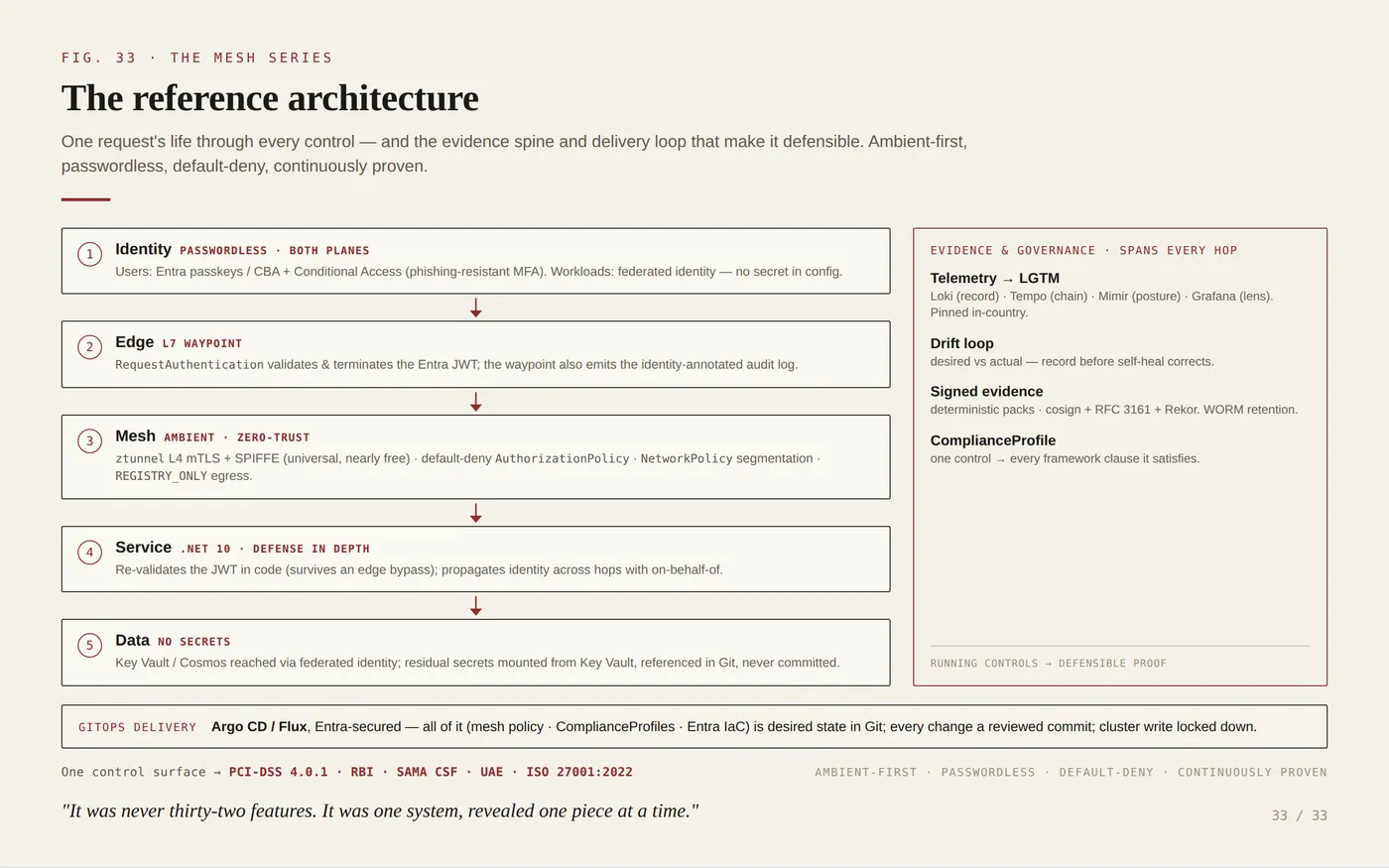
Read the picture as a request's life. It arrives carrying a passwordless, phishing-resistant identity. It is validated and terminated at an L7 waypoint. It crosses a mesh where every hop is mutually authenticated at L4 for free and authorized by default-deny at L7. It reaches a .NET service that re-validates it rather than trusting the edge. It touches data through a federated identity with no secret to leak. And at every step it leaves a signed, identity-annotated, in-country trace — which a drift loop watches, a signing job attests, and a framework map makes legible to four regulators at once. The whole thing is delivered and version-controlled through GitOps.
That is the destination. The honest part — the part that makes it real rather than a diagram — is that almost nobody starts here. You climb to it.
What "audit-ready" actually means
For a regulated institution, the gap this architecture closes has a name the series has used throughout: the demo-to-audit gap. Anyone can stand up mTLS in a demo. Proving mTLS held on every hop, for every request, across an audit window, with the evidence stored in the right country and signed so an operator could not have edited it — that is the second job, and it is the one nobody budgets for.
The reference architecture is what closing that gap looks like at every layer simultaneously. Encryption in transit is not a checkbox; it is ztunnel mutual TLS on every pod, provable by an inspectable SPIFFE identity. Access control is not a policy document; it is a default-deny AuthorizationPolicy you can query. "Every access tied to a user" is not a hopeful log statement; it is a waypoint access record carrying the Entra principal and the verdict, retained in-country for the longest duration any framework in scope demands. And "the control kept operating" — the thing SAMA's maturity model grades and a point-in-time screenshot can never show — is a continuous posture series and a drift loop that records before it corrects.
Stack the frameworks from Articles 29 and 30 against this picture and they stop being four programs. PCI-DSS 4.0.1, the RBI directions, SAMA's CSF, the UAE regulators, ISO 27001:2022 — they ask for the same handful of technical properties in different words, and this architecture provides each property once, as a primitive you can point to, with evidence generated as a byproduct. The frameworks diverge only on where the proof lives, how often you show it, and how fast you report a breach — and those three axes are configuration on the evidence store, not a redesign.
Walking the architecture
Identity, both planes, passwordless. Users arrive through Entra with passkeys, certificate-based auth, and Conditional Access enforcing phishing-resistant MFA — the RBI 2025 direction of travel, not gold-plating. Workloads carry federated identity: a projected token exchanged for an Entra token, no client secret anywhere in config. The credential sprawl the series opened on is gone because there is almost nothing left to steal. That is the passwordless destination, delivered.
The edge, and the L7 waypoint. User identity is validated and terminated at the ingress, and under an ambient data plane the Entra L7 path — RequestAuthentication, the JWT checks — lives on a waypoint proxy for the namespaces that terminate identity. The waypoint is also where the identity-annotated audit log is produced, so it is not optional for a cardholder-data namespace: it is the thing generating your Requirement 10 evidence.
The mesh, ambient-first. ztunnel gives every workload mutual TLS and a SPIFFE identity at L4 — per node, nearly free, which is what lets the encryption baseline be universal instead of selective. Default-deny AuthorizationPolicy at L7, NetworkPolicy at L3/L4, and REGISTRY_ONLY egress compose into zero-trust that holds at every layer and satisfies both the mesh-policy control and the network-segmentation control an assessor tests separately.
The service, defense in depth. The .NET 10 service does not trust the edge. It re-validates the Entra JWT in code — the backstop that survives an edge bypass and holds the line during an ambient L7 cutover — and propagates identity across hops with on-behalf-of, so a call chain carries the real user to the last service and the audit trail reconstructs who did what.
The data, no secrets. The service reaches Key Vault, Cosmos, and the rest through the same federated identity. The residual secret that cannot be federated away is mounted from Key Vault, referenced by name in Git, never committed. There is nothing in config to rotate, and nothing in the repo to leak.
Evidence and governance, the spine. Every hop emits telemetry to a self-hosted LGTM stack pinned in-country: Loki for the record, Tempo for the causal chain, Mimir for the continuous posture, Grafana as the read lens that proves nothing on its own. A drift loop compares desired to actual and records every delta before self-heal corrects it. A signing job turns deterministic evidence packs into cosign-signed, timestamped, transparency-logged artifacts. And the ComplianceProfile maps each control to every framework clause it satisfies. That spine is what turns running controls into defensible proof.
Delivery, GitOps. All of it — mesh policy, ComplianceProfiles, Entra-as-IaC — is desired state in Git, reconciled by an Entra-secured Argo or Flux, where every change is a reviewed commit that doubles as the change-management record. Git is the source of truth, and cluster write access is locked down so nothing can write around it.
The assembled baseline, in code
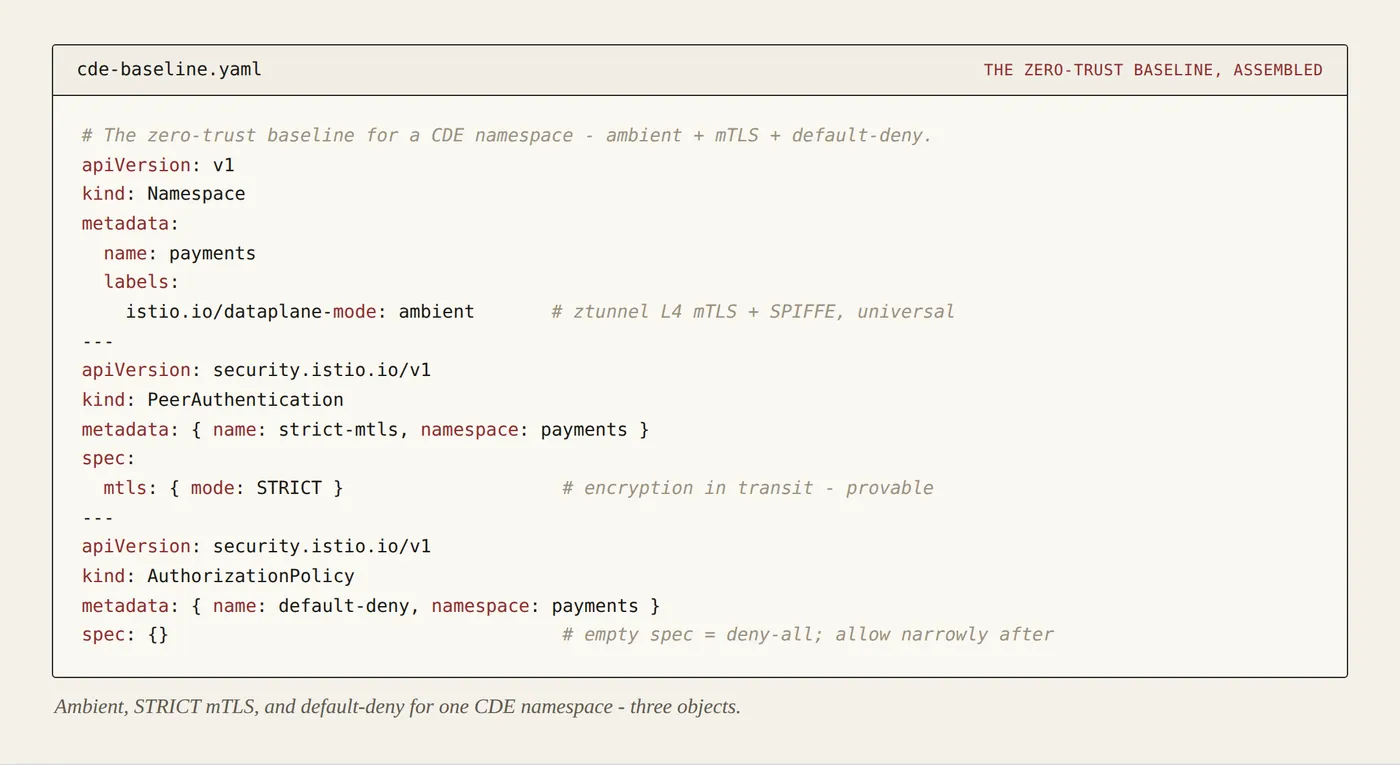
The whole zero-trust baseline for one namespace is smaller than the article count suggests — ambient, STRICT mTLS, and default-deny in one reviewed manifest:
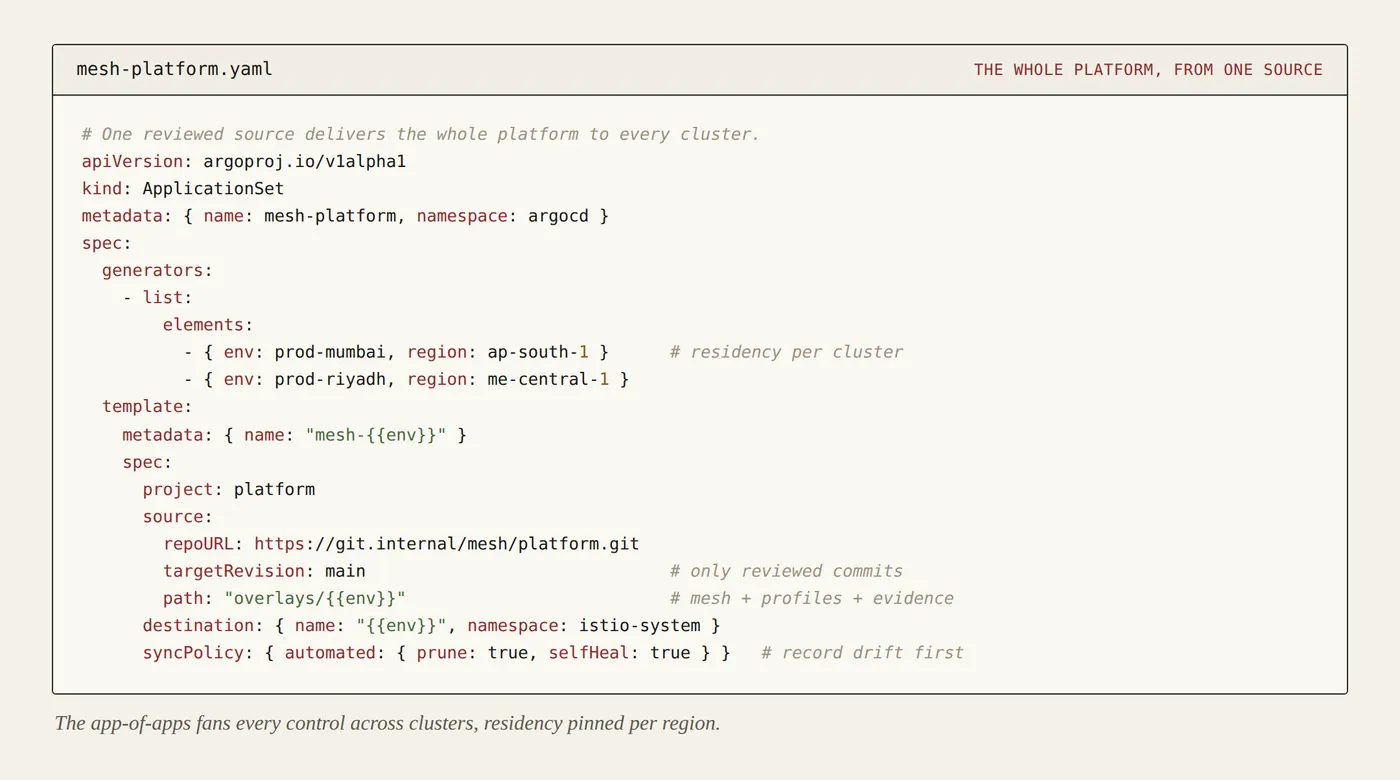
And the whole platform is delivered from one reviewed root — the app-of-apps that fans every control across environments and pins residency per cluster:
Security · Audit · Integration
Security property. Zero trust that holds at every layer at once — identity, encryption, authorization, segmentation, egress — with the credential removed rather than managed. No single control is load-bearing alone; the depth is the point.
Audit evidence. Every control emits signed, identity-annotated, in-country evidence continuously, and the ComplianceProfile makes one evidence pack answer four regulators. The demo-to-audit gap is closed not at audit time but as a byproduct of running.
Integration. This is the integration. Thirty-two articles of separate features resolve into one request path where each control fires in sequence and each leaves proof — assembled, delivered, and version-controlled as a single system.
Build versus buy — the honest investor question
If every component here is open source, why can't a hyperscaler sell it to you as a checkbox? Sit in the investor's chair for a moment, because it is the right seat for a capstone.
The "cloud-native compliance" checkbox. Every hyperscaler offers compliance dashboards and posture tooling, and they are genuinely useful for the account-and-resource layer. They do not give you this. They do not enforce your in-cluster L7 identity, they do not produce a signed per-control evidence pack mapped to RBI and SAMA, and — the specific 2026 reality — the managed AKS Istio add-on does not even support ambient yet; it is sidecar-only, with ambient on the roadmap. Ambient-first on AKS today means self-managed Istio, which is a real trade: you take on data-plane lifecycle in exchange for the architecture. That gap is exactly why this is not a checkbox.
A commercial mesh-and-compliance product. Solo, Tetrate, and the GRC vendors will sell you large pieces of this, and for a team without the platform muscle to run self-managed Istio and a signing pipeline, buying is often the right call — the burn of building and operating this yourself over eighteen months is not small, and it is engineering cost locked in against a runway. Buy when your differentiation is your banking product, not your mesh. Build when the assembly itself — the specific mapping of your controls to your regulators with your residency — is something no vendor packages for your jurisdiction, which for India-plus-Gulf institutions is more often than the vendors admit.
The moat, stated plainly. The moat was never Istio, or Entra, or cosign — those are commodities, and should be. The moat is the assembly and the discipline: the specific composition that closes the demo-to-audit gap for a specific set of regulators, and the operational rigor to prove it keeps holding. That is the thing you cannot download, and the thing a hyperscaler cannot commoditize in eighteen months, because it is not a product — it is an architecture and a practice.
Where to start, and a close
You do not build this greenfield in a quarter. You climb to it, and the order matters. Turn on mesh mTLS first — the L4 baseline is the cheapest win and the one every framework rewards. Then default-deny, one namespace at a time, and watch what screams. Then the identity plane: Entra at the edge, federated identity for workloads, the credential sprawl retired. Then the evidence layer, because a control you cannot prove is a control you do not really have. Then the framework map, then GitOps to enforce it all from a reviewed source, and only then — once the controls are boring and the evidence is automatic — the ambient migration to make the baseline nearly free. Sidecar and secrets stay documented as the fallback for the cases that still need them. A reference architecture is a direction, not a destination you arrive at once.
That is the series. Thirty-three articles from "why a regulated enterprise can't ignore the service mesh" to a complete, defensible platform — Kubernetes, Istio, C#/.NET, and Entra ID treated not as four learning curves but as one zero-trust, provably-auditable, passwordless system. The companion repository holds the runnable version of every piece; check out the tag for any article and you can run it.
If you have read this far across the whole arc: thank you. Build the baseline this week. Prove it next week. And when the auditor asks, point at the running cluster — not the binder.
Thirty-three articles in, the question I keep coming back to isn't technical. It's this: in a regulated shop, what stops teams from ever reaching this architecture — is it the engineering, the audit relationship, the budget, or the org will to hold the discipline? I have my guess. I'd rather hear yours.
Key skills & topics in this article
Ambient meshCompliance evidenceMicrosoft Entra IDAuthorizationPolicyPasswordlessDrift & postureIstiomTLS
Also on LinkedIn.