DORA for platform engineers — what the Act actually asks of your cluster
The Mesh Series · Article 34
You have spent thirty‑three articles building one system: a regulated .NET platform on AKS, Istio and Entra, where every request is authenticated, authorised, encrypted and logged, and where the logs are signed and the posture is watched. You built it for auditors in Mumbai and Riyadh.
Now the same platform has to answer to Vienna.
DORA — the Digital Operational Resilience Act, Regulation (EU) 2022/2554 — has been in force since 17 January 2025. If you sell software to an Austrian bank, insurer or payment firm, or if you are their critical ICT provider, DORA is already the frame your architecture is judged in. And here is the thing nobody tells the platform engineer: DORA is not a new set of security controls. You almost certainly have the controls. DORA is a proof obligation.
One idea: DORA asks the running system to demonstrate five things
Strip away the ninety articles and the five regulatory technical standards, and the ICT risk‑management framework at the heart of DORA (Articles 5–15) asks your platform to exhibit five capabilities, continuously, and to prove it:
- Govern it (Art. 5) — the management body owns ICT risk. Not the CISO's problem; the board's.
- Identify what you have (Art. 8) — assets, dependencies, the functions they support.
- Protect it (Art. 9) — access control, encryption, segmentation, hardening.
- Detect anomalies (Art. 10) — you notice when something is wrong, promptly.
- Respond and recover (Art. 11–12) — you contain, restore, and keep serving.
Then Article 13 closes the loop: you learn and you evolve.
Read that list again as a platform engineer. Protect is PeerAuthentication STRICT and default‑deny AuthorizationPolicy. Detect is the Istio Telemetry access log and the drift loop. Respond and recover is your GitOps rollback and your backup story. You have been building the DORA ICT risk‑management framework since Article 14 of this series. You just called it "the mesh".
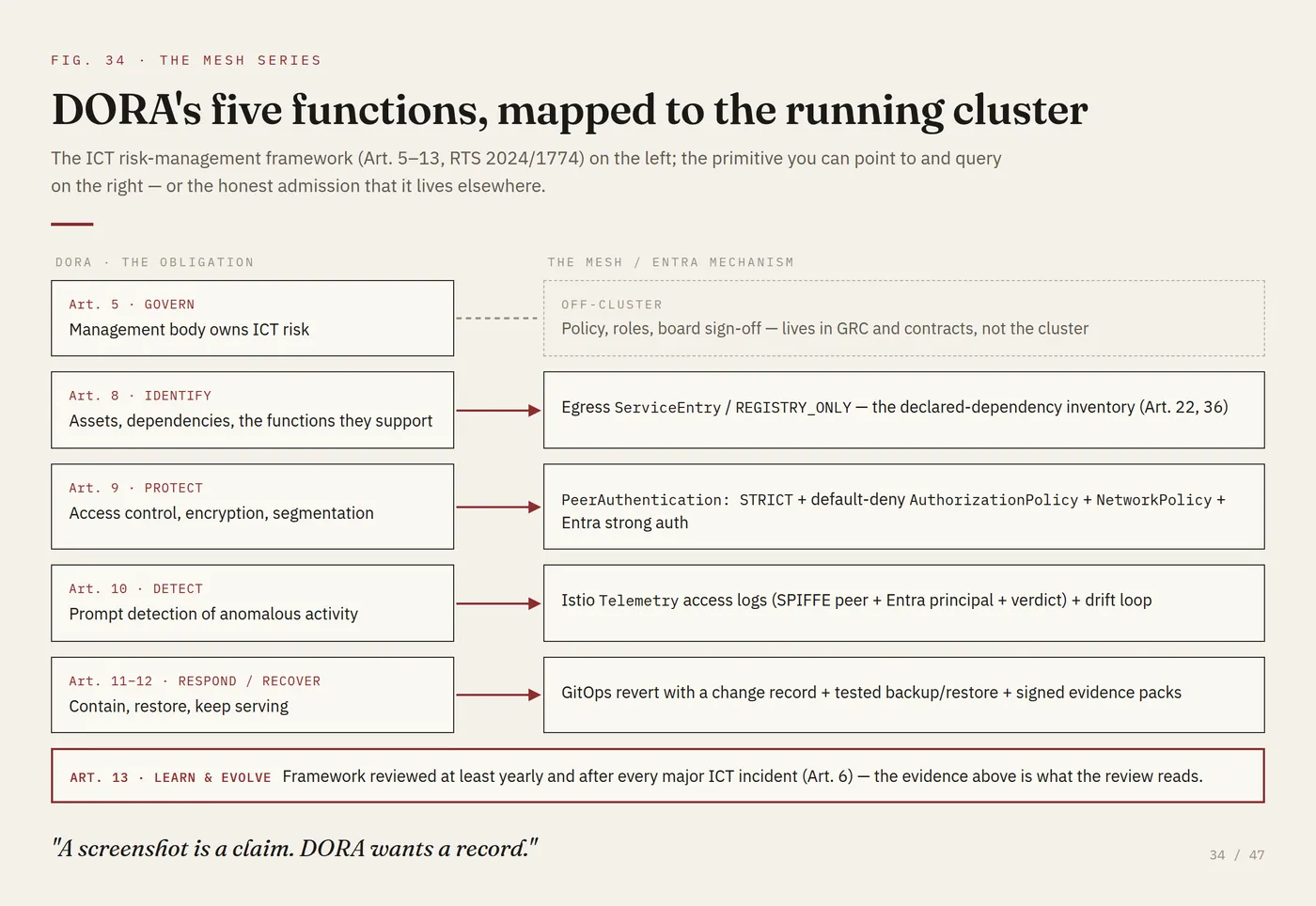
The dashed box matters as much as the solid ones. Governance is real, mandatory, and it does not live on your cluster. Say that out loud in the first meeting and you will be the most credible person in the room.
Why it matters: the Act moved the burden of proof onto you
Before DORA, an Austrian financial institution demonstrated operational resilience mostly on paper, to its own auditors, on its own schedule. DORA changes three things that land directly on the platform.
First, it is a regulation, not a directive — it applies uniformly across the EU with no national transposition to wait for. The FMA in Austria supervises it; the European Supervisory Authorities set the technical standards. There is no "we're still interpreting it locally" grace.
Second, the burden of proof inverted. Article 6(2) requires the ICT risk‑management framework to be documented and reviewed at least yearly, "as well as upon the occurrence of major ICT‑related incidents." Article 10 requires prompt detection of anomalous activities. This is the demo‑to‑audit gap written into law: it is no longer enough that mTLS is on; you must be able to show that it was on, for this workload, during that window, to a supervisor who was not in the room.
Third, it reaches your ICT providers. DORA's third‑party regime (Articles 28–30, and the whole Chapter V oversight machinery) means that if you supply a regulated entity, their DORA obligations become your contractual ones. For a consultant building AKS platforms for DACH banks, that is not a compliance cost. That is the market.
The trap most teams walk into: they hear "resilience" and reach for a GRC platform. They buy a tool that stores control descriptions and schedules attestations. Then the supervisor asks the Article 10 question — show me you detected the anomalous access — and the answer is a policy PDF and a screenshot of a dashboard. A screenshot is a claim. DORA wants a record.
How it comes together: the mesh is the evidence substrate
Here is the integration story, and it is the whole reason Season 1 was worth building. DORA does not ask you to bolt on a compliance layer. It asks you to make the platform you already run produce evidence as a side effect of operating.
Map the framework to primitives you already deployed:
- Art. 9(4) protection — DORA and RTS (EU) 2024/1774 spell out ICT security policies covering access management, cryptography and network security. Your
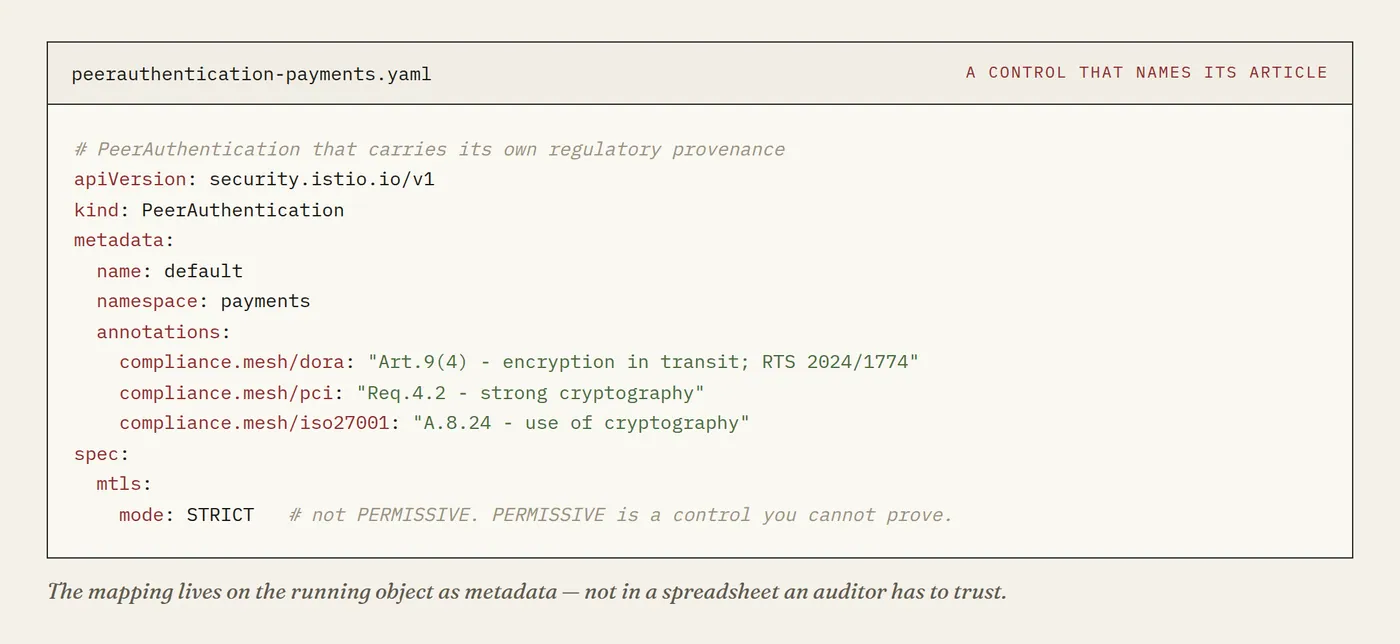
PeerAuthenticationSTRICT gives you encryption in transit; your default‑denyAuthorizationPolicyplusNetworkPolicygives you least‑privilege access and segmentation; your Entra passkeys and workload federation give you strong authentication. Three RTS clauses, three running resources. - Art. 10 detection — the Istio
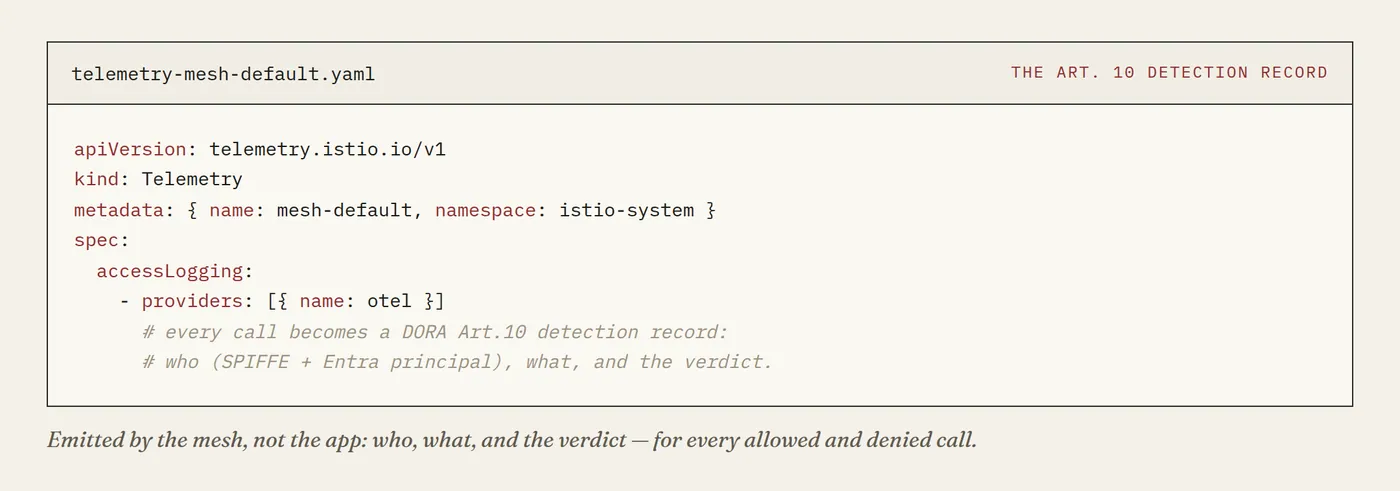
Telemetryaccess log, with SPIFFE peer identity and the Entra request principal inlogFormat.labels, is the detection record. Every allowed and every denied call, with who and what and the verdict. - Art. 11–12 response and recovery — GitOps means your recovery is a revert with a change record, not a heroic afternoon. Your backup‑and‑restore story (Art. 12) is testable, and DORA will ask you to test it.
The mesh does not make you DORA‑compliant. It makes the Articles that live in the data path provable with a query instead of a screenshot, and it makes the honest gap list for the rest — governance, third‑party contracts, board reporting — shorter and clearer. That distinction is the one that separates an engineer who has read the Act from a vendor who has skimmed it.
Show the config: a control that names its DORA article
The cheapest, highest‑leverage move is to make each control state which obligation it satisfies, so the mapping is not a spreadsheet an auditor has to trust — it is metadata on the running object.
And the detection record DORA Art. 10 wants, emitted by the mesh, not the app:
In C#, the same discipline reaches the service. A DORA framework is only as good as the anomaly it surfaces, and the anomaly you most need is the control that failed quietly — so log the raw failure, not the friendly message:
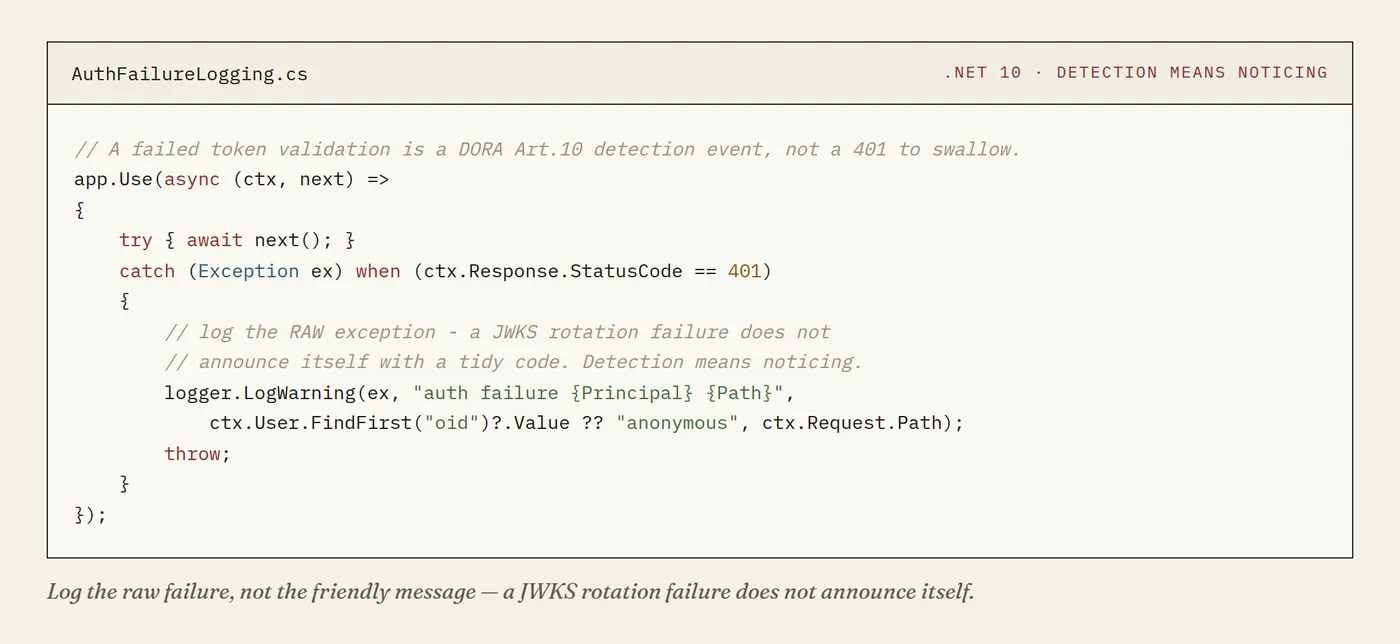
That .NET 10 middleware is not glamorous. But it is the difference between "we detect anomalies" as an assertion and as a log line with a timestamp.
Security · Audit · Integration
Security: the framework's protect function is enforced in the data path — STRICT mTLS, default‑deny, strong auth — not asserted in a document.
Audit: every control carries its DORA article as an annotation, and every access produces a detection record. The mapping is queryable, not narrated.
Integration: governance and third‑party obligations stay explicitly off the cluster, in GRC and contracts, so the boundary between "the mesh proves this" and "the programme owns this" is drawn honestly.
Alternatives, and when you'd pick them
A GRC platform (Vanta, Drata, and the DORA‑branded tools). Genuinely useful — for the half of DORA that is programme, policy, third‑party register and board reporting. But a GRC tool files evidence; it does not produce it. It cannot answer the Article 10 question from live traffic. Pick it to run the programme; do not pretend it covers the data path.
A consultancy readiness checklist. Fine as a gap assessment on day one. Worthless as continuous proof on day ninety — DORA Art. 6 wants the framework reviewed on incidents, not annually in a binder.
Do nothing and rely on your existing SIEM. Defensible if your SIEM already captures identity‑bearing, per‑request records with retention and residency that satisfy the supervisor. Most don't — they capture host and network events, not "which authenticated principal was denied which call". That is exactly the gap the mesh fills.
From simple to standard, and what's next
The toy version is one annotated PeerAuthentication. The industry‑standard version is every control in the reference architecture carrying its DORA article, feeding one signed evidence pack per control window, so that "show me your ICT risk‑management framework" is answered by pointing at the running cluster and a query — not by emailing a 200‑page PDF and hoping.
DORA is the substrate. But it is not the only European rulebook your platform answers to, and the next one comes with personal liability for the people who sign off on it. Next: **NIS2 and the Austrian NISG 2026 — when the platform is the compliance measure, and the board is on the hook.**
Next in the series: NIS2 and the Austrian NISG 2026. Earlier: Art. 29 (PCI‑DSS on the mesh), Art. 30 (regional frameworks), Art. 24–28 (the evidence layer this article leans on).
Key skills & topics in this article
Also on LinkedIn.