Shipping continuous evidence as a product — a report is something you send; evidence is something an auditor comes and takes
The Mesh Series · Article 45 · Part H
Compliance evidenceSupply-chain signing.NET & C#Kubernetes operatorsMicrosoft Entra ID
The ComplianceProfile status says Satisfied. It is signed. It is in the cluster. An external auditor from the FMA's appointed firm arrives, and the first thing she does is decline the dashboard, decline the kubectl session, and ask for the evidence pack for the payments namespace for 14 March — as it was on 14 March, not as the cluster remembers it today — with proof that it has not changed since and proof of when it was produced.
You can generate that. The question is whether you can hand it over.
One idea: a report is something you send; evidence is something an auditor comes and takes
A report is a document you assemble and deliver. Its credibility is yours. Evidence is different in kind: it is a record whose source, integrity, time and custody can each be checked without taking your word for any of them. The whole of Part D and Part H has been building towards that distinction, and this article is where it becomes a thing someone can be retained to operate.
Evidence has a supply chain of four links, and each link is a separate mechanism that fails on its own:
SOURCE — the producers. The operator's signed status (Articles 43–44), Gatekeeper's audit status (Article 21), Envoy's identity‑labelled access logs (Articles 24/26). If a producer goes silent, there is no evidence, however healthy the rest of the chain looks.
INTEGRITY — a cosign v3 signature over the pack. Tamper‑evident: change a byte and verification fails. It does not stop anyone changing the byte.
TIME — an RFC 3161 timestamp from a timestamp authority. The claim "this existed at 09:41 on 14 March" has to come from a clock that is not yours.
CUSTODY — a write‑once store the pack cannot be removed from until the retention clock expires. S3 Object Lock in Compliance mode, in region: not even the root account can shorten it. Tamper‑resistant, which is the property a signature cannot give you.
A CronJob that runs cosign sign-blob owns one link — generation — and is blind to the other three. It does not notice that the TSA has been unreachable since Tuesday, that the producer it packs from has emitted nothing for a week, or that someone with bucket permissions quietly set a lifecycle rule. A product owns all four and never lets one lapse. That is the difference, and it is the whole of the retained tier.
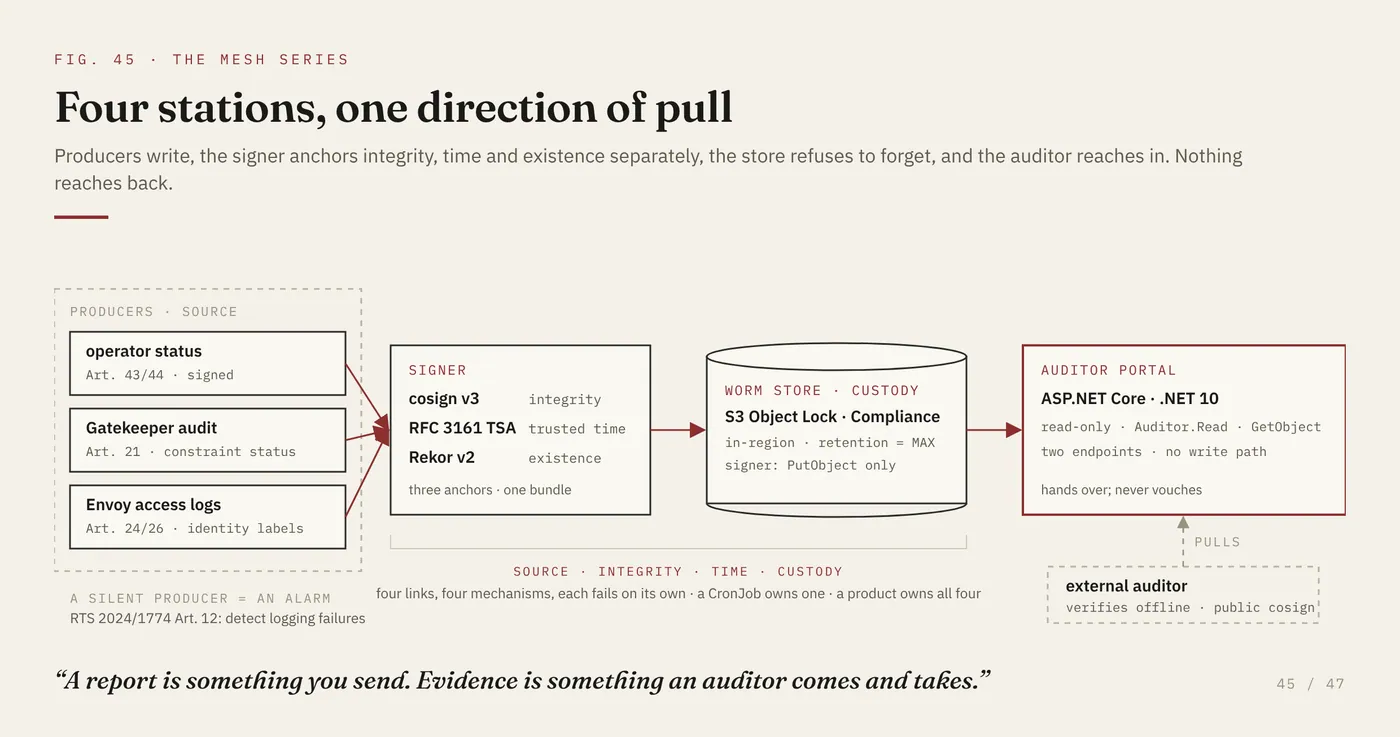
Four stations. The auditor reaches in from the right and takes; no producer can reach back into the store. That direction of pull is the design.
Why it matters: the time leg just moved, and most pipelines have not noticed
The regulatory anchor first. DORA's RTS, 2024/1774, Article 12 on logging, asks for four things that map onto the four links with uncomfortable precision: a retention period set by the entity's own risk assessment (there is no fixed EU number — the floor comes from your own analysis, and from CERT‑In's hard 180 days if you have an Indian arm); protection of log data "against tampering, deletion and unauthorised access" (integrity and custody); clock synchronisation to a reliable reference time source (time); and measures to detect when logging fails (source). That last one is the Unproven state from Article 43 promoted to a first‑class alarm: a silent producer is not a quiet Tuesday, it is a gap in a statutory record, and it should page someone. SAMA's maturity model says the same from the other direction — a gap in continuous operation lowers the score.
Now the sharp current fact. Rekor v2 went GA on 10 October 2025, rebuilt on Tessera's tile‑backed log: cheaper and simpler to self‑host, which is good news for anyone who has to keep a transparency log in‑region. But v2 deliberately removed signed timestamps with inclusion proofs, removed the search index, and keeps only the hashedrekord and dsse entry types. If your 2024‑era evidence pipeline leaned on Rekor's integrated timestamp as proof of when — and many did, because it was free — that assumption is gone in 2026. Rekor v2 proves existence in a log; it no longer vouches for time.
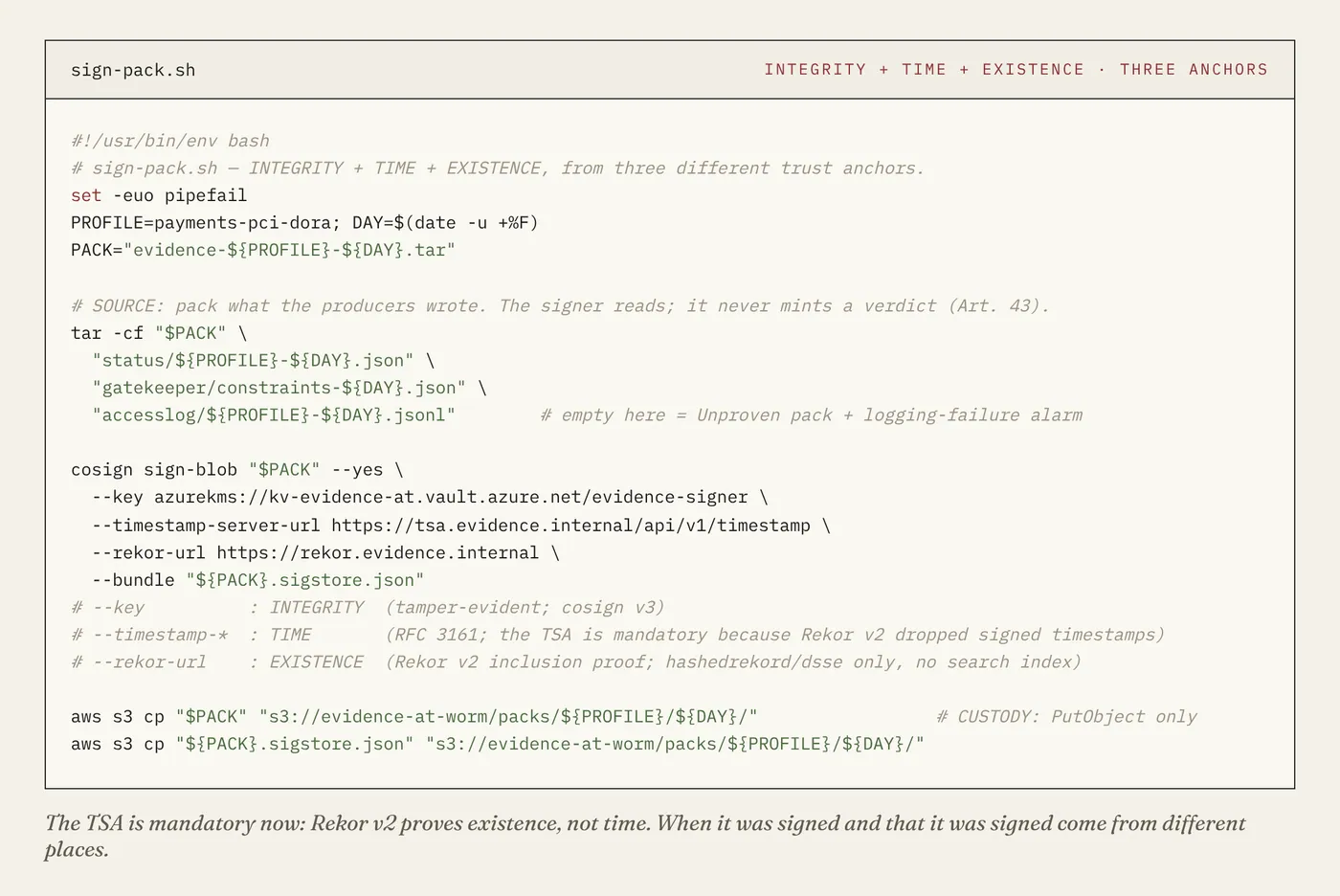
So the signer now does three distinct things with three distinct trust anchors: cosign sign-blob for integrity, an RFC 3161 TSA for trusted time, and a Rekor v2 inclusion proof for existence. When it was signed and that it was signed are different claims, and after this year they come from different places. A pipeline that has not been re‑plumbed for that is producing packs whose time leg is your own cluster clock's word — which is exactly the clock DORA told you not to trust.
How it comes together: four stations, one direction of pull
Producers. Nothing new is built here. The operator writes signed status; Gatekeeper writes constraint status every 60 seconds; Envoy writes identity‑labelled access logs to Loki. The product reads these — compose, don't generate, exactly as Article 43 refused to mint verdicts of its own. A service that produced its own evidence would be marking its own homework and would itself become another primitive to audit.
Signer. A scheduled job packs the day's records for a profile into a tarball and runs cosign v3 with three anchors: a Key Vault key for the signature, a TSA — contracted, in‑region — for the timestamp, and the Rekor v2 instance for inclusion. The bundle that comes back carries all three. The signer also watches the producers: if a profile's access‑log query returns nothing for a window in which traffic existed, it writes an Unproven pack rather than no pack, and raises the logging‑failure alarm Article 12 of the RTS asks for.
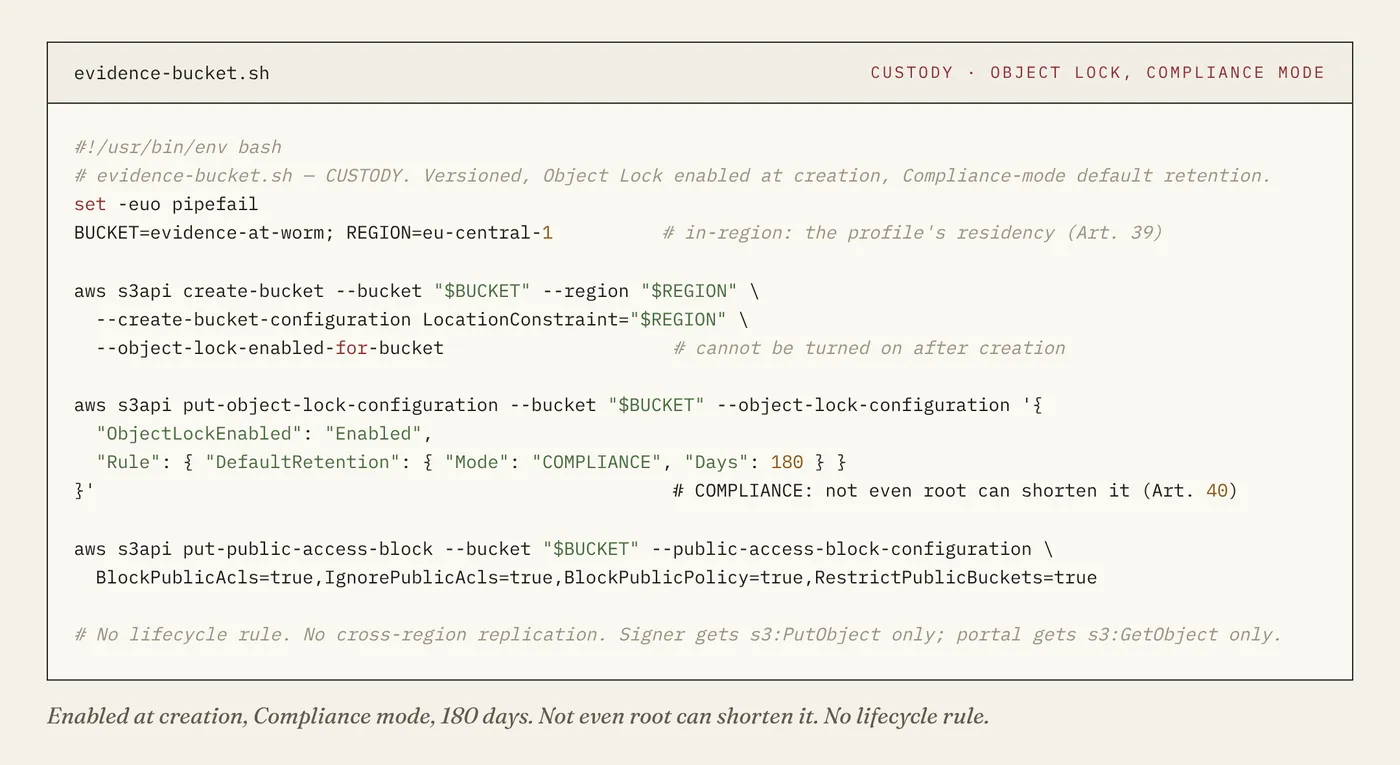
WORM store. A versioned bucket created with Object Lock enabled and a Compliance‑mode default retention equal to the MAX retention across the profile's frameworks. Packs are written once. The signer has PutObject and nothing else. No lifecycle rules. The bucket is in the jurisdiction the profile's residency names (Article 39), and replicates only to another Object‑Locked bucket in the same jurisdiction (Article 40).
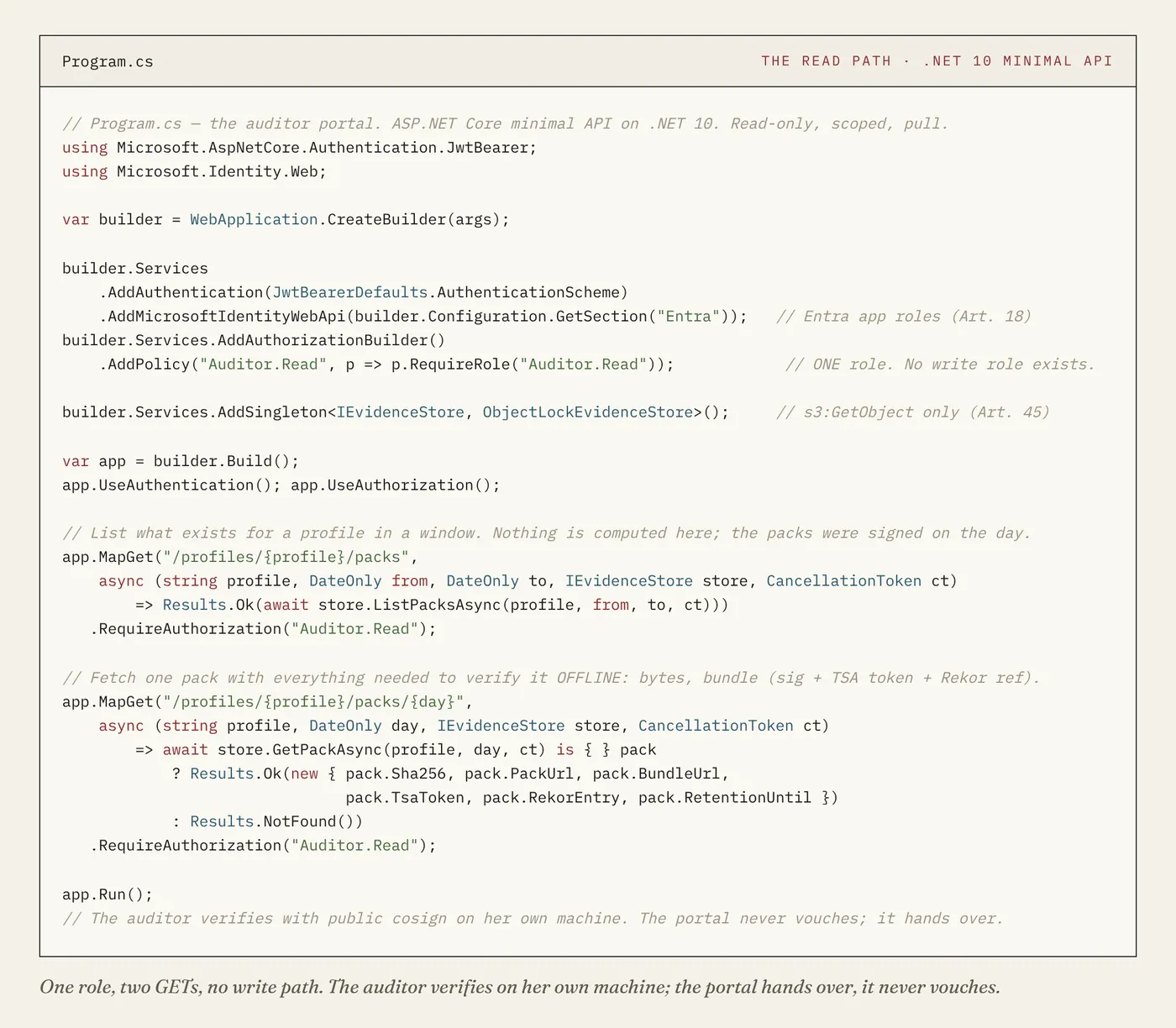
Auditor portal. A plain ASP.NET Core minimal API on .NET 10 — not an operator, not a dashboard. It authenticates against Entra with one scoped application role, Auditor.Read, and exposes two read‑only endpoints: list the packs for a profile and date range, and fetch one pack with its bundle, its TSA token and its Rekor reference. The auditor verifies on her own machine with public cosign. The portal has GetObject on the bucket and no write path anywhere. That is the direction of pull: the auditor reaches in; nothing reaches back.
And the honest paragraph the project guidance requires. None of the four stations is exotic. A client whose platform team can keep this chain running continuously and in‑country — never a missed night, never a lapsed TSA contract, never an unnoticed silent producer — should build it, and this article is enough to start. What you retain someone for is the clients for whom a gap is a reportable event and nobody owns the pager. Not "we generate your evidence" but "there will never be a gap in it, and someone is accountable when there nearly is." That is the retained‑operations margin tier, and it is the first recurring‑invoice thing in this series. It is also, until a readiness review has a client asking for it, a design: a compliance plane you have not sold to anyone is a design, not a product, and a design that oversells continuity it has not operated is the demo‑to‑audit gap wearing a founder's hat.
Show the config: the vault, the signature, the read path
The custody link. Object Lock must be enabled at bucket creation; it cannot be added later.
The integrity, time and existence links — three anchors, one bundle. The TSA is mandatory now because Rekor v2 dropped timestamps.
The read path. Two endpoints, one role, no write.
Security · Audit · Integration
Security: three trust anchors in one bundle — Key Vault signature, in‑region RFC 3161 TSA, Rekor v2 inclusion — over a pack in an Object‑Locked bucket the signer can only append to and the portal can only read; no component in the chain can alter what another wrote.
Audit: an auditor pulls a pack for a date, verifies integrity, time and existence offline with public tooling, and sees retention enforced by the store rather than promised by a policy — RTS 2024/1774 Article 12's tampering protection, clock synchronisation and logging‑failure detection demonstrated by construction.
Integration: producers are Articles 21, 24/26 and 43/44 unchanged; the signer re‑plumbs Article 27 for a post‑Rekor‑v2 world; the bucket follows Articles 39 and 40 for residency and DR; the portal uses Article 18's app roles and nothing the operator SDK provides.
Alternatives, and when you'd pick them
Buy a GRC or CSPM platform. Vanta, Drata, Wiz: a system of record that files evidence humans or integrations upload, tracks controls against frameworks and prints the auditor's binder. Mostly not a system of production — it does not read your data plane — and the evidence often leaves the jurisdiction. Rule it out as the custody link for a continuous in‑country case on both counts. Keep it as the index and the programme tracker. The index you can buy. The vault you own.
One‑off evidence exports. The status quo: a script, a folder, a ZIP sent to the auditor the week before. Source, sometimes integrity, never trustworthy time, never continuous custody. It is a claim assembled under pressure. Pick it only if you have no continuous obligation and no maturity assessor.
GRC as system of record, mesh as system of production. The pattern that holds: build the four stations yourself, let the GRC tool catalogue what the portal serves. The two compose; neither replaces the other.
Build it, don't retain it. Right for a client whose platform team can own the pager for the chain. The retained tier is for the client who cannot — and for whom a gap is a reportable event, not an inconvenience.
From simple to standard, and what's next
The simple version is a CronJob that signs a tarball. The standard version is four stations: producers that already exist, a signer with three trust anchors because Rekor v2 no longer vouches for time, a Compliance‑mode Object‑Locked bucket in the profile's jurisdiction with retention equal to the longest clock, and a read‑only portal through which an auditor pulls and verifies on her own machine — with a silent producer raising an alarm instead of a gap. Nothing exotic; it is Article 27 re‑plumbed and Articles 39, 40 and 43 pointed at a shelf. That closes Part H.
The whole chain depends on one component nobody in this series has stress‑tested: the identity provider every one of those principals came from. Next, Part I opens with Article 46: resilient identity in .NET — what your services do when Entra blips.
Nobody retains you to generate evidence. They retain you so there is never a gap in it.
Next in the series: Art. 46, resilient identity in .NET — when Entra blips (Part I opener). Earlier: Art. 44 (the operator that produces the status), Art. 43 (the Unproven state), Art. 40 (Object Lock and DR), Art. 39 (the bucket's jurisdiction), Art. 27 (tamper‑evident vs tamper‑resistant), Art. 24/26 (the access log is the evidence), Art. 18 (app roles).
Key skills & topics in this article
Compliance evidenceSupply-chain signing.NET & C#Kubernetes operatorsMicrosoft Entra ID
Also on LinkedIn.