Going passwordless — for users and workloads
The Mesh Series · Article 9
PasswordlessMicrosoft Entra IDConditional AccessRBISPIFFEAzuremTLSSAMA
Last article ended on a line worth repeating: the secret is the machine. A client secret is a bearer credential, so whoever holds the string is the service. Now widen the lens, because the same sentence is true of your users. A password is a bearer credential. Whoever types the string is the user. An OTP is a bearer credential with a five-minute shelf life. None of them prove a person — they prove possession of a string, and strings get phished, leaked, and reused.
So the real problem isn't "weak passwords" or "users who click links." The problem is the credential itself. It exists, it's stealable, and everything downstream is spent compensating for that one fact.
Passwordless is the move that removes it. Not "a better password." No password. And here's the part most write-ups miss: it's the same move for users and for workloads, run on two different planes at the same time.
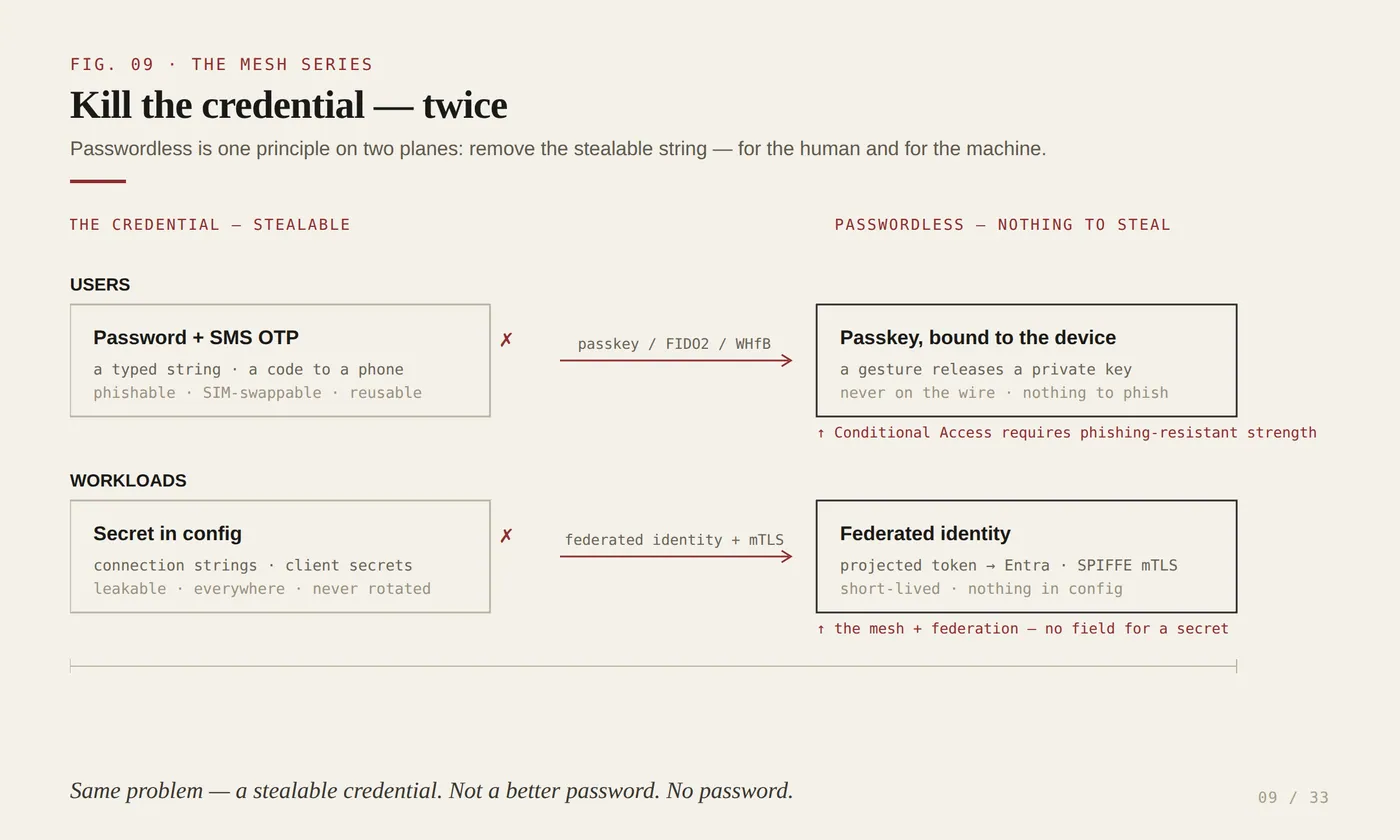
On the user lane, you replace the typed secret with a passkey: a private key bound to the device, released by a local gesture (a fingerprint, a PIN, a face), never transmitted, nothing to phish. On the workload lane, you replace the client secret in config with a federated identity and mesh mTLS — the thing you built in Article 8. Two lanes, one principle: there is no stealable string, because there is no string.
Why regulated enterprises should care
For years the honest answer to "why passwordless?" was "it's more secure, eventually." That's no longer the framing. In both of the markets this series is written for, a regulator is now doing the pushing.
In India, the RBI's Authentication Mechanisms for Digital Payment Transactions Directions, 2025 set a hard line: two-factor authentication for domestic digital payments becomes mandatory on 1 April 2026, and SMS OTP — the default second factor for a decade — is explicitly being phased out. The reasoning is not abstract. SIM-swap fraud turns a phone number into an interception channel; an OTP delivered to a swapped SIM is a second factor for the attacker. The directions steer toward factors bound to a device, and name passkeys as the preferred mechanism precisely because public-key cryptography bound to hardware is phishing-resistant by construction. If you run payments in India, "add an OTP" is no longer a compliance answer. It's the thing being deprecated.
In the Gulf, SAMA's Cyber Security Framework doesn't prescribe passkeys by name, but it grades institutions on a maturity model — you have to demonstrate that strong, phishing-resistant authentication actually operates, continuously, not that you wrote it into a policy PDF. Phishing-resistant authentication has quietly moved from "advanced control" to "expected baseline" across RBI, SAMA, and the frameworks that follow them.
There's a second clock, and it's aimed at your platform team, not your customers. Microsoft's mandatory-MFA enforcement reaches Phase 2 over 2026: create, update, and delete operations through Azure CLI, PowerShell, the REST APIs, the SDKs, and your infrastructure-as-code tooling now require MFA, with tenant enforcement rolling from October 2025 and postponement available only to 1 July 2026. Read that carefully. Your Terraform run, your Bicep deployment, your pipeline service connection — the machinery that changes your cloud — is inside the MFA perimeter now. The interactive human logging into a portal was never the whole attack surface. The automation was.
Two clocks, then — one on your customers, one on your platform. The reassuring part, if you've actually run one of these migrations: it's less dramatic than its reputation. Register the method first, flip Conditional Access to require it second, and the helpdesk surge everyone braces for largely doesn't arrive. The fear is doing it all at once. The fix is doing it in that order.
How the pieces come together
Passwordless is not one feature you switch on. It's an enforcement principle applied at two boundaries, and the tools are different at each.
For users, Entra is the enforcement point. The authentication method is a passkey (FIDO2), Windows Hello for Business, or certificate-based auth for the cases that need it. But registering a passkey isn't enough on its own — a user with a passkey and a still-valid password is only as strong as the password. The enforcement lever is Conditional Access, specifically an authentication-strength policy that says: to reach this application, you must satisfy phishing-resistant MFA — not "any MFA," which would happily accept the SMS OTP you're trying to kill. The strength requirement is what makes the weaker methods unusable, not merely discouraged.
For workloads, there is no Conditional Access, no gesture, no phone. A machine proves itself the way Article 8 laid out: a projected service-account token federated to an Entra managed identity for the outward path, and a mesh-issued SPIFFE identity over mTLS for the inward path. The enforcement is structural — there's no secret in config because the config has no field for one.
The symmetry is the point. Entra owns the human boundary; the mesh and federation own the machine boundary; both are executing the same instruction — remove the stealable credential — and that shared instruction is what makes the platform coherent instead of two unrelated security projects.
Show the config
The most striking thing about going passwordless is how little of it is application code. That's not a gap in the article. That's the design. Identity strength is a property of the platform, not something each service reimplements.
On the user side, the load-bearing artifact is a Conditional Access authentication-strength requirement — configuration, not code:
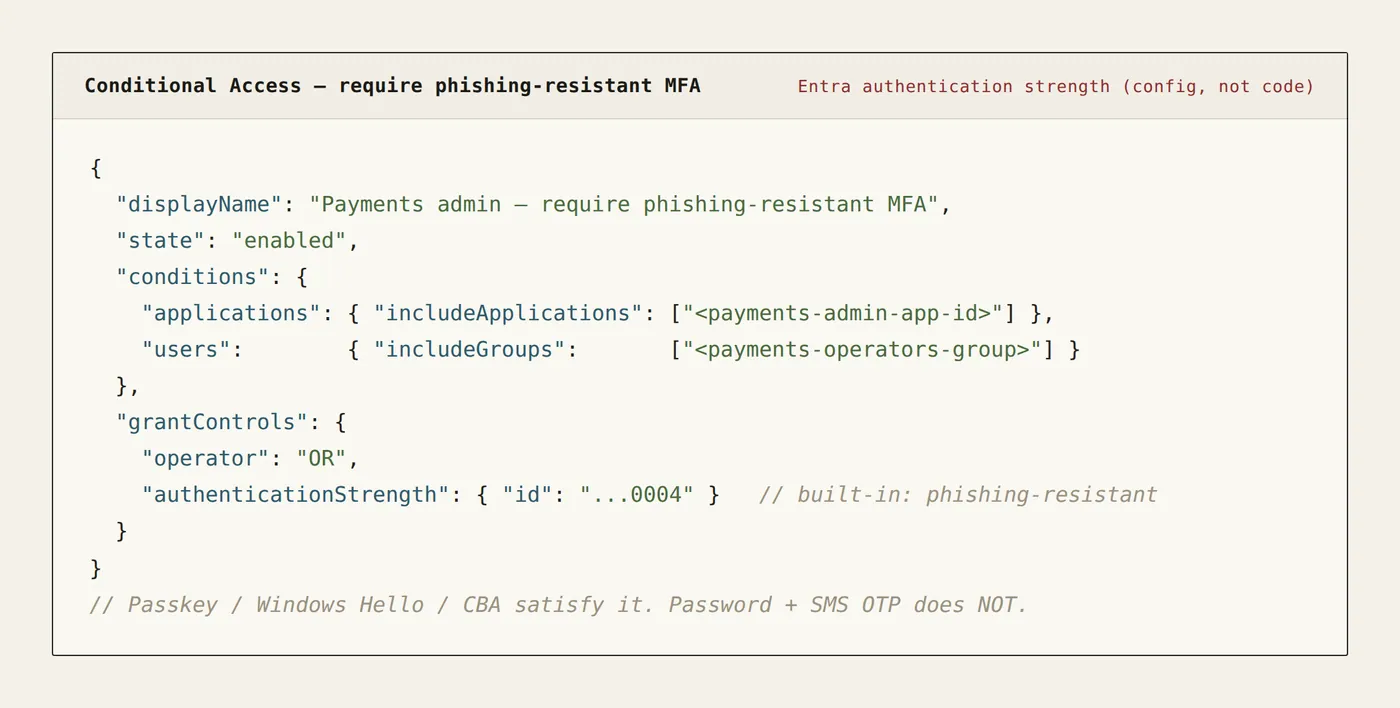
That built-in strength ID is Entra's phishing-resistant MFA strength — passkey (FIDO2), Windows Hello for Business, or certificate-based auth, and nothing weaker. A password plus an SMS code does not satisfy it, which is the entire objective.
Your service, meanwhile, doesn't handle passkeys at all. It never sees one. It requires a validated token and reads the claims — the same posture whether the user signed in with a passkey or a password, because the strength decision was made upstream by Conditional Access. In a .NET 8 API the surface is just this:
Microsoft.Identity.Web on top of MSAL.NET 4.87.0. Note what is absent: no password store, no credential table, no reset flow, no "forgot password" path to exploit. There is nothing here to breach because the app was never the keeper of the secret.
And the workload half is the code you already wrote in Article 8 — the same DefaultAzureCredential over a federated credential, no secret in the file:
var credential = new DefaultAzureCredential(); // Azure.Identity 1.21.0 — nothing in config to leak or rotateTwo lanes, and neither of them has a string to steal.
Security · Audit · Integration
Security property gained. The phishable, swappable, reusable credential is gone on both boundaries. A passkey's private key never leaves the device and never crosses the wire, so there is nothing to intercept; a federated workload token is short-lived and audience-scoped, so there is nothing to lift from config. You have removed the object that most incidents are actually about.
Audit evidence produced. Conditional Access records which strength was satisfied for each sign-in — you can show an auditor that access to the payments application required phishing-resistant authentication and that weaker methods were rejected, not merely disabled. For workloads, every access still resolves to a named managed identity. Against RBI's 2025 directions and SAMA's maturity grading, "we require phishing-resistant auth and here is the per-sign-in evidence" is a materially stronger position than "we have an MFA policy."
How it integrates. The user plane (Entra + Conditional Access) and the workload plane (federation + mesh mTLS) are the two halves of the same principle, and they converge in the reference architecture at the end of this series. This article is where the credential-sprawl story the series opened on finally gets its answer: not manage the secrets better, but have no secret to manage.
Alternatives, and when you'd actually pick them
Entra passkeys plus Conditional Access is the right default when your users already live in Entra and your workloads run on AKS. The honest alternatives:
Okta or Keycloak for passwordless. If your user identity doesn't sit in Entra — a heterogeneous estate, a data-residency constraint that keeps the IdP self-hosted, an acquisition still on its own stack — Okta and Keycloak both do FIDO2/passkeys competently. The identity provider changes; the principle does not. Pick these when Entra isn't already the source of truth for humans, and accept that you're now running (or paying for) the enforcement plane yourself.
Hardware security keys (YubiKey and kin). Passkeys on a phone or laptop are enough for most users. Hardware keys earn their cost in the high-assurance corners: shared workstations where no single device is "yours," privileged-access and break-glass accounts, air-gapped or offline-capable environments, branch staff who rotate seats. Reach for them where device-bound-to-a-personal-device breaks down — not as the default for everyone, which is how you fund a drawer of unused keys.
SPIRE for the workload half. As in Article 8: if workload identity has to span clouds or on-prem and you don't want Azure as the root of trust, SPIRE issues SPIFFE identities across the lot. Same trade — real portability, real operational weight.
"Just add another OTP." The tempting non-answer. It feels like progress and it satisfies a naive "two-factor" checkbox, but SMS OTP is a bearer credential delivered over a channel an attacker can hijack — which is exactly why RBI is phasing it out rather than blessing it. Layering a second phishable factor onto a first is motion, not security. Name it for what it is so nobody mistakes it for the destination.
From the toy to the standard
The toy is one Conditional Access policy and one federated pod. The industry-standard version is the same principle with no exceptions: no human authenticates with a phishable secret, no workload holds a static one, every human sign-in resolves to a phishing-resistant method Conditional Access can prove, and every machine access resolves to a named identity with nothing in config to leak. The credential-sprawl problem this series opened on — the LDAP wiring, the appsettings full of secrets you're afraid to rotate — doesn't get managed. It stops existing.
That leaves one honest question hanging. If Entra is now the enforcement point for every human, and the mesh is the enforcement point for every workload, how do those two planes actually fit together into one system rather than two — and where exactly does each one's authority begin and end?
That's the next article: the integration thesis — Entra for users, Istio for workloads, and the seam where they meet.
Next in the series — Article 10: The integration thesis — Entra for users, Istio for workloads.
Key skills & topics in this article
PasswordlessMicrosoft Entra IDConditional AccessRBISPIFFEAzuremTLSSAMA
Also on LinkedIn.