What the reference architecture didn't plan for — the 2027 wall
The Mesh Series · Article 48 · Part J
The reference architecture from Article 33 is on the wall of the platform team's room, and by now it is largely true. Default-deny. STRICT mTLS. Entra at the edge, SPIFFE between services. Signed evidence in a store nobody can edit. It answers DORA, NIS2, PCI-DSS 4.0.1 and the regional frameworks from one set of primitives, and Season 2 proved it could be operated, upgraded, recovered and tested.
Then three things arrive in the same quarter. Risk asks whether the credit-scoring model the data team is about to deploy is "high-risk" and what the platform has to do about it. Legal forwards a question from a customer: can you supply an SBOM and a vulnerability-handling policy for the service you host for them. And procurement wants a sentence on "sovereignty" for a tender, by Friday.
None of the three is on the diagram.
One idea: you don't get a 2027 platform by building a new one
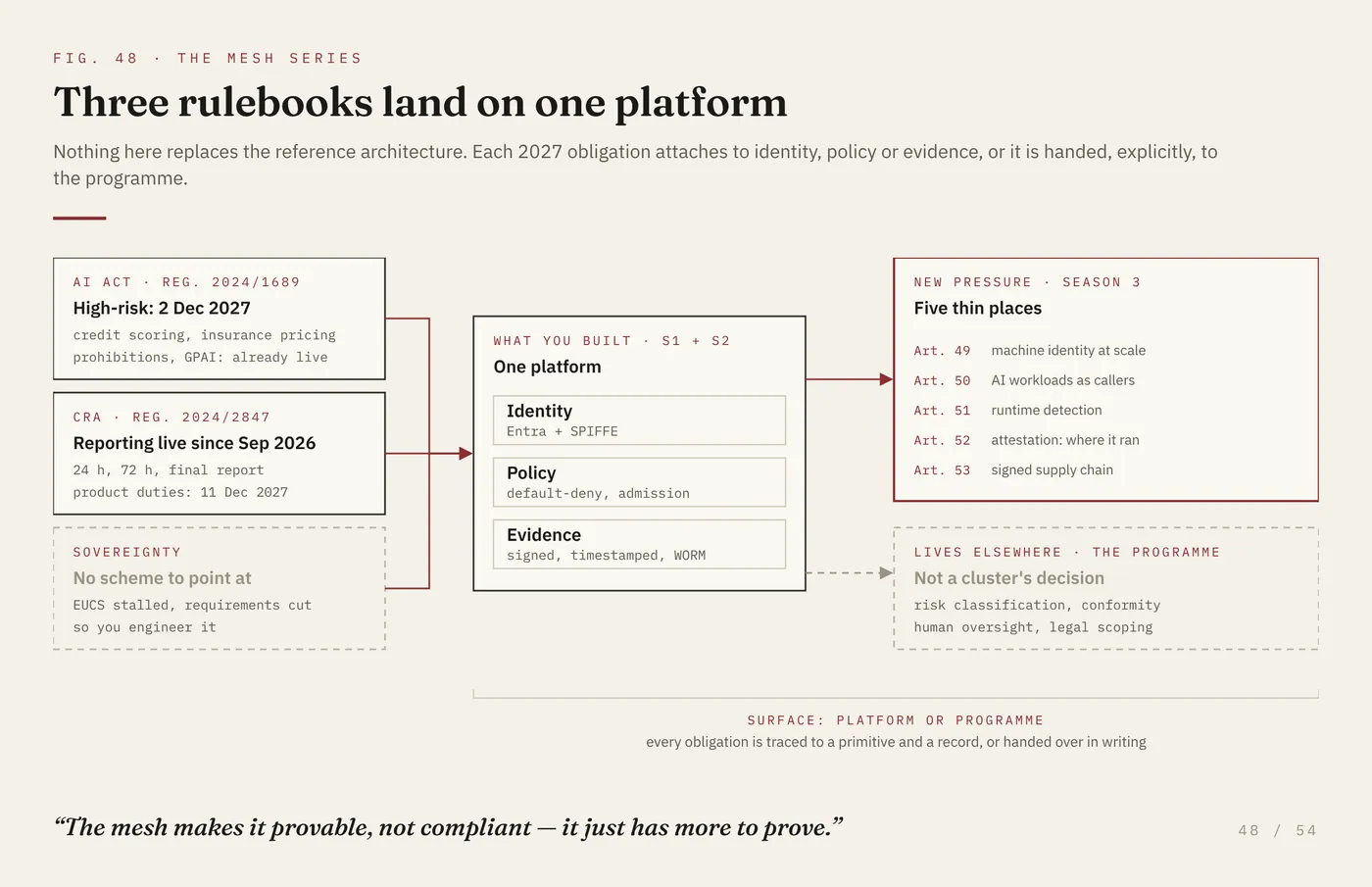
The instinct, when a new regulation lands, is a new workstream with a new tool. Resist it. The claim of this series since Article 29 has been that the mesh does not make you compliant — it makes you provable: one platform, many rulebooks, each obligation traced to a primitive that enforces it and a record that shows it did. 2027 does not break that claim. It tests it, by adding three rulebooks and one change in what runs on the cluster.
The AI Act. Regulation (EU) 2024/1689, as amended this summer by the Digital Omnibus. The amendment moved the heavy date: obligations for stand-alone high-risk systems — the Annex III list, which is where creditworthiness assessment and life and health insurance pricing sit — now apply from 2 December 2027. That is not a reprieve so much as a deadline with a year on it. And parts are already live: the prohibitions, the general-purpose model rules, the transparency duties, with two new prohibitions taking effect on 2 December 2026.
The Cyber Resilience Act. Regulation (EU) 2024/2847 puts obligations on products with digital elements. Its reporting duties have been live since 11 September 2026; the main body applies from 11 December 2027. A financial institution's internal platform is not obviously a product. The software a provider ships to that institution may well be.
Sovereignty, which the EU did not legislate. The European cloud certification scheme that was meant to define it stalled, with the sovereignty requirements taken out of the draft. So the tender question has no scheme to point at. If a client needs to show who could read their data while it was being processed, that is now an engineering answer, not a certificate.
And the workload changed. The services on the cluster used to be things you wrote, calling things you listed. Now there are agents choosing their own calls, and machine identities outnumbering human ones by two orders of magnitude.
The honest reading is that each of these lands partly on the platform and mostly somewhere else. The discipline is knowing which part is yours.
Why it matters: three clocks, and one of them is already running
Start with the one people assume is far away. The CRA's reporting clock is not a 2027 problem. Since September, a manufacturer in scope reports an actively exploited vulnerability through ENISA's single reporting platform: an early warning within 24 hours, a notification within 72, a final report after the fix. If your client ships software to others, somebody needs to know today which components are in it — and "we would have to ask the team" is the answer an SBOM exists to replace.
The AI Act's high-risk date is a year out, and a year is short for the thing it actually requires. High-risk systems need logging that allows their operation to be traced, human oversight, and documentation that somebody else can assess. Two of those are organisational. The first is a platform property: which workload called which model, on whose behalf, when, and whether it was allowed. That is an access log with identity on it — Article 24 — pointed at a new kind of caller.
Sovereignty has no date at all, which makes it the easiest to defer and the hardest to answer under time pressure. The residency work in Articles 39 and 40 says where the bytes rest and where the keys live. It says nothing about who could read memory while the workload ran.
Outside the EU the shape repeats with different names. India's DPDP Rules phase in through 2027. SAMA and the RBI already expect third-party and model risk to be governed. The specific articles differ; the demand — show the control operating, continuously, with a record — does not.
How it comes together: extend the map, don't redraw it
Article 34 mapped DORA's functions to primitives. The move for 2027 is the same map with more rows and one extra column, and the extra column is the important one: surface. For every obligation, say whether it lands on the platform — something a cluster can enforce and record — or on the programme — something a person, a policy or a lawyer has to do. A map without that column invites the worst kind of over-claim: a platform team asserting AI Act compliance because it has an access log.
Read the rows that way and the 2027 work sorts itself into five places where the existing architecture is thin, and the next five articles.
Machine identity at scale (Article 49). The series built workload identity to prove who a service is. It never asked how many there are, who owns each, or what happens when the service is gone and the identity is not. DORA's RTS already asks for identity lifecycle and access review without exempting machines.
AI workloads as callers (Article 50). An agent is not a new kind of workload. It is a caller whose next request you cannot predict, which breaks the assumption behind every allow rule you have written. The mesh's job shifts from permitting known edges to fencing an actor.
Runtime detection (Article 51). Every control so far acts at admission or at connection. None sees what a process does after it has been let in. DORA Article 10 asks for detection, in layers.
Proof of where it ran (Article 52). Residency is where data rests. Attestation is evidence about the machine it was processed on — the part of sovereignty you can actually engineer.
A signed supply chain (Article 53). The series signs evidence and signs verdicts. The CRA puts the product under obligation: provenance, SBOM, a vulnerability process with a clock.
Then a capstone (Article 54) that redraws Article 33 with these in place.
What stays off the cluster, in every row: deciding whether a system is high-risk, the conformity assessment, the human-oversight procedure, the fundamental-rights assessment, and the question of whether the CRA applies to what you ship. A platform can make each of those easier to evidence. It cannot perform any of them.
Show the config: the obligation map, with the honest column
One artefact for this article: the map, extended. Each entry names the obligation, the primitive that enforces it, the record that proves it, and the surface it lands on.
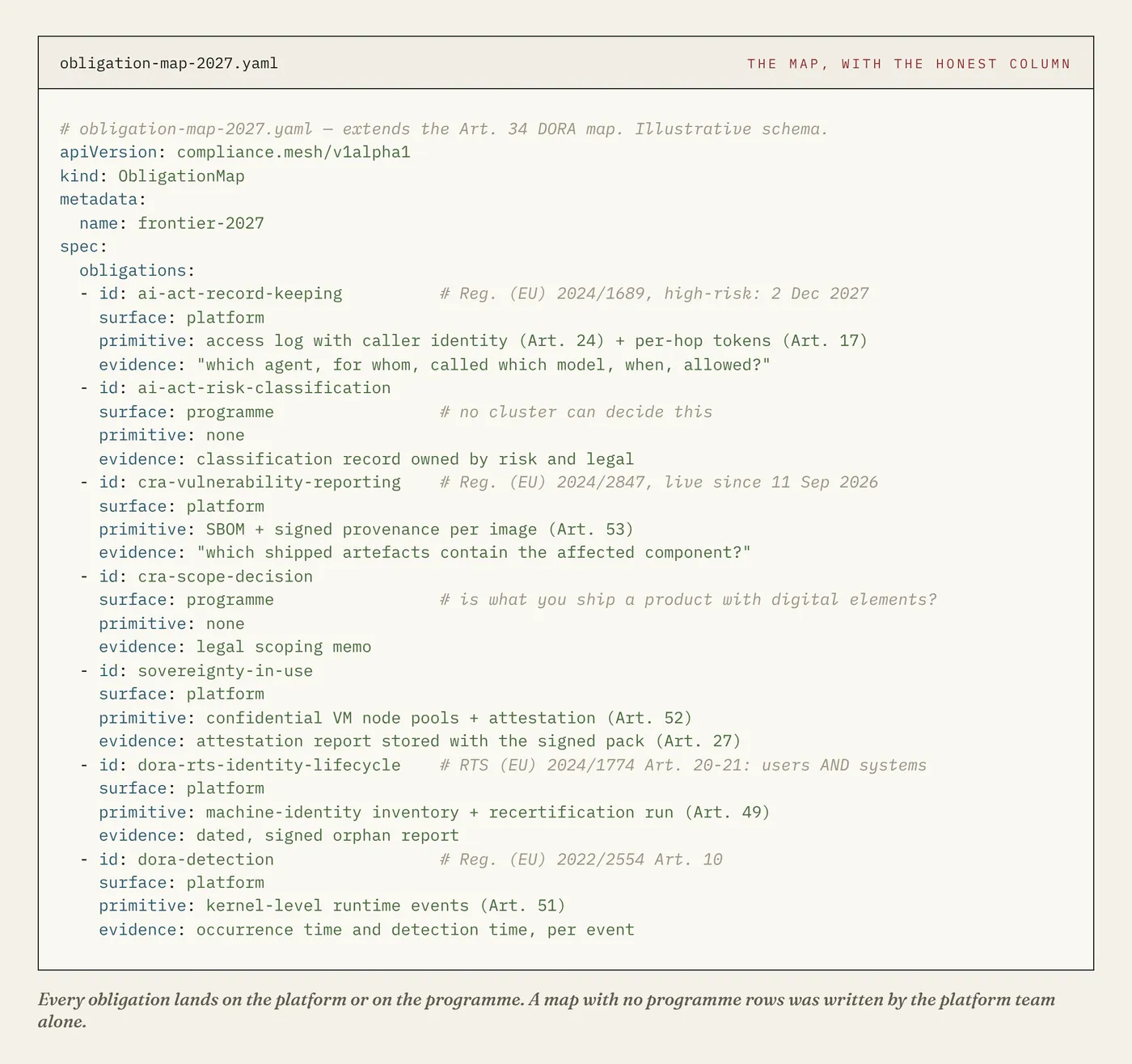
Seven rows, two of them marked programme. A reviewer who sees no programme rows in a map like this should assume the platform team wrote it alone.
Security · Audit · Integration
Security: the five thin places are all post-admission or beyond-the-edge — identities that outlive their workloads, callers whose requests you cannot enumerate, processes acting after they were let in, memory in use, artefacts built elsewhere — which is exactly where a 2026-shaped zero-trust design stops looking.
Audit: the surface column is itself evidence of scope: it shows an assessor which obligations the platform claims to prove and which it explicitly hands to the programme, so nobody mistakes an access log for an AI Act conformity assessment.
Integration: nothing here replaces Article 33; each 2027 row attaches to a primitive already running — identity, policy, evidence — and the next five articles thicken those three rather than adding a fourth.
Alternatives, and when you'd pick them
Wait for the guidance. Defensible for the programme-side questions, where harmonised standards and supervisory guidance are still arriving. Not defensible for the platform-side rows: an identity inventory, an SBOM pipeline and runtime detection are useful under DORA today and need the lead time.
Buy a platform per rulebook. An AI-governance tool, a supply-chain tool, a sovereign-cloud contract. Each files evidence for its own regulation and none of them reads your data plane. You end up with three systems of record and the same unanswered question about what actually ran. Buy the index; keep producing the evidence yourself (Article 45).
Minimum viable 2027. For a small estate with no AI workloads and nothing shipped to third parties: the identity inventory and runtime detection, because DORA already asks for both, and a written note that the other rows are out of scope and why. A scoped "not applicable" with a reason is a better artefact than a half-built control.
Sovereign-cloud offering instead of engineering it. Reasonable where a national scheme or a client mandate names one. Understand what it attests to — operator nationality and jurisdiction, usually — and what it does not: it is not evidence about a specific workload on a specific day.
From simple to standard, and what's next
The simple response to 2027 is three projects, three tools and a slide that says "AI Act ready". The standard response is one map with a surface column: each new obligation traced either to a primitive the platform already runs — identity, policy, evidence — or handed, explicitly, to the programme. Five rows are thin, and they share a shape: they all concern what happens after the door has been opened. The reference architecture decided who may come in. 2027 asks what you know about them once they have.
The first thin place is the oldest one in this series, grown past the point anyone counted. Next, Article 49: governing identities you didn't create — non-human identity at machine scale.
One platform, many rulebooks. The mesh makes it provable, not compliant — it just has more to prove.
Next in the series: Art. 49, non-human identity at machine scale. Earlier: Art. 47 (testing — the Season 2 close), Art. 34 (the DORA map this extends), Art. 33 (the reference architecture), Art. 30 (one surface, many rulebooks), Art. 29 (provable, not compliant), Art. 27 (signed evidence), Art. 24 (the access log).