Governing identities you didn't create — for people you run joiner, mover, leaver; for machines you run joiner
The Mesh Series · Article 49 · Part J
Ask the identity team how many people can sign in to the estate and you get a number, a system of record and a process: someone joins, someone moves, someone leaves, and each event has an owner and a ticket. Access is reviewed every quarter because an auditor asks for the review.
Now ask how many machine identities there are. Service accounts, app registrations, managed identities, federated credentials, SPIFFE registrations. Who owns each. Which are still attached to something that runs.
The room goes quiet, and then somebody offers to write a script.
One idea: the lifecycle has five steps and you run one
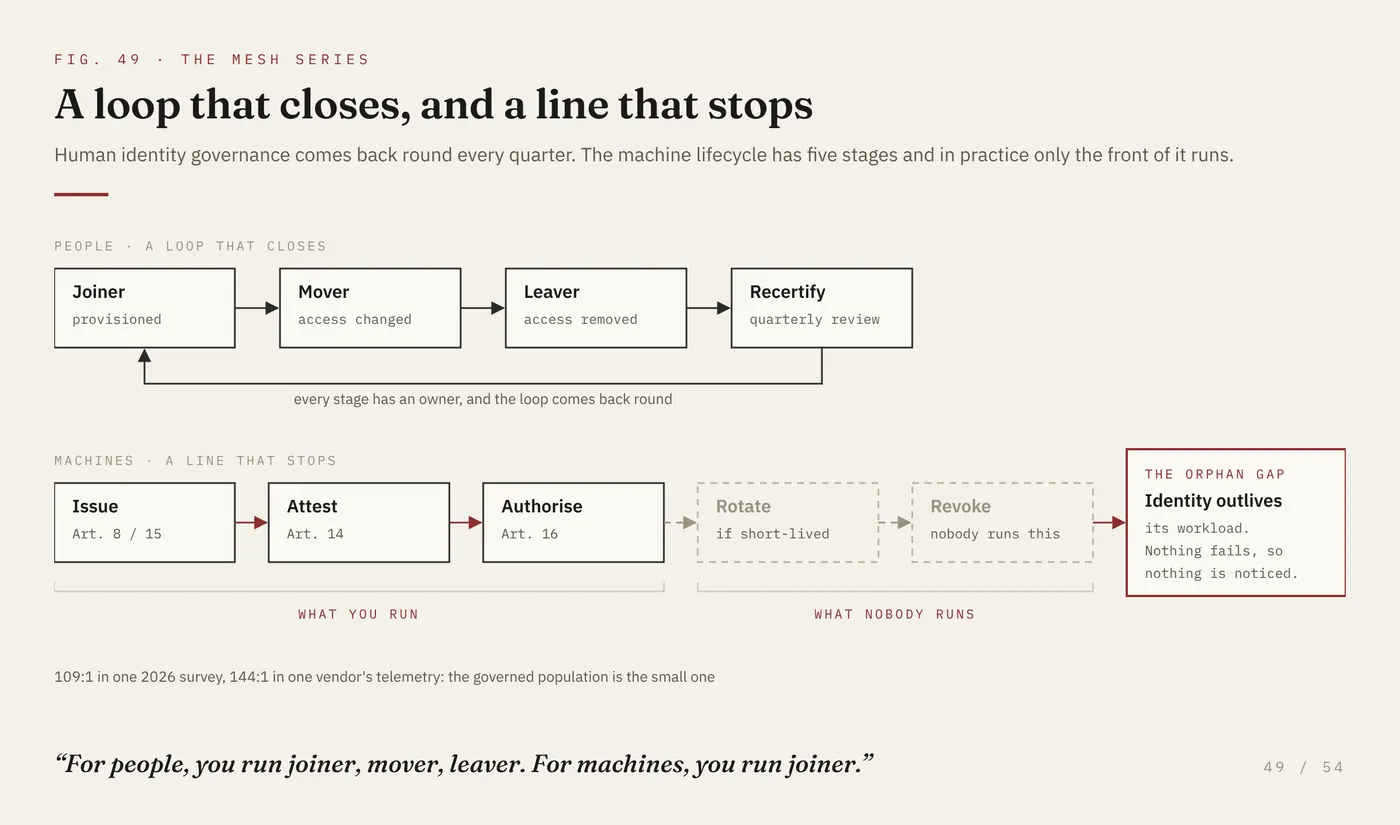
For people, identity governance is a loop. Joiner, mover, leaver, and a periodic recertification that closes it. It is unglamorous and it works, because every stage has an owner and the loop comes back round.
For machines the lifecycle has five stages: issue, attest, authorise, rotate, revoke. This series has spent most of its length on the first three. Issue a workload identity without a secret (Articles 8 and 15). Attest it — the SVID is proof of what the workload is (Article 14). Authorise it with policy that names the principal (Article 16). That is real progress, and it is all at the front of the lifecycle.
Rotation is partly solved, where the credential is short-lived by design. Revocation, and the question that precedes it — does this identity still correspond to anything? — is where the loop stops. A deployment is deleted; its service account stays. A team disbands; its app registration and its federated credential carry on trusting a cluster issuer for a subject nobody will ever present again. Nothing fails, so nothing is noticed.
That is the orphan gap. It is not a tooling problem first. It is a missing half of a process: for people you run joiner, mover, leaver. For machines you run joiner.
And the population is not small. The published ratios of machine to human identities now run past a hundred to one — 109:1 in one 2026 survey of security leaders, 144:1 in one vendor's scan telemetry. The two numbers measure different things and should not be averaged. Either way the conclusion is the same: the governed population is the small one.
Why it matters: the regulation never said "human"
Read the DORA RTS with the word machine in mind. Article 20 of Delegated Regulation (EU) 2024/1774 requires identity management policies and procedures that ensure unique identification of those accessing the entity's information assets — and it speaks of both staff and ICT systems — with a lifecycle for identities and accounts. Article 21 requires access rights on a need-to-know, least-privilege basis, segregation of duties, and review of access rights at a defined frequency. Regulation 2022/2554 Article 9(4)(c) sets the principle: limit access to what is required. None of it carves out service accounts.
Then the angle people miss. A federated credential is a standing statement that your tenant trusts tokens from somewhere else. That is a third-party trust relationship, and Articles 28 to 30 want those known and registered (Article 36 of this series). An inventory of machine identities is partly a Register of Information exercise.
NIS2 Article 21(2)(i) names access control and asset management together, which is exactly the right pairing: a machine identity is an asset with access.
The regional texts read the same way. RBI's IT governance direction asks for least privilege and periodic review of access, not of human access. SAMA's maturity model is the sharpest test: a one-off clean-up, however thorough, scores as a one-off. What is graded is whether the process repeats.
The governance studies say most estates would fail that test today. Around half of organisations in one 2025 survey could not name an owner for their machine identities. Roughly four in ten Entra applications in one cloud-telemetry report carried credentials older than a year. And the agent wave is arriving on top: in a January 2026 survey, about four in five organisations had no formal process for decommissioning an AI agent. An agent is a machine identity with initiative. That is the next article; the inventory problem is this one.
How it comes together: the inventory is a join, not a product
The first instinct is to buy something. Hold that thought, because the inventory already exists — in three registries you operate, none of which talks to the others.
The SPIRE registry. Every registration entry is a statement: this selector, on this node or in this namespace, may receive this SPIFFE ID. That list is the workload-identity inventory for everything the mesh issues to. It has been sitting there since Article 14.
Entra. App registrations, service principals, managed identities and their federated credentials, readable through Graph, with the sign-in activity that tells you when each was last used.
Kubernetes. ServiceAccounts, and — the part that matters — whether any running pod still uses each one.
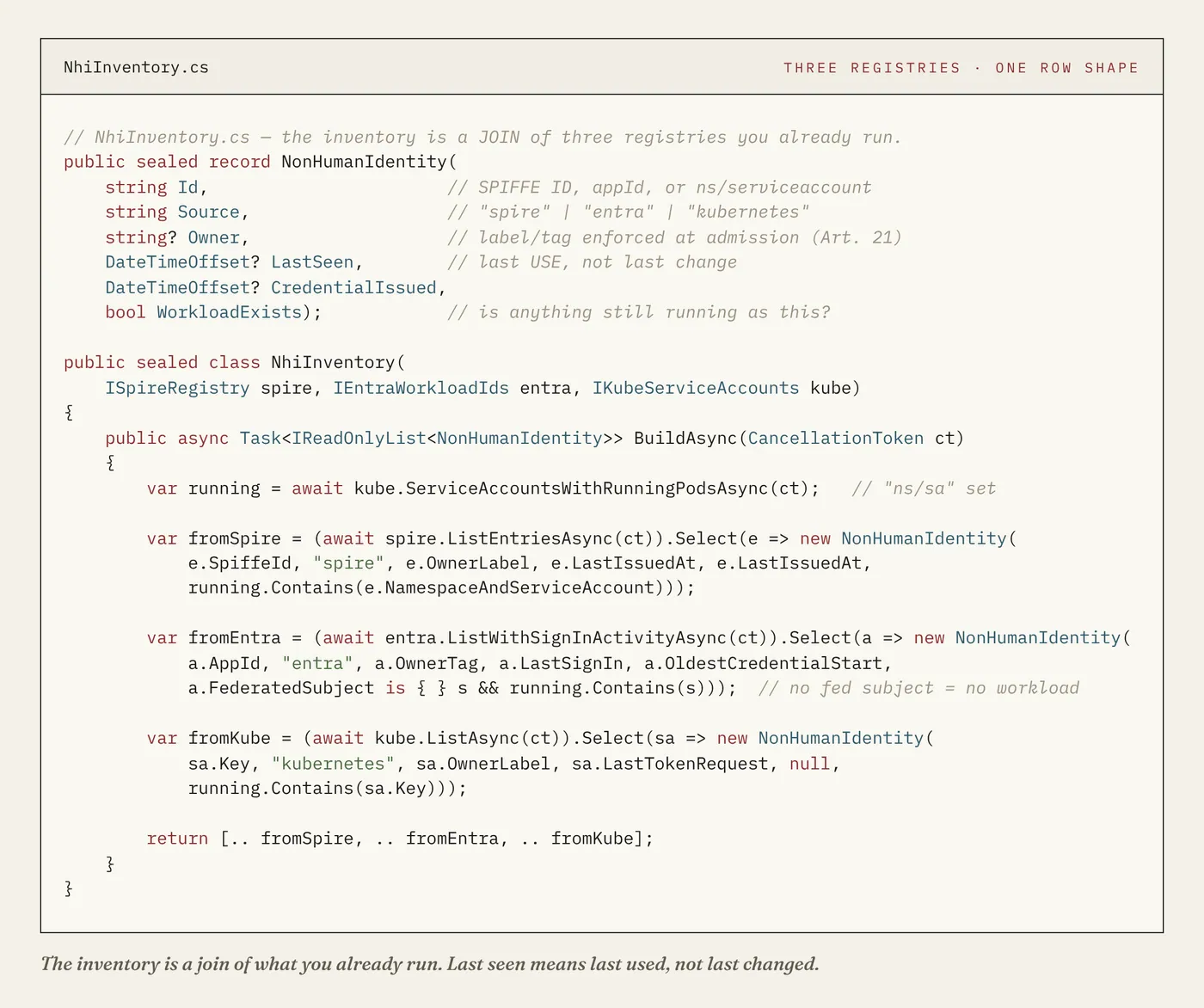
Join the three on the things they share: the namespace and service-account pair appears in the SPIFFE ID, in the federated credential's subject and in the pod spec. The result is one row per machine identity with four facts that no single registry holds: where it came from, who owns it, when it was last used, and whether its backing workload still exists.
Two of those deserve emphasis. Last used is not last changed. An app registration modified last week by a tidy-up script and not signed in to for a year is stale; the modification date will tell you the opposite. And owner is a field you have to add, as a label on the ServiceAccount and a tag on the registration, enforced at admission (Article 21) so that an identity cannot be created without one. An inventory with no owner column produces a report nobody is obliged to read.
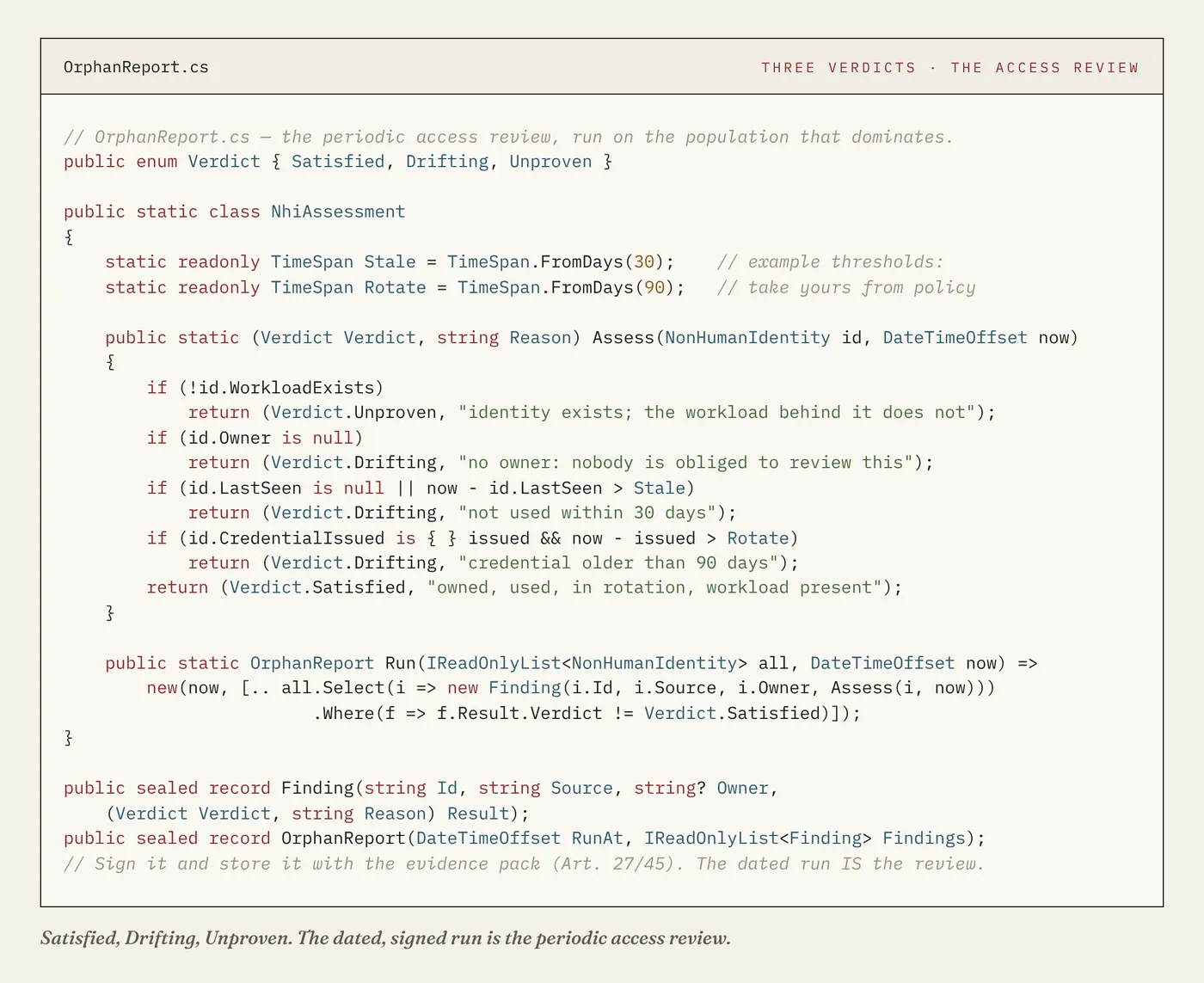
Then give each row a verdict, and reuse the three states from the ComplianceProfile operator (Article 43), because they fit exactly. Satisfied: owned, used recently, credential within its rotation window, workload present. Drifting: something has slipped — unused beyond the threshold, or a credential past its window. Unproven: the identity exists and the workload that justified it does not. That last state is the orphan, and it is the one that matters.
Run that on a schedule, sign the output, store it with the rest of the evidence. The dated, signed run is the periodic access review, performed on the population that actually dominates.
One more point, and it is the architectural one. Detection finds orphans. Expiry prevents them. An SVID with a one-hour lifetime cannot be orphaned for longer than an hour; a per-request federated token exchange leaves nothing to forget. The best-governed identity is the one you do not have to govern because it stops existing. Spend the budget on making identities ephemeral first and on discovering the long-lived ones second.
Show the config: the join and the verdict
The inventory: three registries, one row shape.
The verdict: three states, and the report an access review can cite.
Security · Audit · Integration
Security: an orphaned identity is standing access with no workload to constrain it and no owner to notice its use; short lifetimes shrink what must be governed, and the report finds what the lifetimes cannot reach.
Audit: a dated, signed recertification run over every machine identity is the periodic access-rights review RTS 2024/1774 Art. 21 asks for — evidence of the review happening, rather than a policy that says it should.
Integration: SPIRE, Entra and Kubernetes are read by one job into one report; each federated credential it lists is also a third-party trust relationship for the Register of Information (Art. 36).
Alternatives, and when you'd pick them
Retrofit the human IGA platform. SailPoint, Saviynt, Omada: one pane for people and machines, which a governance team will like. The model underneath is request-and-approve, built for an entity that can be asked a question. Pick it when your machine identities are long-lived and human-adjacent — a handful of integration accounts with named owners.
Mesh-native: the SPIRE registry as source of truth. Lowest ceremony, and it composes with everything in this series. Its limit is its scope: it knows what SPIRE issues to, and nothing about the vendor API key in a pipeline variable.
A dedicated NHI platform. Oasis, Entro, Astrix, Token Security, GitGuardian and others discover across clouds, SaaS and code out of the box, which a join of three registries will not. The trade is that you have installed another highly privileged system that reads your whole identity estate — assess it as the critical third party it is.
Entra Agent ID for the agent slice. A dedicated identity class with sponsors and lifecycle for AI agents. It governs the agent population, not the service accounts beside it. It is the bridge to the next article.
From simple to standard, and what's next
The simple version is the script somebody offered to write: a list, run once, emailed round. The standard version is a scheduled join of the three registries you already operate, an owner enforced at creation, a verdict per identity with last used rather than last changed, and a signed report that stands as the access review — with the architecture doing the heavier work, because an identity that expires in an hour needs no leaver process. You built workload identity to prove who your machines are. Now you have to prove you still know how many there are.
One class of machine identity does not wait to be called. It decides what to call. Next, Article 50: AI under the rulebook — securing AI and agentic workloads on the regulated mesh.
The best-governed identity is the one you don't have to govern because it expires.
Next in the series: Art. 50, AI and agentic workloads on the regulated mesh. Earlier: Art. 48 (the 2027 wall), Art. 43 (the three verdicts), Art. 36 (the Register of Information), Art. 21 (admission policy), Art. 17 (On-Behalf-Of), Art. 15 (workload identity federation), Art. 14 (SPIFFE), Art. 8 (workload identity).