The detect layer you can't buy from your service mesh — the mesh authorises the call; it never sees the syscall
The Mesh Series · Article 51 · Part J
Ambient meshIstioAuthorizationPolicyService meshCompliance evidence
The agent from the last article is fenced. One model host in its egress list. One allow rule at the waypoint. Tokens that say for whom. Every call it makes across the network is judged and logged.
Then a document arrives with instructions buried in it, and the agent does not make a network call at all. It starts a shell inside its own container and reads the service-account token off the filesystem.
Look for that in the mesh. There is no request, so the waypoint has nothing to authorise. There is no connection, so ztunnel has nothing to carry. The access log, which Article 24 made the spine of your evidence, has no line. Every control this series has built did its job, and none of them was in the room.
One idea: Envoy sees the request; only the kernel sees the shell
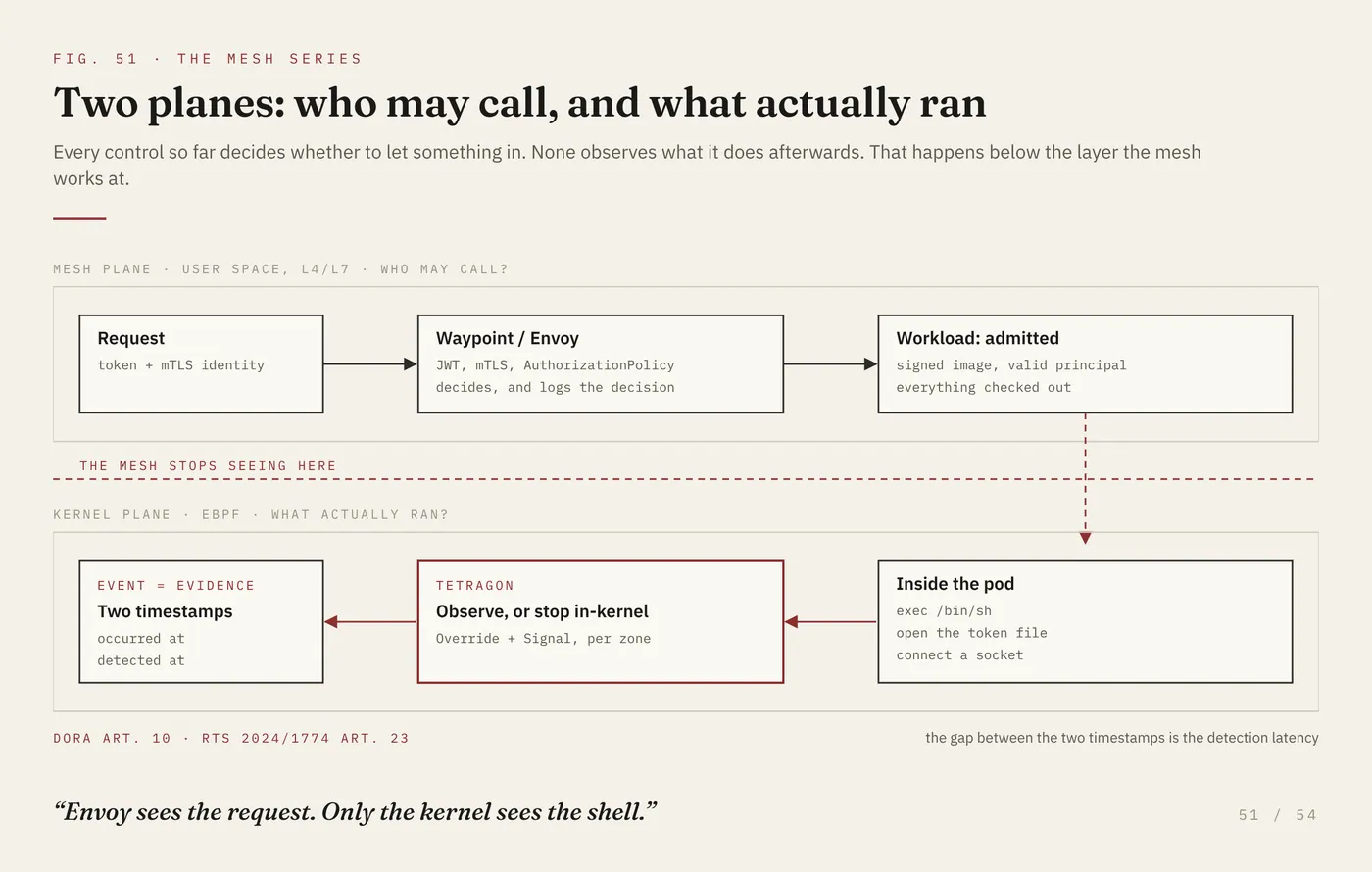
There are two planes, and until now the series has only stood on one.
The mesh plane lives in user space at layer 7 and layer 4. It answers who may call whom: mutual TLS, SPIFFE principals, JWT claims, AuthorizationPolicy. It is the right place for that question and nothing here replaces it.
The kernel plane sees what a process actually does: which binary it executed, which file it opened, which socket it created. Every one of those is a system call, and none of them is a request.
Hold the two against the timeline of an attack and the gap is plain. Every control from Season 1 is an admission-time or connection-time control. Is this image signed. May this pod be scheduled. May this principal open this connection. All of them are decisions about letting something in. None is an observation about what it does once it is in.
So take the cases that matter. A workload you correctly authorised is compromised through a vulnerability. A dependency you correctly admitted turns out to carry a backdoor. An agent you correctly fenced is talked into misbehaving. In each, the malicious act is an exec, a file read or a socket inside an admitted pod. It is below the layer the mesh works at. Envoy is not negligent. It is structurally blind.
eBPF is how you put an observer where those acts happen. A small program attached to a kernel function runs when that function is called, with the process, the container and the pod identity in hand. Tetragon — the runtime-security project that grew up beside Cilium — turns that into Kubernetes-shaped policy: watch this kernel function, for pods with these labels, and when the arguments match, record it, or stop it.
The mesh decides who may talk. The kernel is the only witness to what they do once you let them in.
Why it matters: detection is its own article of the regulation
DORA separates protection and prevention from detection, and gives detection its own article. Article 10 of Regulation (EU) 2022/2554 requires mechanisms to promptly detect anomalous activities, and it asks for three things that a logging pipeline alone does not give you: multiple layers of control, defined alert thresholds and criteria that trigger incident response, and resources devoted to monitoring user activity and ICT anomalies.
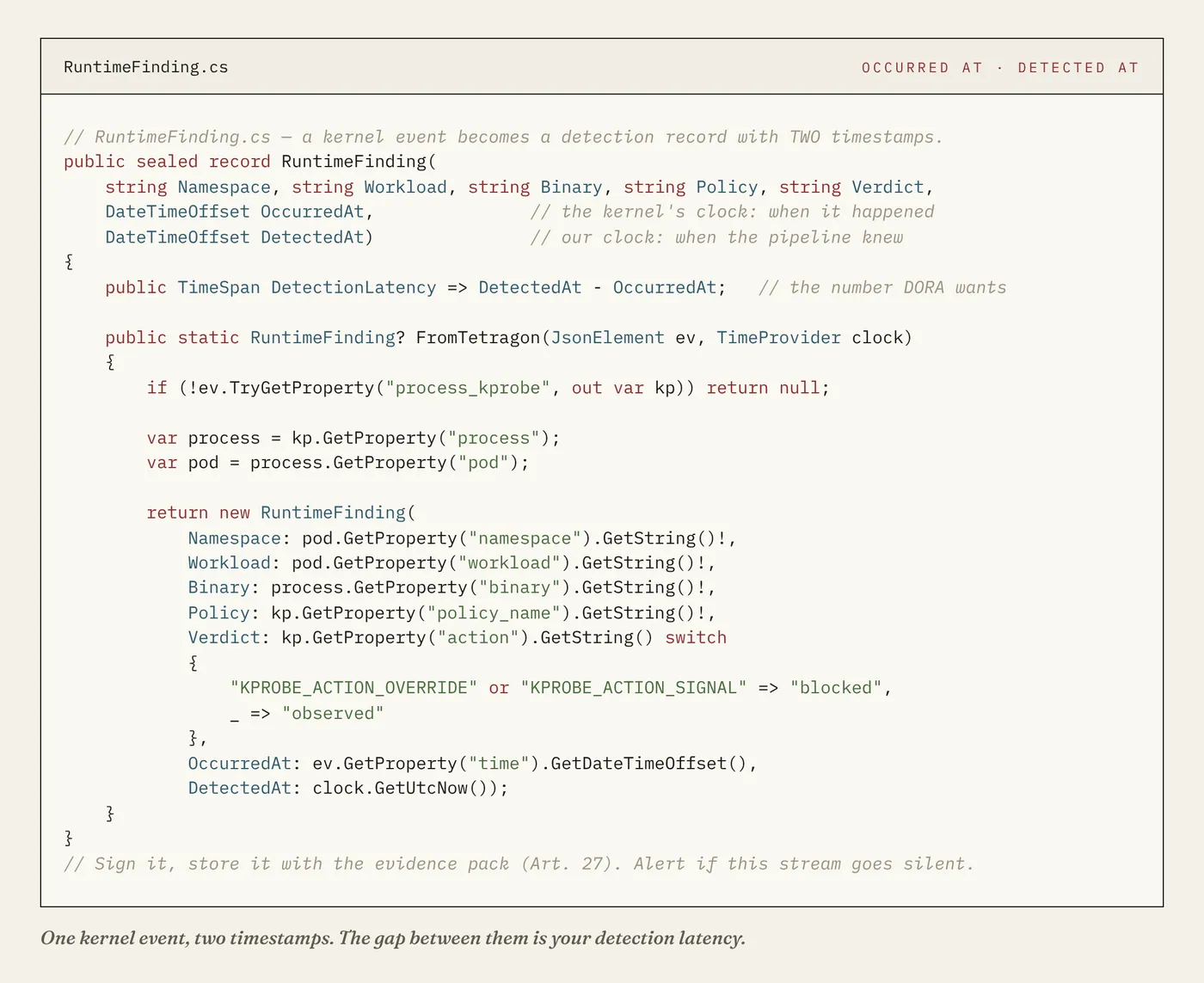
The RTS sharpens it. Article 23 of Delegated Regulation (EU) 2024/1774 asks you to collect and analyse the relevant signals, to run tooling that raises alerts for at least the functions that matter, to protect the recordings against tampering — and to record, for an anomalous activity, both when it occurred and when it was detected.
That last requirement is the spine of this article. Two timestamps. The difference between them is your detection latency, and it is a number that no admission policy, no AuthorizationPolicy and no signed image can produce — because those controls record decisions, not occurrences. If the only way you learn about the shell in the container is a log search three days later, your detection time is three days, and you have just written it down.
"We collect logs" is not an answer to Article 10. Logs are where you go after something has told you to look. Detection is the thing that tells you.
The other regimes agree in their own vocabulary. NIS2 Article 21 lists incident handling among its measures. CERT-In's clock starts six hours from noticing, which quietly assumes you have a way to notice. SAMA's maturity model distinguishes a control that ran once from one that operates continuously.
How it comes together: add a plane, don't swap a mesh
The conversation this usually triggers is the wrong one: should we move from Istio to Cilium? That is a migration argument, and you do not need to have it.
Keep three jobs apart. Istio ambient stays where it is: it terminates Entra tokens and applies L7 policy at the waypoint, and its ambient mode is generally available. Cilium, if it is your CNI, gives you identity-aware L3/L4 policy underneath — the belt to the mesh's braces from Article 20; its own sidecarless mesh mode exists and is still maturing. And Tetragon does runtime. The point that saves the argument: Tetragon attaches to the kernel, not to Cilium's data plane. It runs as a DaemonSet on any conformant cluster with a recent enough kernel. An Istio-meshed estate can add it without touching the mesh.
Then proceed in the order that does not page you at 3 a.m.
Observe first. Deploy with no enforcement and look at what your namespaces actually do. You will learn that an init script runs a shell, that a health probe executes a binary, that a JVM forks. A week of observation is the allow-list you would otherwise discover in production. This is "deny-all and watch what screams" from Article 16, one layer down — except here you watch before you deny.
Decide what should never happen. Not a thousand rules. A handful of invariants per zone: in the cardholder-data namespace, no interactive shell; no write to a binary directory; no outbound socket except through the mesh. Short lists survive contact with reality.
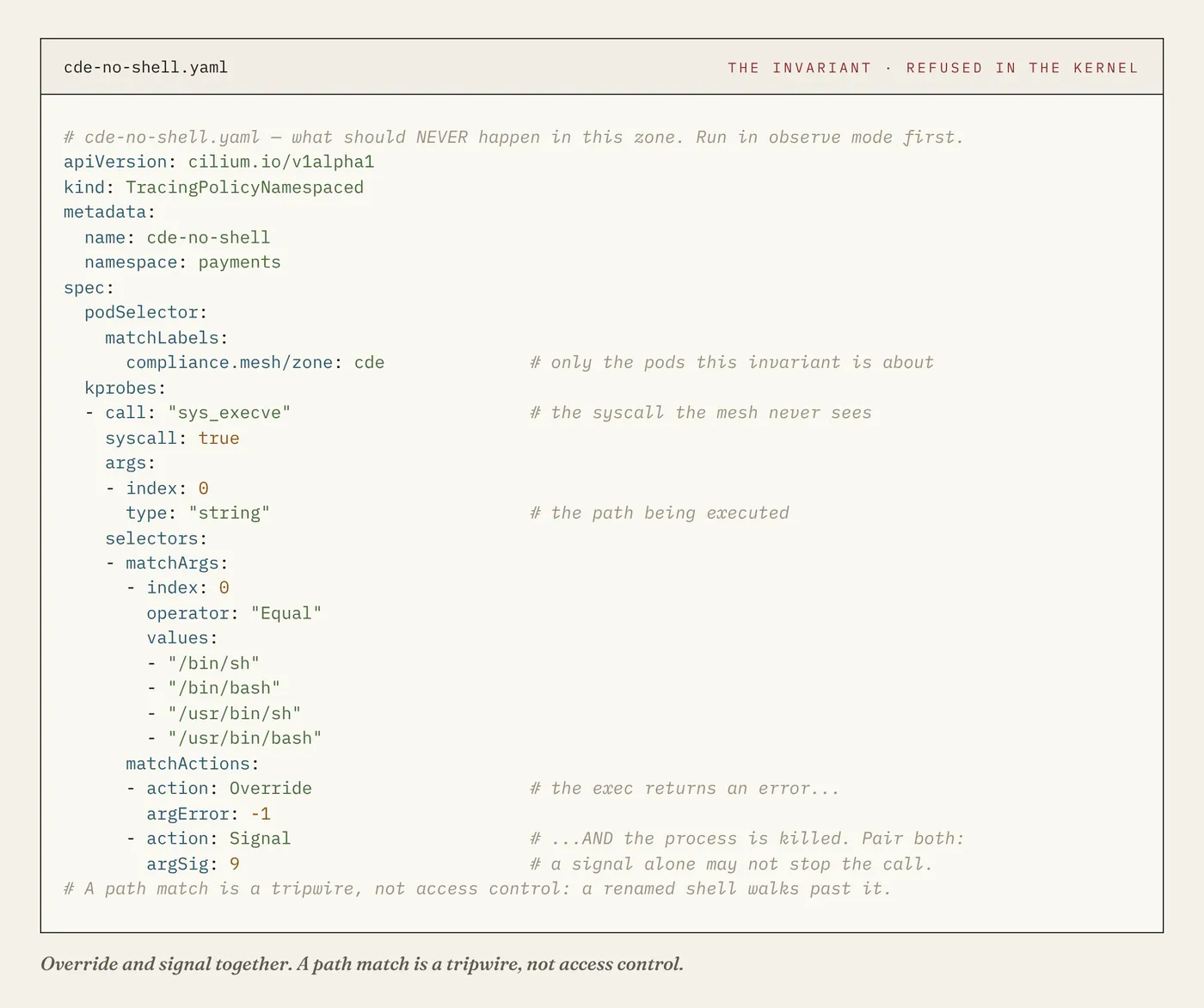
Enforce in the kernel, narrowly. For those few invariants, have the kernel refuse the call and kill the process, synchronously, before the action completes. Two cautions from the documentation that belong in your design, not your post-mortem: a kill signal on its own does not always stop the operation already under way, so pair it with an override of the call's return value; and a path match on a binary name is a tripwire, not access control — a copied or renamed shell walks past it. Treat a tracing policy as detection with teeth, never as the thing that authorises.
Make the event evidence. Each event carries the pod, the workload, the binary and the kernel's timestamp. Stamp the time your pipeline received it, and you have the two fields the RTS asks for. Sign and store it with everything else (Article 27). And alert when the event stream itself goes quiet — a silent detector is the Unproven state from Article 43 again.
What eBPF does not see: layer-7 identity. It knows which process opened a socket, not which user's token was on the request. The two planes answer different questions, which is why you need both.
Show the config: the invariant and the record
The invariant: no shell in the cardholder-data zone, refused in the kernel.
The record: one Tetragon event, mapped to the two timestamps the RTS asks for.
Security · Audit · Integration
Security: the mesh bounds who a workload can reach; the kernel layer bounds what it does once something has reached into it — two planes of defence, and the second is the only one that sees the shell an injected agent starts.
Audit: each runtime event is the detection record RTS 2024/1774 Art. 23 describes, carrying occurrence time and detection time; the gap between them is a measured detection latency rather than a claimed one.
Integration: Tetragon attaches to the kernel, not to the mesh, so it composes with Istio ambient and whichever CNI you run; its events join the same signed store as the access log and the operator's verdicts.
Alternatives, and when you'd pick them
Falco instead of Tetragon. CNCF graduated, the largest rule library, strong on detection and alerting; enforcement is someone else's job. Tetragon enforces inline in the kernel and carries Kubernetes identity natively. Pick Falco for breadth of rules and a team that wants alerts; Tetragon where a few invariants must be stopped, not reported. Plenty of estates run both.
Cilium's mesh instead of Istio ambient. A real option, improving quickly. Today the mature path for Entra token handling at L7 is Istio's. Revisit when Cilium's mesh mode is generally available and your L7 needs are covered; until then this is "both", not "either".
Just ship everything to the SIEM. The default, and the one Article 10 reads as written against. It cannot stop anything, it stretches the gap between occurrence and detection, and it fails silently when log shipping breaks.
A commercial runtime platform. Reasonable if nobody will own the policies. Check where the events are stored and whether you can sign and retain them yourself (Article 45): the index you can buy, the vault you own.
From simple to standard, and what's next
The simple version is log collection and a hope that a rule fires. The standard version adds a second plane: a kernel-level observer on every node, a week in observe mode, a short list of per-zone invariants enforced in the kernel with override and signal together, and every event stored as a detection record with two timestamps — with an alarm for the day the detector itself goes quiet. The mesh stays exactly where it was. It authorises the call. It never sees the syscall.
That covers who may come in and what they do once inside. It says nothing about the machine all of this ran on — whose it was, and who else could read its memory. Next, Article 52: prove where it ran — sovereignty, confidential computing and attestation.
Envoy sees the request. Only the kernel sees the shell.
Next in the series: Art. 52, sovereignty, confidential computing and attestation. Earlier: Art. 50 (the fenced agent), Art. 43 (the Unproven state), Art. 32 (ambient), Art. 27 (signed evidence), Art. 24 (the access log), Art. 23 (threat-modelling), Art. 20 (network policy and mesh policy), Art. 16 (deny-all and watch what screams).
Key skills & topics in this article
Ambient meshIstioAuthorizationPolicyService meshCompliance evidence